Life in 2026 is tough. Even in happy times, storm clouds lurk overhead, shadowing us as we flee, slamming the door hard behind us. Movies entertain us and also construct metaphors for our vague, universal twitchiness and dread. The 10 best French films of the year so far tell stories of people working to make it to the other side. Lovers, seekers, characters whose lives would be soaring, if it weren’t for that one pesky desire, war, hurricane, ex-girlfriend, or dead patient. The protagonists are motivated to find answers, love, a way out of Afghanistan. And the actors tasked with climbing into their skin are tortured souls with big plans, uncontrollable yearning, and fire in their eyes.
As we leap into the year’s second half, let’s take a look back at the best French movies of 2026… so far.
The Top French Films of 2026
1. Alpha
Director Julia Ducournau follows her controversial Palme d’Or winning Titane with this hallucinatory coming-of-age body horror film about troubled 13-year-old, Alpha (Mélissa Boros). When the rebellious teenager comes home with an ugly stick-and-poke tattoo, her French Moroccan physician mother (Golshifteh Farahani) fears she will contract the mysterious disease slowly turning victims into marble statues. As Alpha navigates bullying and puberty, her mother treats patients fighting this strange plague and remembers scenes of her emaciated heroin addict brother Amin (Tahar Rahin) wasting away years earlier. Set in the 90s, Alpha joins a recent sci-fi trend of AIDS allegories, revisiting the trauma of that health crisis, when fear of contracting the disease led to homophobia, public shame, and the heartbreak of whole swaths of society wiped out in the face of political indifference. In Alpha, the layering of different time periods, muddled metaphors, and scenes with Amin—is he dead or alive, a ghost or a memory?—make for a tricky, at times confounding viewing experience. It’s a rocky ride. Watch anyway, for its bold, breathtaking imagery, and a thrilling performance by young Boros.
2. Arco
The tagline for this gorgeous, environmentally-conscious animated film, conceived by comic book writer-turned-director Ugo Bienvenu, is “What if rainbows were people from the future traveling in time?” It is fitting that the touching, whimsical story begins with a 10-year-old boy from a utopian future in the clouds snagging his sister’s rainbow robe to time travel to the age of dinosaurs. Unfortunately, he misses his target and crash-lands instead into 2075, and a version of Earth devastated by extreme weather events. Discovering Arco (Oscar Tresanini) in the forest, Iris (Margot Ringard Oldra), a girl his age, takes him in and vows to get him home, with the help of Mikki, the nanny bot who cares for Iris and her baby brother while their parents work away from home. While Iris and Arco’s adventure takes place in a world where people activate fireproof domes to fend off near-constant wildfires and storms, their story is an optimistic one, about a friendship that might be able to accomplish life-changing miracles. A dubbed English-language version features the voices of Natalie Portman (also a producer), America Ferrera, and a trio of curious numskulls played by Will Ferrell, Andy Samberg, and Flea.
3. The Little Sister
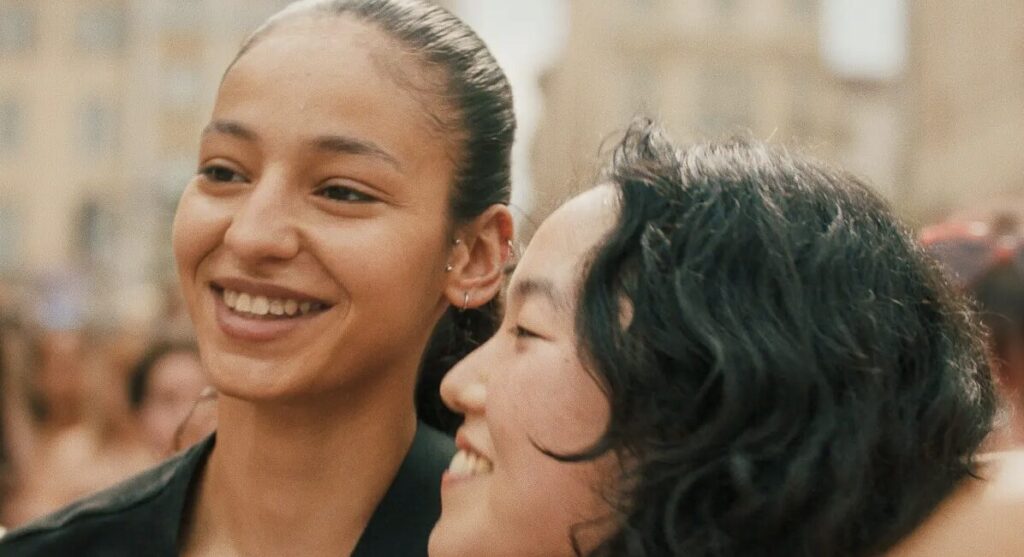
At the core of Hafsia Herzi’s poignant coming-of-age story (titled La Petite Dernière in French) is a young woman struggling with her conflicting sexuality and faith. When we meet Fatima (Nadia Melliti), the youngest of three sisters in a loving Algerian family in Paris, she is a smart 17-year-old who comes off as gruff and defensive, despite her loving family, faith in god, good grades, boyfriend, and a rowdy group of male friends. Then a gay student being bullied by her cohort calls her a lesbian, causing her to erupt in a violent rage. She breaks up with her marriage-minded boyfriend and cautiously starts meeting women through a dating app, at first only to ask questions about sex between women. But soon she meets Ji-Na (Park Ji-Min), a young nurse, and falls head over heels, though the relationship is doomed to be a short one. Later, in college, Fatima joins a lesbian community that provides support and allows her to embrace her desires. But fear simmers beneath the surface, where Fatima suspects that her church and family will reject her when they learn the truth. The quiet film, driven by an extraordinary central performance that won Melliti awards at Cannes and the César and Lumière Awards, defies expectations, leading not to judgement or emotional fireworks, but gentle acceptance and hope.
4. A Private Life
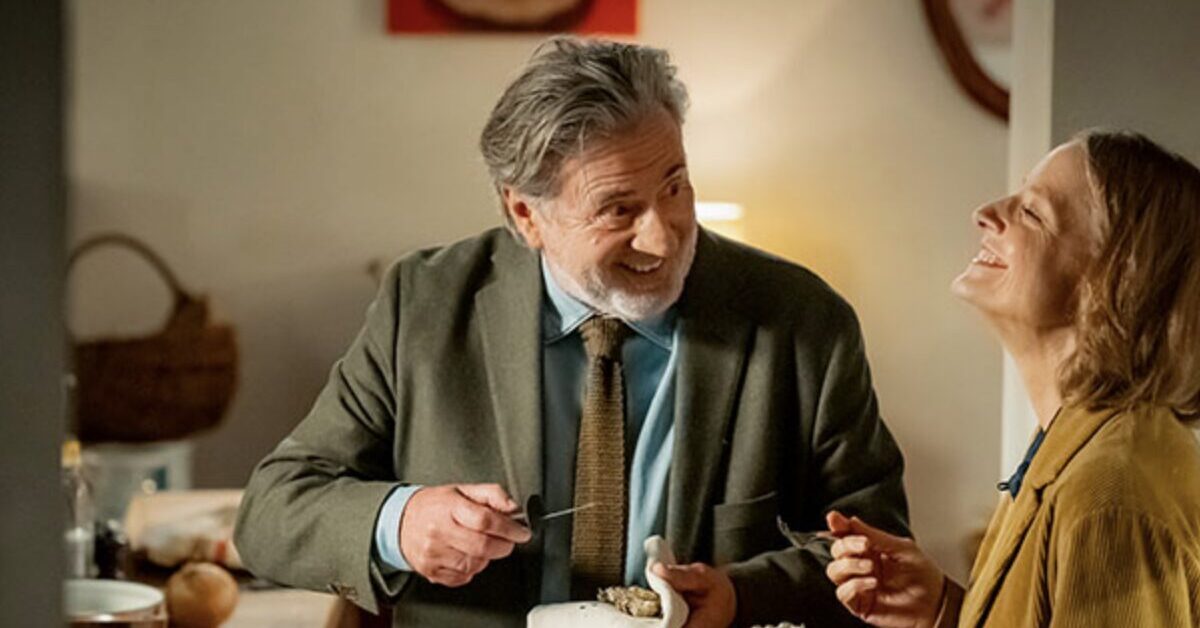
In the latest film by Rebecca Zlotowski (Other People’s Children), Jodie Foster has the opportunity to show off her near-perfect French in a rollicking murder mystery about an American psychiatrist in Paris who becomes convinced that Paula (Virginie Efira), a patient who allegedly killed herself, was in fact murdered. Unable to believe she might have failed her patient—or, even worse, driven her to suicide— Dr. Lilian Steiner (Foster) spirals, turning amateur sleuth in an attempt to prove that Paula’s husband (Mathieu Amalric) and daughter conspired to kill her. When she solicits help from her ex-husband, played lightheartedly by Daniel Auteil, with whom Foster has crackling chemistry, the film becomes increasingly zany. The tone and humor of Vie Privée recall the Murder Mystery series starring Jennifer Aniston and Adam Sandler, with a pair of ordinary lovebirds whose relationship has gone stale breaking into suspects’ houses and rifling through their trash. Foster and Auteil are so playful and sweet together, it makes for a goofy good time.
Rent on Prime or Google Play.
5. Sirāt
Despite its many strengths, it is hard to recommend a film as brutal and traumatizing as Sirāt. The French co-production has been called “astonishing,” “a spiritual odyssey,” and “the year’s most terrifying movie” for good reason. Only you know if you can handle its sinister vision! The winner of the Cannes Jury Prize, directed by French-born Spanish director Oliver Laxe, floored festival audiences, before crushing viewers’ hearts and minds in theaters worldwide. Sirāt is a shocking survival story set in the Moroccan desert, where a father (Sergi López) drags his young son Esteban (Brúno Nuñez) and their dog to an illegal rave in search of his missing daughter. The arrival of a convoy of military vehicles rounding up EU citizens, and the movie’s general Mad Max vibes, hint that something bigger is going on, a global economic collapse or, perhaps, the apocalypse. The father and son collide with a group of revelers, played by non-actors, who reluctantly let them tag along. Balancing doom and peril with bodies moving ecstatically to music, a message emerges about a community of strangers holding each other up on the eve of destruction. Their kindness and help, however, are futile in the face of a merciless universe that couldn’t care less if they live or die.
6. The Stranger
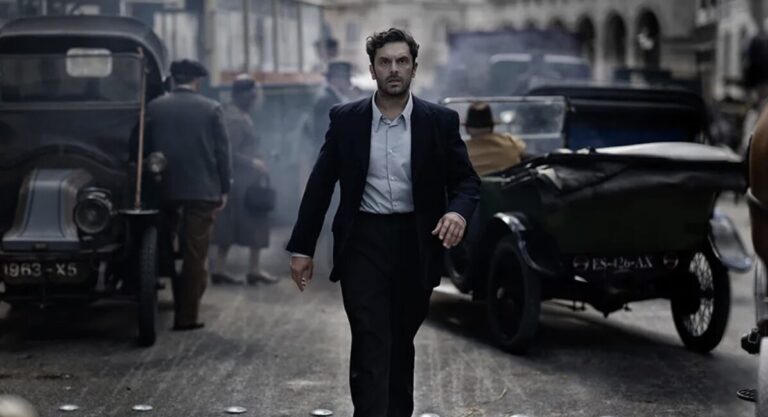
In beloved director François Ozon’s faithful black-and-white adaptation of Albert Camus’ classic existentialist novel, L’Étranger, rising star Benjamin Voisin (The Quiet Son, Lost Illusions) plays nihilist antihero Meursault, who inexplicably kills a man on the beach days after his mother’s death. Meursault famously doesn’t cry at the funeral, displaying a chilling indifference and lack of compassion that play a larger role in his sentencing than the crime itself. The film, which won Lumière Awards for Best Film, Actor, and Cinematography, took a notable departure from the novel that has been debated since its Venice Film Festival premiere. Camus’ masterpiece was published in 1942, two decades before Algeria was liberated from French rule. In a postcolonial context, Ozon modifies Meursault’s young Algerian victim (Abderrahmane Dehkani) and Algerians in general, showcasing the poor treatment of the local Arab population by French Algerians. More boldly, Ozon gives Meursault’s formerly anonymous victim a name and creates a sister for him, whose appearance in the courtroom reminds us that this man is more than the nameless Arab from the novel; he is a human being.
Rent on Prime.
7. 13 Days, 13 Nights
Based on the memoir 13 jours, 13 nuits dans l’enfer de Kaboul, by Commander Mohamed Bida of the French National Police, this film from The Three Musketeers director Martin Bourboulon tells the action-packed true story of the United States’ withdrawal from Afghanistan and the Taliban takeover, which began on August 15, 2021. With American troops pulling out, Taliban insurgents seizing power in Kabul, and thousands of residents scrambling to find safety, the French embassy is preparing to evacuate. Commander Bida (Roschdy Zem, in superhero mode) witnesses the desperation of hundreds of people terrified for their lives outside the embassy gates and invites them in, hatching a nearly impossible plan to transport them all to the airport. The tense big-budget thriller tells the story of this 13-day effort on the part of 10 police officers who risked their own lives to get these abandoned citizens to freedom.
Rent on Prime Video.
8. Two Pianos
Back in the 90s, director Arnaud Desplechin burst onto the French film scene with so much energy, talent, and intelligence that cinephiles everywhere raved. He curated a sort of Brat Pack français, which included young actors like Matthieu Amalric, Emmanuelle Devos, Emanuel Salinger, Jeanne Balibar, and Chiara Mastroianni, to act in his brilliant, rambling, eccentric soap operas like My Sex Life… or How I Got Into an Argument and A Christmas Tale. His collaborators went on to impressive careers and Desplechin kept making movies. Most premiered at Cannes. His latest, Deux Pianos, employs the messy heightened emotions that characterize his work in the less sprawling story of Mathias (François Civil), a concert pianist who returns to Lyon from Tokyo, where he’s been hiding out and teaching, to perform a series of concerts with his mentor, Elena (Charlotte Rampling). Early on, Mathias attends a party. Exiting the elevator on his way out, he finds himself face to face with a woman, Claude (Nadia Tereszkiewicz)—and promptly faints, whacking his head on the elevator door as Claude flees. We learn that Claude’s husband is Mathias’ best friend. Then Mathias encounters a boy in the park who looks identical to his childhood self. We might think, hope, that we know where this is going. But Desplechin is incapable of making a conventional film, and this one mystifies and frustrates, even as it prods the brain and heart in ways that capture the insanity and passion of this idiosyncratic director’s vision.
Rent on Prime.
9. Young Mothers
The brilliant directing team of Jean-Pierre and Luc Dardenne made documentaries in the 1970s, before turning to raw, socially driven narrative film in 1996 with the scalding La Promesse, followed by 1999 Palme d’Or-winner, Rosetta. (They won Cannes’ top prize again in 2005 for L’Enfant, and the Grand Prix for The Kid with the Bike in 2011.) The Belgian brothers’ unvarnished, compassionate, often devastating portraits of working-class Belgians rip open the socioeconomic fabric of society, revealing unsettling truths. The Cannes Best Screenplay-winning Jeunes Mères follows four teenage mothers and mothers-to-be in a group shelter in Liège. Pregnant Jessica (Babette Verbeek) obsesses over the mother who gave her up at birth. Perla (Lucie Laruelle) tries desperately to build a life with her baby’s dismissive father. Recovering addict Julie (Elsa Houben) is committed to raising her child with her loving boyfriend, but paralyzed by her fear of relapsing. Dreaming of a better life for her daughter, Ariane (Janaïna Halloy Fokan) considers giving her up for adoption. In the background of these gnarled lives lie questions about cycles of poverty and abuse, asking whether a person who was parented badly can find a path to safely, lovingly raise a child. The jury is still out for these young women, but the stunning film cautiously offers reason to hope.
10. The Wizard of the Kremlin
In French director Olivier Assayas’ English-language chronicle of the rise of Vladmir Putin, Jude Law plays the Russian dictator with a bad comb-over and perpetual pout. Paul Dano slithers up to him as Vadim Baranov, a soft-spoken fictionalized version of Vladislav Surkov, a former theater director turned political strategist who is referred to as the “New Rasputin.” The story is framed as a 2018 conversation between the now-retired Baranov and an American journalist (Jeffrey Wright). In this way we witness Baranov’s early years as an artist and advertising executive, when he was in a relationship with a young actress (Alicia Vikander) who attaches herself to powerful men. But the main focus here is the rise of totalitarianism in Russia and Baranov’s role in shaping it. The film has been getting some negative reviews. It can feel more like a history lesson than a drama at times, covering such events as the Chechen War and the invasion of Crimea, but Assayas is capable of great insight and poetry. He uses his vast talents to make sense of the rise—and the appeal—of the man still clinging to unequaled power in Russia today. The film functions as a deep dive into authoritarianism and how a country’s institutions can tremble and fall under the right leader. This is an important story for our time. It behooves us all to watch carefully and take notes.
Andrea Meyer has written creative treatments for commercial directors, a sex & the movies column for IFC, and a horror screenplay for MGM. Her first novel, Room for Love (St. Martin’s Press) is a romantic comedy based on an article she wrote for the New York Post, for which she pretended to look for a roommate as a ploy to meet men. A long-time film and entertainment journalist and former indieWIRE editor, Andrea has interviewed more actors and directors than she can remember. Her articles and essays have appeared in such publications as Elle, Glamour, Variety, Time Out NY, and the Boston Globe.