

L’Etranger (The Stranger), the 1942 novella by Nobel Prize-winning French Algerian author Albert Camus, is one of the most widely read French books of all times. Selling more than 6 million copies and translated into over 60 languages, the book is widely considered a masterpiece. The universally revered work is also confounding, inspiring philosophical discussions, debate, and more than a little head scratching. Protagonist Meursault, a renowned antihero, is a man detached from society who floats through life, taking it in, but refusing to engage, question, or form opinions. He is also notoriously incapable of lying or feigning emotion.
Camus famously summed up the story like this: A man who does not cry at him mother’s funeral will be condemned. Thus, the novel begins: “Mother died today. Or maybe yesterday, I don’t know,” introducing Meursault’s flat, noncommittal tone. Even on the subject of his mother’s death, he takes no stance. From there the story of an incomprehensible murder, a trial, and a quiet man’s decision to throw his fate to the winds of providence and public opinion erupts like a literary volcano.
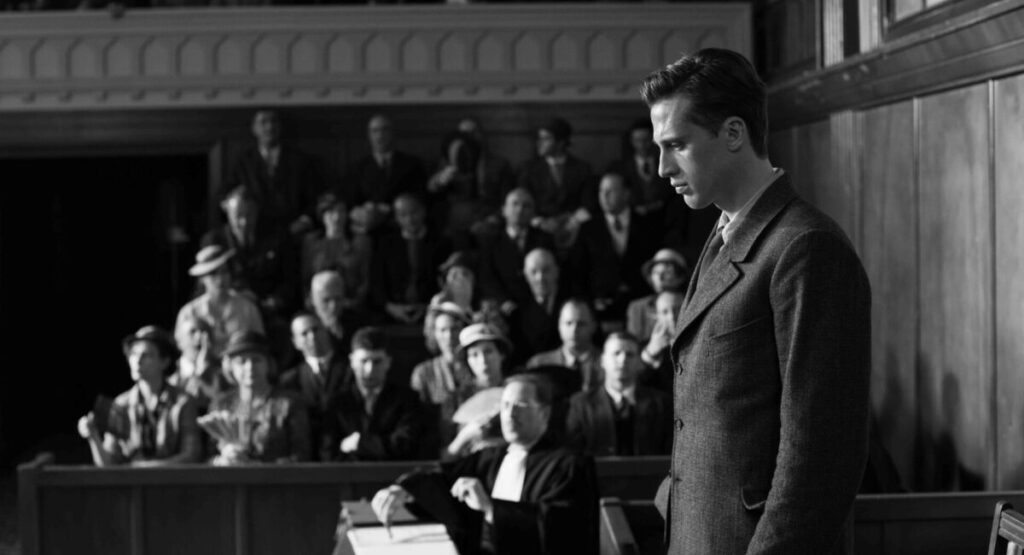
Italian director Luchino Visconti adapted The Stranger for screen in 1967 to middling reviews, with Marcello Mastroianni and Anna Karina starring. Now the prolific French director François Ozon (Swimming Pool, Eight Women, When Fall is Coming), whose work often drips with camp, sex, and interpersonal tension, has created a striking new version, which won three Lumière awards and one César. Ozon faithfully adapts Camus’ work, shooting in Tangiers, Morocco, which stands in for 1930s Algiers, and taking small liberties to build a contemporary context for a story that, in its stark, existential focus, has always had a modern sensibility. Benjamin Voisin, who starred in Ozon’s 2020 drama Summer of 85, plays Meursault with an exquisite, almost ethereal remove from the crisp black-and-white world around him. His Meursault is a cipher, cold and impenetrable, but Ozon allows him a few lovely moments in which his humanity is briefly, tantalizingly returned to him. Meursault’s prison sentence in the film’s final chapter is also stretched out, granting the character a period of introspection that reaches toward something like enlightenment. Rebecca Marder, who appeared in Ozon’s The Crime is Mine, plays Marie, a character who becomes more complex in the hands of a director whose female characters are often his most fascinating.
Andrea Meyer spoke with Ozon and his leading lady about making old stories relevant to new audiences, finding a character’s soul, and how scary it can be to adapt a masterpiece.
Q&A with François Ozon and Rebecca Marder

What drew you to this project? Did you have a special connection to the book, or was there a particular reason you wanted to make this film now?
François Ozon: Of course I had read the book when I was in high school, like all French students. But if you asked me three years ago, I would have said “never,” because it’s a masterpiece and so well-known in France with so many readers worldwide. I was working on a project about a young man played by Benjamin Voisin who commits suicide, faced with the absurdity of the world. I was unable to find the money to make it. Some people who read the script said, “It reminds me of The Stranger.” I read the book again and realized it was still powerful and modern and mysterious and asked Benjamin if he felt capable of playing this iconic character of French literature. He agreed, and I decided to adapt it. I was quite intimidated, but I did a lot of research that helped me make a contemporary adaptation of the book.
What makes this story relevant in our current moment in history? What about it resonates today, particularly given that it takes place during the French occupation of Algeria?
Ozon: For me it was obvious that the film would resonate today. If the novel is considered a masterpiece and continues to be studied today, it’s because it resonates with life today by tapping into the absurdity of the world. It’s a philosophical novel that enables us to ask many questions. And the way Meursault interrogates his existence and distances himself from the world feels very contemporary.
Rebecca Marder: I had worked with François two years before, on The Crime is Mine. I auditioned to play Marie and was so glad he called me back and…
Ozon: [We auditioned Rebecca] to see her chemistry with Benjamin. I knew you were a good actress. I didn’t know about the chemistry.
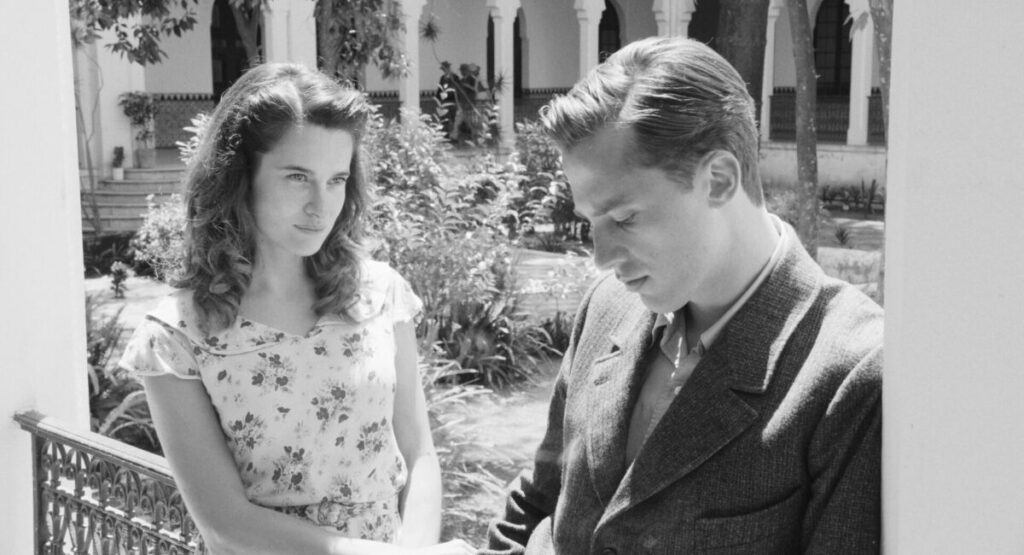
Marder: I was so happy to be back. François is really loyal. He knows how to keep his troupe together. I was really happy about that, and also about acting with Benjamin. I thought it was a great privilege to dive into Camus again. Like François, I had read the book in high school and I had a really vivid memory of it, but I only remembered the sensations. I had a physical experience of it when I was a teenager, but I don’t think I understood all of the story at the time. It was interesting to be the character that highlights Meursault’s incapacity to live. It was the first time that someone offered me a role of such a feminine, sexy, bubbly woman and also a visionary. She gives herself to him without being married and she has a job. She’s ahead of her time.
What is your take on Meursault? Who is this man for you?
Ozon: I think Meursault is an abstraction. It’s hard to use psychology to define him. He is an enigma and I made the film as a way to understand the character, who is a spectator and only becomes a real player in the world at the end, when he suddenly blows up at the priest and expresses what he really feels. Beforehand, he is simply observing. He distances himself and I realized the character had something in common with me as a director, observing the actors and crew, but maintaining a distance.
Your adaptation is fairly faithful to the original, but you modified the story in key ways, for example giving the murdered man a name, and developing the female characters. Can you describe the ways you broke from the novel and why you made the changes you did?
Ozon: For me it was important to make a film from 2026, not 1942, so I needed to integrate the perspective of today and the events that have happened over the last 85 years since the book was released. The Algerian War of Independence happened in the meantime, so I needed to integrate that. It was important to contextualize the story and bring in French colonization. Algeria at the time was considered part of France. Algiers was a French department and to understand today the story that Camus was telling, the viewer needs to have that context.
Regarding the female characters, I realized early on that all the male characters in the novel were extremely toxic. There’s one who beats his dog, another who beats his mistress, another kills an Arab, so it was hard to identify with the male characters. It seemed to me that the female characters, who weren’t very developed in the book, merited more space. The character of Marie was important because she has a conscience and offers a different perspective on the events, and so was the character of the murdered Arab’s sister, who gives a voice to him in a way that does not happen in the novel.
While the action is seen primarily through the eyes of Meursault, Marie’s perspective becomes an important anchor for the viewer. Rebecca, can you talk about what drew you to the character and what it was like to play a woman in a movie about violent men?
Marder: It was the first time I was asked to give a character a soul. In the book, Marie is described as the ray of the sun, the flame of desire. It was disconcerting, the way she’s described in the novel as flesh, as a body. We had to invent a personality for her. I think Marie believes that Meursault is in love with her. The moments when he’s with her, making love or swimming, are the only moments when he lives in the present. She’s not crazy or living an unrequited love story. This was the first time I acted in such carnal scenes, and it was also interesting to talk to Moroccan women during the shoot. I was thinking about my character, who was a colonist but didn’t have many rights. Some of these Moroccan women, notably women in the crew, would tell me about their lives, and told me that marriage was a way of finding independence, of emancipating themselves. I thought about Marie, who is so obsessed with marrying Meursault, and thought that maybe marrying him was a way of liberating herself, because in a sense, at least before the murder, he’s the least bad of the men described. He’s the most handsome, he takes her to the movies, there’s this possibility that maybe they’ll go to Paris.
Some critics have suggested that there’s a queer element to the scene on the beach, that Meursault might be attracted to Moussa, the man he kills. Was this intentional?
Ozon: If this was not a film by François Ozon, I am curious if people would ask this question. I think everything is erotic for Meursault. Everything is sensual. Marie is sensual and this boy on the sand is sensual as well. It’s very hot, the sun. He’s a handsome man. I don’t know if there’s a kind of attraction, but I wanted to make it erotic. He doesn’t know what to do with his sensuality. It doesn’t mean he wants to kill what he desires. That was not my vision. But I wanted to make it erotic. Hitchcock said you have to film a murder scene like a sex scene and a sex scene like a murder, so maybe I’m close to Hitchcock in this scene.
Camus described Meursault as a man who is condemned because he doesn’t play the game. He suggests that in a world where a French man can presumably get away with killing an Algerian man if he comes up with the right excuse, he would be found innocent if only he lied and expressed remorse.
Ozon: I think what is very modern about the character is that he doesn’t follow the rules of society. He’s a rebel, and I think that’s why the book appeals to young people. When we are teenagers, we become aware of life’s hypocrisies and grow disillusioned with our parents, and Meursault doesn’t play the game. He says exactly what he thinks… I think we identify with him.
The Stranger opens on Friday, April 3, in New York and Friday, April 10, in Los Angeles and Chicago.
Andrea Meyer has written creative treatments for commercial directors, a sex & the moviescolumn for IFC, and a horror screenplay for MGM. Her first novel, Room for Love (St. Martin’s Press) is a romantic comedy based on an article she wrote for the New York Post, for which she pretended to look for a roommate as a ploy to meet men. A long-time film and entertainment journalist and former indieWIRE editor, Andrea has interviewed more actors and directors than she can remember. Her articles and essays have appeared in such publications as Elle, Glamour, Variety, Time Out NY, and the Boston Globe.