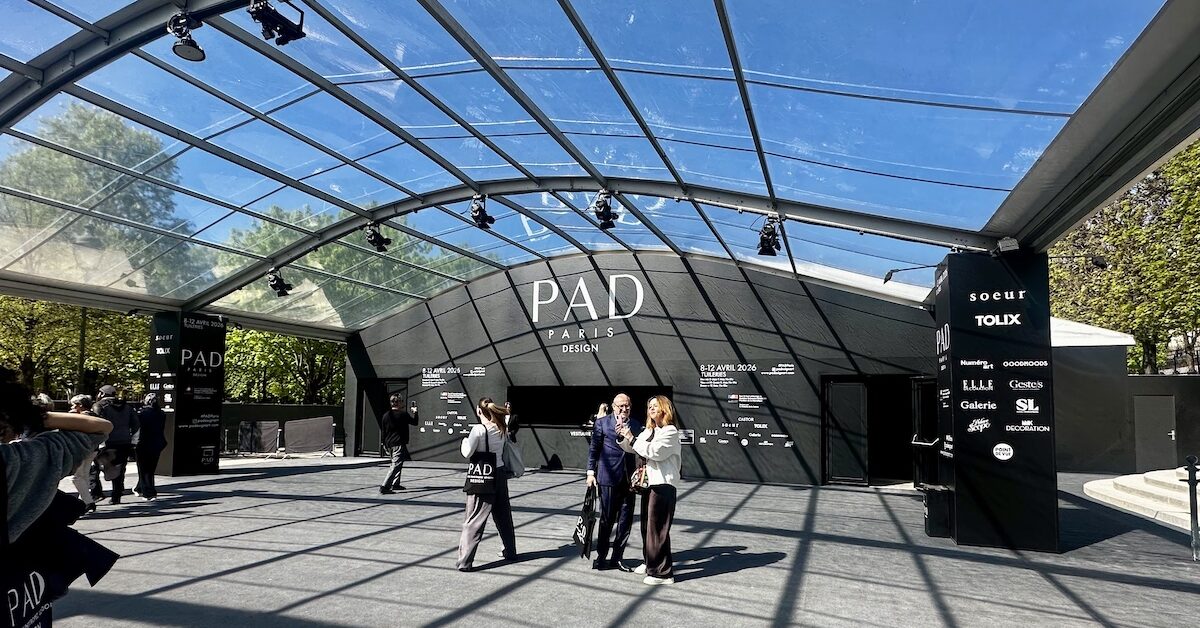
Every April, a row of temporary pavilions appears in the Jardin des Tuileries, drawing collectors, designers, and gallery owners to one of the more discreet yet influential events on the Paris calendar.
PAD Paris, or the Pavillon des Arts et du Design, has just completed its 28th edition, which ran this year from April 8th to 12th, once again drawing the international design world to Paris for a week centered on collectible design.
What Is PAD Paris and Why Does It Matter?
Each year, PAD awards three prizes selected by a jury of architects, curators, and designers: Best Stand, Best Contemporary Design, and Best Historical Design. Founded in 1998 by a fourth-generation Parisian antique dealer, Patrick Perrin, the fair positioned itself early on as something more than a commercial event. At a time when design was still largely categorized as decorative or functional, PAD treated it as a field worth collecting, studying, and exhibiting with the same rigor as fine art.

PAD has now become one of the clearest expressions of the French art de vivre, not as an abstract concept but rather as something material, collectible, and even exportable. In this context, design is more than aesthetic; it is a marker of lifestyle, craftsmanship, and perhaps even intellectual heritage. A Boketto armchair or a contemporary collectible piece shown at PAD is not just an object, but a fragment of a broader cultural narrative that continues to resonate globally, as collectible design gains traction among French and international collectors and galleries.
How PAD Turned Design Into Collectible Art
When it was founded, at a time when furniture and objects were still largely seen through a functional or decorative lens, PAD made a more radical proposition: that a chair, a lamp, or a screen could carry the same artistic weight, historical value, and desirability as a painting. Nearly three decades later, that idea feels less like a provocation and more like a given. But it is here, in Paris, that it first took hold.
Rather than overwhelming visitors with scale, PAD favors precision. Booths feel closer to exhibitions than sales floors, with scenography that encourages visitors to take their time examining the works on display. Collectors, curators, and designers move through the fair with a shared understanding that what is on display is not simply design, but collectible design: limited edition or one of a kind pieces, often signed by their designers, where a chair might be produced in a series of eight, or a cabinet treated as a sculptural work rather than a purely functional object. The pieces are chosen as much for their authorship and rarity as for their form.
PAD Paris 2026

The 2026 edition brought together around 70 galleries, with a strong French presence alongside international names. Established galleries such as Galerie Kreo, Carpenters Workshop Gallery, and Galerie Gastou sat alongside newer entrants like Gallery Gaïa & Romeo, a young Paris space founded in 2025.
What distinguishes PAD is less the volume of exhibitors than their presentation. Booths are staged with a curatorial approach, often built around a narrative, a period, or even a hypothetical scenario to display not just furniture but tapestries, ceramics, and even jewelry. At this year’s fair, for instance, gallerist Amélie du Chalard reimagined Claude Monet’s studio as if the artist were alive today, mixing contemporary furniture and objects with references to Monet’s studio environment, using color, texture, and placement to explore how taste evolves across time.
The setting plays a role in how all of this is perceived. The Jardin des Tuileries places the fair within a distinctly Parisian cultural geography, between the Louvre and Place de la Concorde, and at the intersection of the city’s Left and Right Bank gallery scenes. This situates PAD within an unbroken continuum of art, design, and state-sponsored culture. Visitors arrive into a landscape already associated with design and display, which in turn encourages a slower, more contemplative mode of looking. It is part of what the organizers describe as the fair’s “motor” and remains a defining element of PAD’s identity.

Among the 2026 winners was Joseph Savina’s 1961 cupboard in carved and polychromed cherry wood. Its façade is animated by sculptural detailing, with seahorse-shaped brass keyholes that introduce a distinctly maritime, almost folkloric dimension to an otherwise functional form.
Aurélien Veyrat’s AGF02_coffre was awarded in the contemporary design category. Assembled from oak, pine, bricks, plaster, and leather, the chest pushes storage furniture into a more experimental, material-driven territory, where construction methods and raw textures remain deliberately visible rather than concealed.
The prize for Best Stand went to Galerie Romain Morandi, recognized for a presentation that felt less like a fair booth and more like a carefully staged interior. Furniture and objects were arranged in distinct but connected vignettes, with seating, lighting, and tables positioned as they might be in a real, lived-in space. Visitors, therefore, encounter the ensemble as a narrative rather than a series of individual objects for sale.

Maison Intègre received the Special Prize for an installation conceived as an immersive environment centered around a bronze table whose surface captures the imprint of scattered seeds. The use of bronze is central to the artisanal traditions of Burkina Faso and anchors the piece in a lineage of skilled metalwork. The imprint of scattered seeds introduces a subtle reference to agrarian cycles that underpin many artisanal traditions in Burkina Faso. These motifs continued through surrounding tapestry and lighting elements, creating a dialogue between the different Burkinabé cultures and craftsmanship.
Across these selections, a common thread emerges: an emphasis on material depth, craft-led making, and strong narrative or scenographic framing. Whether through hand-carved wood, patinated metal, or experimental composites, the focus is on how an object is made and the story it carries as much as its function.
Why Does PAD Matter Specifically in Paris?

PAD Paris operates differently. Its scale is smaller, its selection tighter, and its emphasis is placed on connoisseurship, on how objects are contextualized as much as how they are sold. That matters when thinking about PAD in relation to other design events. Milan’s design week, for example, is closely tied to industry and production, driven by major brands and new launches. London’s fairs tend to be more explicitly market-oriented. For example, at Frieze London or Collect at Somerset House, the rhythm tends to be faster, with a stronger emphasis on immediacy, market turnover, and gallery programming rather than the slower, more curated framing of individual objects that defines PAD’s approach.
It’s here that chairs, tables, and lighting are framed as cultural artifacts, markers of a certain way of living, tied to craftsmanship, authorship, and history. That framing has proven exportable. PAD now has editions in London and is preparing a summer edition in Saint Tropez, extending its model beyond Paris while keeping the original fair as its reference point.
Even with that expansion, Paris remains at the center. Not just because the fair started here, but because the ecosystem around it, including galleries, collectors, and institutions, supports the kind of cross-period dialogue PAD relies on. It is one of the few fairs where a 1950s ceramic, a contemporary limited edition chair, and a piece of designer jewelry can coexist without feeling out of place.
Nicole Maria is an American writer and journalist based in Paris. Her work explores fashion, culture, and everyday life in the city. When she’s not writing, she’s usually baking something new or wandering through neighborhood markets.