
Few expatriates who moved to France have made quite as lasting an impression on the art world as John Singer Sargent (American; 1856–1925). When Sargent moved to Paris in 1874 at 18 years old, he quickly began his tutelage with the well-respected French portraitist Carolus-Duran (French; 1837-1917). It only took him three years studying with the venerable artist—as well as an education garnered through living in the artistic epicenter of Europe—to make his debut at the famous Paris Salon. A decade after the young artist moved to Paris, however, his submission to the 1884 Salon was deemed so shocking, that Sargent fled to London. Although he was ultimately able to rebuild his reputation among the artistic elite in Paris, he never again lived in the city.

A hundred years after his death, The Metropolitan Museum of Art has opened an exhibition celebrating this career-defining period in the artist’s life. Simply titled “Sargent & Paris,” the show follows his development from young art student, to world-renowned portraitist. The first few galleries are focused on Sargent’s copies of those venerable artists who came before him (think, Frans Hals [Dutch; 1580-1666]), his en-plein-air and genre paintings done along the French seaside, and the artist’s versions of Grand Tour paintings from Venice, as well as his take on Orientalism from time spent in Morocco. It is within that third gallery, with pieces like Fumée d’ambre gris (Smoke of Ambergris [1880]), that we begin to really see the characteristics that have come to be synonymous with Sargent’s work. The way light reflects off of small pieces of metal, the deep folds found in swaths of heavy fabric, stark whites set off by vibrant reds: these are the details found in the garments worn by the painting’s subject that display the iconographic elements associated with Sargent’s paintings of this period.
Sargent’s Expat Paintings Made Parisian Heads Turn

As you continue on through the galleries, the walls begin to bear the life-sized renderings of aristocrats and artistic elites whom the portraitist spent countless hours meticulously painting (including 83 hours alone for the young Edouard and Marie-Louise Pailleron [Portraits de M. E. P. . . . et de Mlle L. P.]). Like the artist himself, the subjects of these paintings were by-and-large expatriates who had moved to Paris for one reason or another. In commissioning a portrait of themselves—and one done by such a celebrated and charismatic artist as Sargent—they worked to elevate their societal status. In turn, the favorable reception of these paintings of the who’s-who of the Parisian upper-class aided the artists’ rapidly growing fame.

Though many of his grand portraits from this period (1879-1882) were of the artist’s friends, the attention they received at the Paris Salon aided in his efforts to achieve critical acclaim. By 1882, Sargent’s submissions to the Salon were highly praised, both by regular visitors and by art critics, making him one of the French capital’s most well-known artists. For the Salon of 1883, the artist chose to exhibit The Daughters of Edward Darley Boit, which the Met has dedicated an entire gallery to. This monumental painting provides a portrait of youth and the tender emotions associated with growing up. Drawing inspiration from Diego Velázquez’s (1599–1660) Las Meninas, The Daughters of Edward Darley Boit is exemplary of the artist’s skillful and striking rendering of light and shadow. The familial portrait remains one of Sargent’s most well revered works of art, and stands out in great contrast to his rather scandalous submission to the Salon the following year.
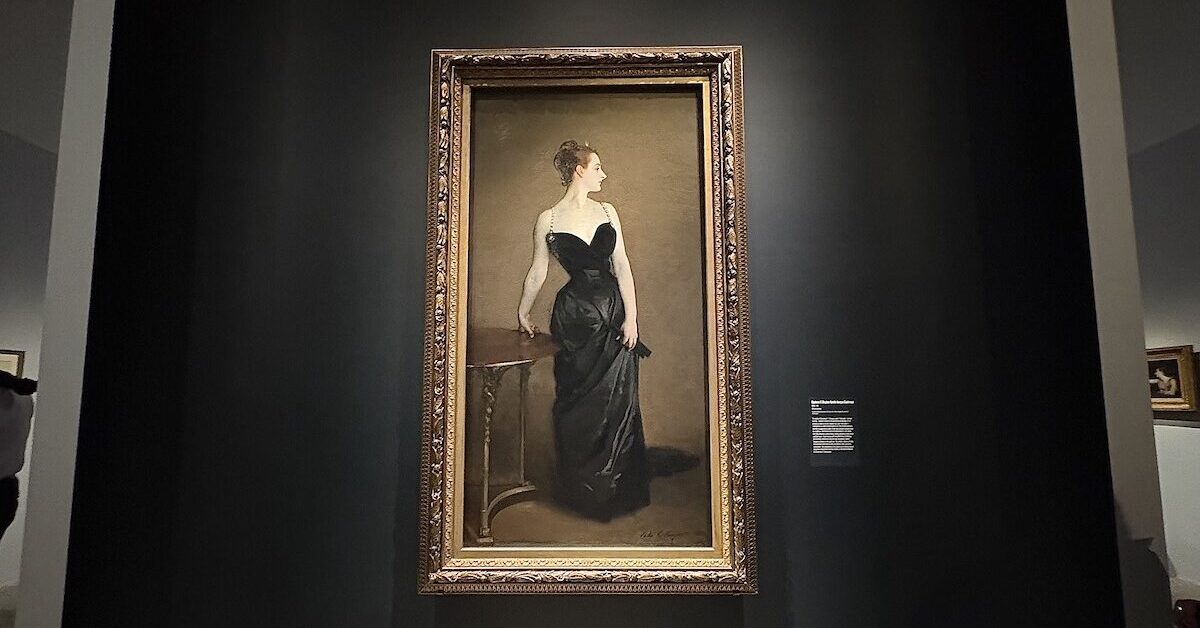
Madame X at the Met

“Sargent & Paris” culminates with Sargent’s most (in)famous piece: Madame X. His portrayal of fellow American expatriate Virginie Amélie Avegno Gautreau (American; 1859–1915) was, as the exhibition explains, “…conceived… as a bold image of a modern, self-styled celebrity, but viewers saw a controversial Parisienne (or worse, an American interloper) who challenged the manners of French society.” In it we see Gautreau wearing a low-cut black dress that reveals the expanse of her luminous white skin. Originally, her garment was held up by only one crystal-encrusted strap, with the other one left dangling off of her shoulder. It was her state of undress—now seen clearly as it was originally envisioned on the neighboring wall of the gallery in Study of Mme Gautreau (Unfinished Replica of “Madame X”)—that sparked the most uproar from viewers. One critic, Emile Hervet, wrote a response in La Patrie saying, “We regret to say that Mr. Sargent has produced the worst, most ridiculous, and most insulting portrait of the year.”

What is now considered Sargent’s best work (even he thought so), was met with such great vitriol that the artist soon fled Paris for London. Though he remained there the rest of his life, he continued to exhibit in Paris. The final gallery of “Sargent & Paris” displays the portraits that restored his reputation in the Parisian art scene following the monumental scandal of Madame X in 1884. His painting La Carmencita was even bought by the French State in 1892 for Paris’s contemporary art museum, the Musée du Luxembourg, solidifying Sargent’s place in the history of French art.
As you leave the final gallery, visitors are met with an interactive aspect of the exhibition. A table with cards and pencils is laid out where you too can write your own review of Sargent’s most (in)famous painting, or follow in the footsteps of the artist’s contemporary critics and draw a cartoon rendering of the piece.
“Sargent & Paris” is on view at the Metropolitan Museum of Art now through August 3, 2025.
Karina Grady is an art historian with over a decade of experience in archives and collections. She holds an MA from Hunter College, CUNY, and has worked with the Museum of Russian Art, the High Museum of Art, and The Willem de Kooning Foundation. Her work is grounded in a strong interest in modern art.