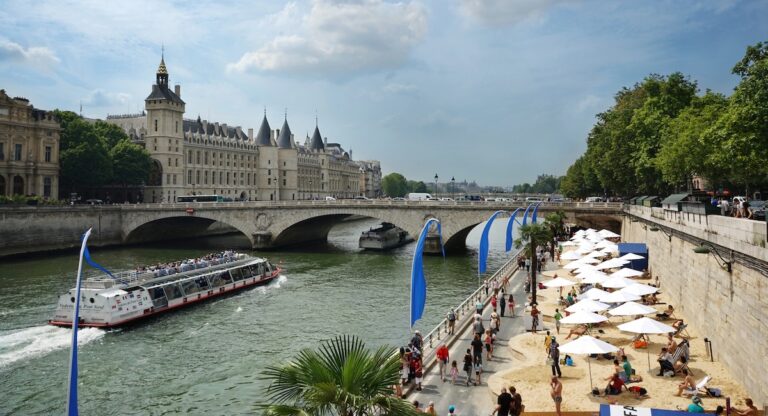
The Camargue is a region of France that most foreigners don’t visit. Which is a shame, because it’s home to some of the most incredible salt marshes in the world. And if you’re thinking, “It’s just salt—is it really that cool?” Then I’d ask you to take a look at some of the photos below.

Not too shabby, right?
I recently visited the Camargue as part of a press trip for La Baleine, the iconic French sea salt brand, which just celebrated its 90th anniversary this year. La Baleine is the top brand of culinary sea salt in France, and they operate as part of the Compagnie des Salins du Midi, which has been in operation since 1856. You’d probably recognize them by their tall blue salt canisters and whale logo, which has evolved over the years (my favorite is this one from the 1970s), but was originally designed by the same illustrator of the Laughing Cow (La Vache qui Rit) cheese logo.
The Salins Group
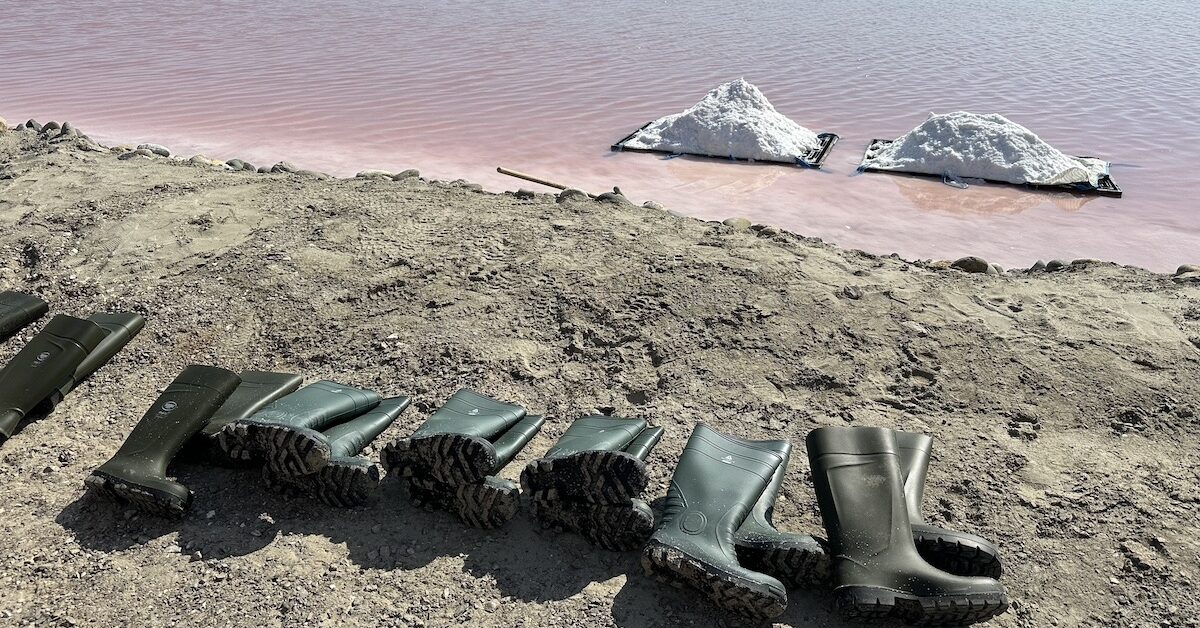
The Salins Group, which is the only European player dedicated exclusively to the production and marketing of salt, harvests 250,000 tons of salt each year from the Salins d’Aigues-Mortes. These beautiful pink salt marshes are located in the medieval French village of Aigues-Mortes, and the town’s picture-book fortress can be seen from across the flat expanses of the salt tables. These salins, which take up around 20,000 acres (the size of Paris!), are unlike anything you’ve ever seen. They look like something out of a fairytale, large cutouts of pink water lapping up against the network of salty, sandy paths that cut through the marshes. Some have a subtle rosy tint, like the reflection of a sunset, while others are as pink as the flamingos that populate the salt marshes. In some places, the salt gathers in fluffy piles like sea foam along the shore, while in others, it crystallizes on the surface of the water, like sheets of ice.
Closer to the factory where the salt from the salins is processed, enormous piles of salt rise from the earth, resembling snow-covered mountains. These camelles, as they are called, are a natural way of storing both industrial and culinary salt, which has been sorted by type, and will later be processed for use in cooking, pharmaceuticals, animal feed, de-icing, softening tap water, and more.
It’s a jarring optical illusion, this ersatz Arctic landscape glittering in the thick June humidity.

Algae and Flamingos in the Camargue

The salt harvested in Aigues-Mortes is pure white—so why are the waters it comes from so pink?
This unique coloring is caused by a beta-carotene-rich algae called Dunaliella Salina, which is also used in skin creams and serums by the French beauty brand Eclaē. The algae is eaten by tiny shrimp in the water, the largest of which are no longer than a centimeter in length, and these shrimp are then eaten by the flamingos. During the breeding season, the male flamingos store the beta-carotene coloring in a special gland, and then wipe it on their wings to give them vibrant color in hopes of attracting a mate. So apparently this algae’s cosmetic applications run deep!

This group of 30,000 flamingos, the largest in Europe, can only exist because the area is both a protected natural environment, as well as an industrial one. If salt production ceased, the marshes would dry up, and the flamingos would have nowhere to hunt for shrimp. So the entire ecosystem there exists in a perfect balance between human activity and thriving flora and fauna.

Sauniers and Fleur de Sel
The salt marshes are overseen by sauniers, or salt harvesters, who control the flow of sea water from the Mediterranean into this enormous network of canals. (In other parts of France where salt is harvested, like Guérande in the west of France, these salt workers are called paludiers.) The hot midsummer sun spurs on evaporation, and the powerful winds in the marshes push the salt to the edge of the salt tables. The sauniers monitor the levels of evaporation in the different sections of the salins, and the mineral levels of the salt there, particularly magnesium. This is especially important for fleur de sel, which requires higher magnesium levels to form. With its clean, briney flavor, and moist, yet crunchy texture, fleur de sel is a premium style of salt used to finish dishes, and Fleur de Sel de Camargue has earned its own PGI designation. The structure of the salt granules that make up fleur de sel take more time to dissolve on the tongue than normal salt, so it can give the impression of being “saltier,” even in the same amount. My favorite way to enjoy it is on top of rich chocolate desserts, or luscious pieces of caramel, but it can be used to elevate something as simple as good French butter spread on bread.

Fleur de sel, whose name comes from the French expression à fleur d’eau (at the water’s surface), forms a crust on top of the water as a result of a thermal shock that occurs when fresh air meets warm water. (Regular sea salt forms a thick “cake” below the water, which is collected with machines.) Fleur de sel is harvested by hand in July and August, over a period of six to seven weeks, by a small team of twelve to fifteen workers, usually the sons and nephews of the year-round sauniers. But in Aigues-Mortes, this tiny team harvests 500 tons of fleur de sel per year.
It’s a hard job, in high heat, working through throngs of mosquitoes. Though I visited too early for the fleur de sel harvest, for photo-op reasons, they allowed a few of us into the salt marshes to pretend-shovel salt into tall piles. Now, I’m no body builder, but the salt was so heavy I could barely lift it above the water. (It probably didn’t help that Luke, the head saunier, cheekily handed me one of the largest shovels, which could have easily held a gallon of water.) I can tell you for sure that I would not want to be one of the young men tasked with handling this precious cargo under the blaring Mediterranean sun. But I certainly appreciate their hard work, and the supremely tasty results of it.