Today, being a dissident might sound like something out of a textbook, a relic of yesteryear, its meaning diffused and exaggerated by history. And yet, in a world where Venezuela’s elected opposition leader María Corina Machado, now in hiding, has just been awarded the Nobel Peace Prize, dissent feels more urgent than ever. So much so that Taha Siddiqui, a Pakistani journalist, opened The Dissident Club in Paris in 2020—a bar for outcasts, leftists, and those who’ve felt the hand of politics and authority press too close.
“I identify as a political dissident. For me, dissent means standing up to abusive power and authority,” says Siddiqui. “In Pakistan, I was a resident dissident; in Paris, I became an exiled dissident.”
The award-winning Pakistani journalist has lived in exile in Paris since 2018, when he survived a kidnapping and assassination attempt linked to his reporting. Before leaving Pakistan, Siddiqui worked with outlets like The New York Times, The Guardian, France 24, Arte, Christian Science Monitor, and Al Jazeera, and won the 2014 Prix Albert-Londres for a documentary on the polio crisis in Pakistan and Afghanistan. He recently published The Dissident Club: Chronicle of a Pakistani Journalist in Exile, a graphic memoir that transforms trauma into art. Told through dark humor and illustrated protest, the comic reimagines his story of abduction, censorship, and survival as both satire and resistance—making his message accessible to those who might never read a political essay but will stop for a drawing that speaks truth to power.
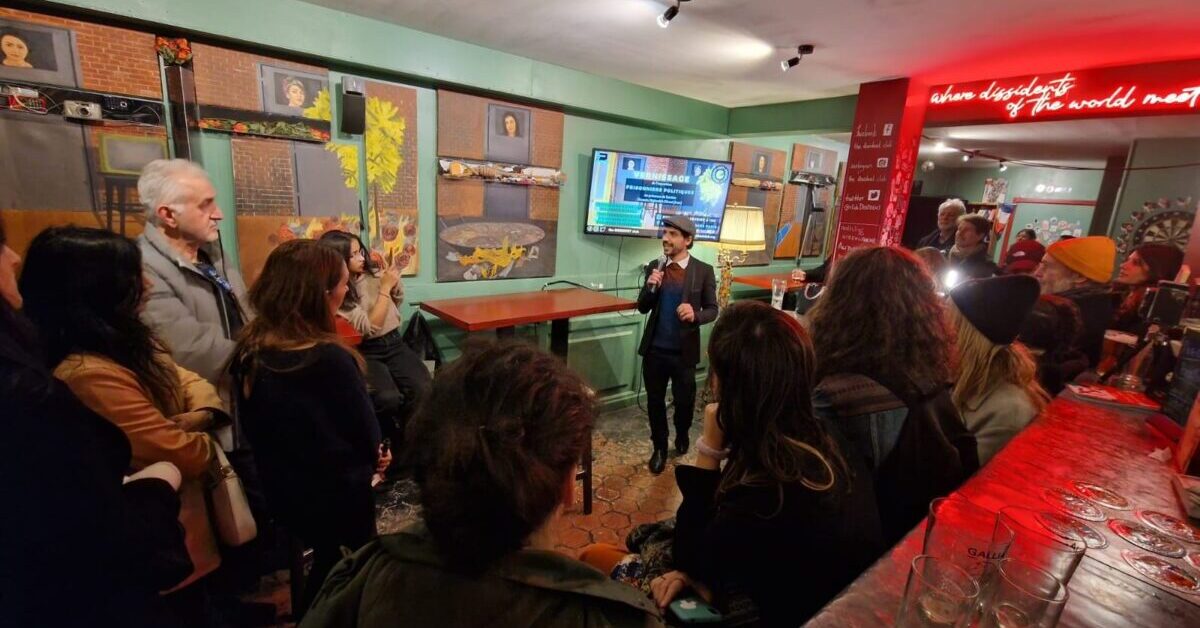
Today, in Paris, he has turned survival into community. The Dissident Club, located in the 9th arrondissement (at 58 Rue Richer, just off Rue du Faubourg Montmartre), is a bar-meets-salon where exiles, artists, and activists gather for talks, jazz nights, writing workshops, comedy shows, and mental-health meetups. Siddiqui’s project pushes back against transnational repression by building bridges—Russians with Ukrainians, Tibetans with Hong Kongers, Afghans with Pakistanis—and revives the old Parisian ideal of cafés where strangers debate ideas. Journalism gave him the instinct to listen; hospitality gives him the room to make people listen to each other.

Inside the Club, the air hums with quiet rebellion and time travel. A faded Che Guevara poster watches over the bar. The walls, lined with protest art, slogans, and notes from people in exile, glow under dim red light. On any given night, a comedian takes the stage after a jazz trio, as the smell of toasted sandwiches mingles with conversation in half a dozen languages. It’s a refuge disguised as a bar, equal parts café littéraire and underground salon, in the otherwise bourgeois 9th arrondissement.
“Paris used to have cafés where strangers debated ideas. Today you sit with your own group and never talk,” says Siddiqui. “I want to bring that culture back. I introduce strangers to each other at the bar, and they end up talking all night. People are hungry for connection.”
And Paris, naturally, is the perfect backdrop for Taha Siddiqui’s vision, a city that has long romanticized rebellion, from café philosophers to exiled poets. The Dissident Club continues that lineage, but with a modern pulse, also acting as a forum for the politically displaced. Within its walls, conversations move between art and activism, exile and belonging.
What began as one man’s act of survival has evolved into a living archive of defiance—a space where difference isn’t just tolerated but toasted to. Whether Ukrainian or Palestinian, Venezuelan or Afghan, conversation here circles back to the same core pursuit: the right to live, think, and speak freely. Ultimately, Siddiqui speaks of freedom. I spoke with the journalist about navigating clashing ideologies, the politics of the left, and how hospitality itself can become an act of resistance.
You bring together people from so many different places at The Dissident Club. Do conflicting perspectives ever collide?
In the beginning, I did have this problem of navigation, because sentiments were really high and people were very tense at that moment—the war, the invasion, had just happened. And I understood that people could be emotionally charged at that time.
When the war broke out in Ukraine—actually, the invasion by Russia—I wanted to do an event with Russians in exile and Ukrainians in exile together. But the Ukrainians said, “No, we will not share a room with another Russian, whether they’re in exile or not.” And I tried to explain that these are the people who are actually your allies—they don’t like Putin, they don’t like the regime in Russia, they want the same change that you want. So they are the allies you should be finding.
It took some time, but eventually I did an event where I brought them together. It wasn’t easy. But that’s the point of the Dissident Club: to bring people who’ve experienced oppression, sometimes from opposite sides, into the same space to talk.
When you look at these oppressive regimes—Russia, China, Pakistan, Saudi Arabia—you see that they all oppress their own people in the same way: through technology, through surveillance, through jail time, through murder, through different tools of control. They collaborate in their oppression. Pakistan buys surveillance technology from China to monitor its citizens. Saudi Arabia does the same. Russia helps create troll armies across the world.
And if they are collaborating in that way, then it’s even more important for us, the exiled dissidents, to collaborate and work together. Because strength is in numbers. That’s what I try to do at The Dissident Club: bring people from different, diverse backgrounds, learn from each other’s experiences, and fight back together.

What politics do you subscribe to?
By nature, it is the left. Within the left, we are always kind of divided, always challenging each other. Because if we were not doing that, then we would probably be right-wingers. The right wing is very united; they all agree that migration is a problem, that Islam is a problem. But the left celebrates differences. We debate, we disagree, and that makes us better. Those divisions are not a weakness, they’re what make us strong.
You’ve mentioned there are ‘good’ and ‘bad’ dissidents. What do you mean by that?
When I started this project, the name attracted all sorts of people. Some came in saying, “We’re dissidents too,” and then I’d find out they were supporting the far right. They said, “Oh, we live in cities that vote for the left, and we vote for the right, so we’re dissidents.”
And I had to redefine it for myself. Because that’s not what this space stands for. There are good dissidents and bad dissidents. The good kind are those who fight for freedom, equality, and justice. The bad kind are those who just oppose whatever is popular, without any values behind it.
Paris feels like the perfect city for your project—a place where rebellion, art, and politics have always intertwined. What role does the city play for you?
Paris has a long history of cafés and bars where people came together to exchange ideas. The café littéraire as it was called. And I think that culture has really died. Now, if you go to most bars, you sit with your own group, you don’t talk to anyone else. You never make new friends, you never exchange ideas. I’m completely against that. I want to bring that culture back.
When someone walks into the Dissident Club, I talk to them. People are hungry for that. They want connection, and that’s exactly what I’m trying to build here.

You’re a journalist by training, not a bar owner. How did hospitality become part of your activism?
I’ve never done hospitality before, but journalism and hospitality share something. In both, you talk to people, you listen, you try to understand. That’s what I’m doing here—just with drinks instead of interviews.
And honestly, it’s safer. In journalism, you can be killed for asking questions. Here, the only danger is drunk people and that’s much easier to handle. But even in exile, there’s no absolute safety. There’s this thing called transnational repression—people still get threatened or surveilled even after they’ve left. So this bar, for me, is a safe place. It’s an act of resistance, but it’s also a way to survive.
And how have Parisians reacted to the Club? Do they understand what you’re doing?
I’ve been in this neighborhood for six years now, and honestly, not all of my neighbors get it. Some say the place gives off “too much of a leftist vibe.” Others tell me it’s “too political” or “anti-capitalist.” But I’m not here to blend in. I’m doing something with purpose.
People sometimes say, “You’re a dissident in Pakistan, not here.” And I tell them, no—I’m a dissident here too. France is my home now. My son is growing up here. So if I want this country to be better, that’s my right. That’s what being a dissident means—wherever you are.
What are the next steps for The Dissident Club?
I want to have a media platform where I can record, broadcast, and archive all the activities we do every day. The idea is that if you’re not coming to The Dissident Club physically, you can still access it virtually—listen to what we’re doing, watch what we’re doing, even from a distance. The membership drive is basically about keeping people connected to us online, keeping them informed about our work. And whenever they come to Paris, they can drop by.
What does freedom mean to you now?
Freedom isn’t just about being safe. It’s about being able to build, to connect, to create something meaningful. That’s what the Club is, it’s a place where survival turns into community.
I want to add to that Parisian culture through this project—that’s my aim and my objective. Sometimes it gets very tiring because, you know, when you’re trying to do something intellectual, it’s not always financially sustainable.
In a city that once toasted revolution with coffee and debate, The Dissident Club feels like both a relic and a revelation. Behind its modest bar, posters of protests and jazz nights share wall space with hand-written notes from visitors who can’t go home. For Siddiqui, freedom isn’t about safety or escape—it’s about connection. And in a world that still punishes dissent, that may be the most radical act of all.
Angelika Pokovba is a writer and longtime Francophile originally from NYC, now based in Mexico. She’s into food, wine, skincare, and all things French—especially summers in the South and pharmacy finds she stocks up on way too early.