If you are a French food lover in search of quintessentially French flavors, I recommend you skip Paris and head straight to the heart of French cuisine, Lyon.
Here, you will be welcomed by a gorgeous city nestled alongside the Alps, with temperate weather and flowing wine. More importantly, you’ll be greeted by a rich culinary history that has birthed some of France’s most famous chefs and culture-defining dishes—dishes that are deeply comforting, unctuously rich, and grandmother-approved.
And all of this will be abundantly clear once you take your first step into a bouchon.
These cozy, often chaotic little restaurants are the beating heart of Lyonnais culture. They’re not polished, they’re not made for Instagram, and they’re certainly not subtle. But they do provide some of the most gratifying culinary experiences you can have in France.
Let’s dig in.
So, What is a Bouchon, Exactly?

In short, a bouchon is a traditional Lyonnais restaurant serving hearty, meat-forward dishes rooted in local history. But that definition doesn’t quite capture the vibe.
The word bouchon itself is said to come from the bundles of straw (bousche) that were once hung outside inns, which signaled to travelers that they could stop in for a meal and a rest. Over time, those humble stops evolved into the restaurants we know today.
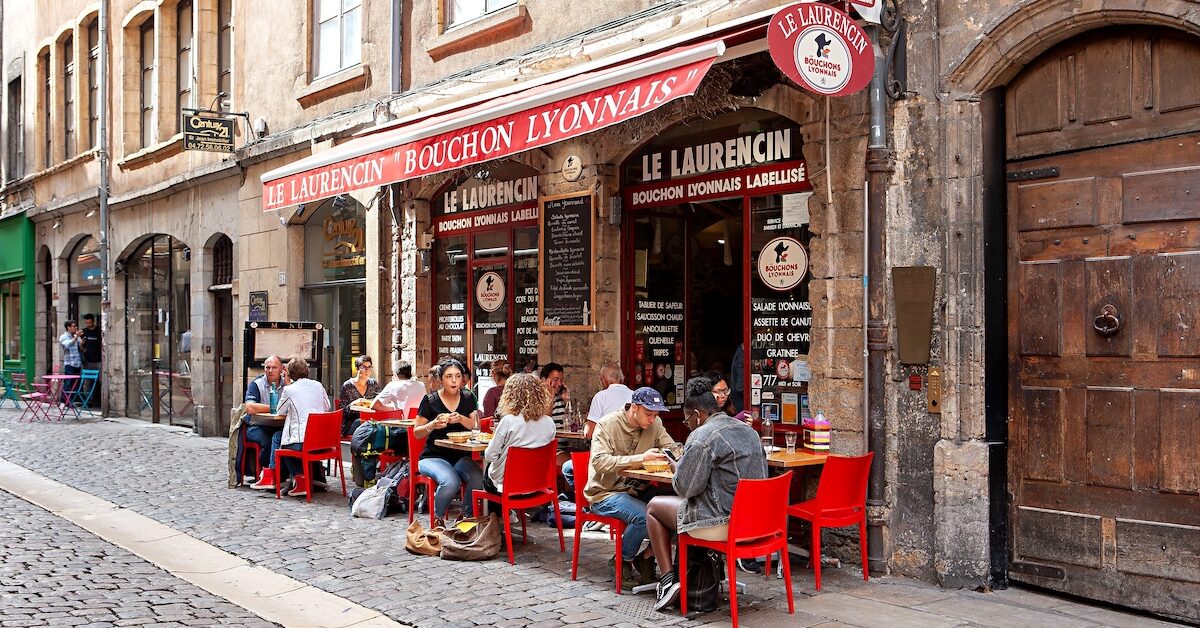
Inside you will find tables packed tightly together, checkered tablecloths, vintage posters, and the occasional pig- or duck-themed knick-knack. There’s usually a chalkboard menu out front, a mix of devoted locals and intrigued tourists, and a server rushing around with no time for your indecision.
Oh, and did I mention the volume? Bouchons are loud, filled with people chattering, plates clattering, and an infectious sense of joy. But that’s all part of the charm!
A Working-Class Culinary Legacy
During the 19th century, Lyon was a major hub for silk production, populated by workers known as canuts (you can find murals of them all over the city!). Feeding a workforce like that required food that was filling, affordable, and made from whatever was available.
Enter the mères lyonnaises. These were female cooks who decided to leave bourgeois households and open their own establishments, bringing with them a style of cooking that was hearty, refined, and deeply rooted in necessity.
As is the case with most working-class cuisines, they didn’t waste anything, using less glamorous but more affordable parts of the animal, such as offal, tripe, and pork cuts. By their culinary prowess and skill, these rejected ingredients became the bedrock of the iconic dishes that formed Lyon’s culinary scene.
Today, bouchons continue that legacy, serving recipes that haven’t changed in generations.
Classic Bouchon Dishes

As I am sure you have gathered, this is not light fare. If you’re looking for a quinoa salad or a delicate entree, you’ve come to the wrong place.
Here are some classics you’re likely to encounter at a Lyonnais bouchon.
Salade lyonnais
A deceptively simple mix of frisée lettuce, crispy lardons, croutons, and a poached egg. It’s smoky, rich, and somehow still qualifies as a salad.
Quenelles de brochet
These poached dumplings made from pike are served in a creamy sauce, usually with a tomato or crayfish base. Rich and delicate, this is one of the dishes that really highlights the artistry behind bouchon cooking.
Andouillette
This sausage made from pork intestines is not for the faint of heart. It has a very distinct aroma and flavor, and is usually served with a sharp mustard sauce to try and mask it somewhat. Some people love it, others try it once and never again. Taste at your own risk!
Tablier de sapeur
Directly translated as ‘fireman’s apron,’ this is a dish of breaded and fried tripe. It’s chewy, crispy, and yet surprisingly moreish. If you’re on the fence about offal like I was, this is a great place to start.
Cervelle de canut
Around the time that bouchons were coming into popularity, cervelle, or brain, was a popular dish among the bourgeois. This fresh cheese spread with herbs, garlic, olive oil, and vinegar was offered as a more affordable stand-in for pricey cervelle, and named for the canuts who couldn’t afford the real thing. Today, it’s a perfect accompaniment to a hunk of bread and a glass of Coteaux-du-Lyonnais.
Tarte aux pralines
End on a sweet note with this Lyon specialty, a bright pink tart made with caramelized almonds. It’s sugary, crunchy, and completely over the top. If you can’t snag one in a bouchon, there is no shortage of boulangeries in the old town selling them too.
Tips for Making the Most of Your Bouchon Experience

Dining at a bouchon is just as much about the experience as it is the food. Here are some things to know for your first experience:
- Set menus are your friend. Many bouchons offer a fixed-price menu with a few choices per course. It’s part of the tradition and makes it much easier to pick out a few classics for your first time.
- Sharing is caring. Portions can be generous, and meals are often meant to be communal. Some bouchons will even lean into this with long group tables and shared sides. Don’t be surprised if your neighbor strikes up a conversation.
- Wine is non-negotiable. Lyon sits at the crossroads of several major wine regions, including Beaujolais and the Rhône Valley. A carafe of local red helps to round out the meal and keep you chatting late into the night.
- It’s a marathon, not a sprint. Like any good French meal, these are meant to be savored. Take your time.
How to Tell a True Bouchon From a Tourist Trap
Be warned, even though a place may look like a bouchon, smell like a bouchon, and quack like a bouchon, it may be simply an imposter.
Unfortunately, not every restaurant that calls itself a bouchon is the real deal. In fact, the term isn’t strictly regulated, which means some places lean more toward tourist traps than tradition.
There’s a helpful label to look for: Les Bouchons Lyonnais. This certification is awarded to restaurants that meet the specific and rigorous criteria for authenticity.
But there are also a few other helpful clues to look for to find the real deal.
Firstly, be a little cautious around tourist areas, particularly near Place Saint-Jean and other areas of the Old Town. While there are exceptions, many restaurants here rely on heavy foot traffic and prioritize convenience over authenticity.
Secondly, menus are a dead giveaway. If a restaurant has a giant laminated menu displayed outside in languages other than French, or has a photo of every dish, your alarms should be blaring! Most traditional bouchons keep things simple, using chalkboards and hand-written menus in French, and have only a small selection of dishes.
Thirdly, true bouchons aren’t afraid to roll out the classic Lyonnais dishes. If you don’t see some of the dishes we mentioned, like quenelles, andouillette or tablier de sapeur anywhere on the menu, you may be in a restaurant simply mimicking the bouchon decor.
Finally, cost can be another great indicator. As bouchons were historically working-class restaurants, they shouldn’t have luxury dining prices. If menu prices are dramatically higher than similar restaurants in the city, you might be paying for location instead of quality.
A Few Bouchons We Recommend Seeking Out

Of course, no article about bouchons would be complete without mentioning a few of our favorites to get you started on your own journey.
My first bouchon experience was at Daniel & Denise Croix Rousse, and it’s still close to my heart. Located in the historic silk workers’ district, Croix-Rousse, you’ll feel like you’ve stepped back in time with their exposed beams, checkered tablecloths, walls adorned with photos, and old-world charm. Make sure to try the pike quenelle, crayfish omelet, and sweetbread pâté en croûte (which won World Champion Pâté-Croûte in 2009).
Le Bouchon de Filles is another standout. It strikes that difficult balance between honoring tradition and keeping things fresh. The atmosphere is warm and welcoming, the cooking is excellent, and it’s a great choice for first-time bouchon diners who want an authentic experience without feeling overwhelmed.
I’ve also had consistently great meals at Le Bouchon de Cordeliers. With an unbeatable location in the heart of Lyon’s Presqu’île district and even better service, this bouchon has all the hallmarks of classic Lyonnais dining. Here expect generous portions, rich flavours, and the kind of convivial atmosphere that makes you order that extra glass of wine just so you can enjoy your time there for a little longer.
Then there’s La Tête de Lard whose name roughly translates to “pig’s head” (a promising sign for a bouchon). Honoring both tradition and family, this spot offers honest and generous Lyonnais cuisine in a delightfully quirky and time-honored atmosphere.
But don’t let our list limit you! Half the fun of bouchon dining is finding your own favorite. Some of the best dining experiences are tucked down tiny alleyways or found by following the sounds of locals enjoying a raucous meal.
So Why Should You Care About Bouchons?
Bouchons are a window into Lyon’s history and identity.
They tell a story of working-class ingenuity, of women who shaped a culinary tradition, of a city that takes its food seriously without taking itself too seriously.
When you sit down to eat at a bouchon, you are participating in a cultural ritual that has been passed down for generations. In a world where food fads come and go as quickly as a French waiter, there’s something comforting about the consistency of the bouchon.
Come Hungry, Leave Happy
If you’re heading to Lyon and you skip the bouchons, you’re missing the point.
These restaurants aren’t perfect. They’re not polished. Service can be brusque, menus loaded with offal can be intimidating, and you may not love every dish you try. But that’s the beauty of it.
So go on. Order something you’ve never heard of. Talk to the table next to you. Drink the local wine. And embrace the experience of what is messy, delicious, and unmistakably Lyonnais.
An Australian freelance writer living in Paris, Joe Ciliberto has a background in international relations and renewable energy. He is passionate about gastronomy, politics, travel, and finding the best cold brew coffee in Paris.