
It all starts in a car. In the back of a vintage Mercedes winding through thick Canadian woods, we see, as if spying, two pairs of hands jostled by the road. Just hands sitting there on the legs of their respective humans, except that one of them is visibly yearning toward another, though it doesn’t dare touch. The scene’s tension is underscored by the drone of disquieting music as the car creeps toward a place we already have reason to dread.
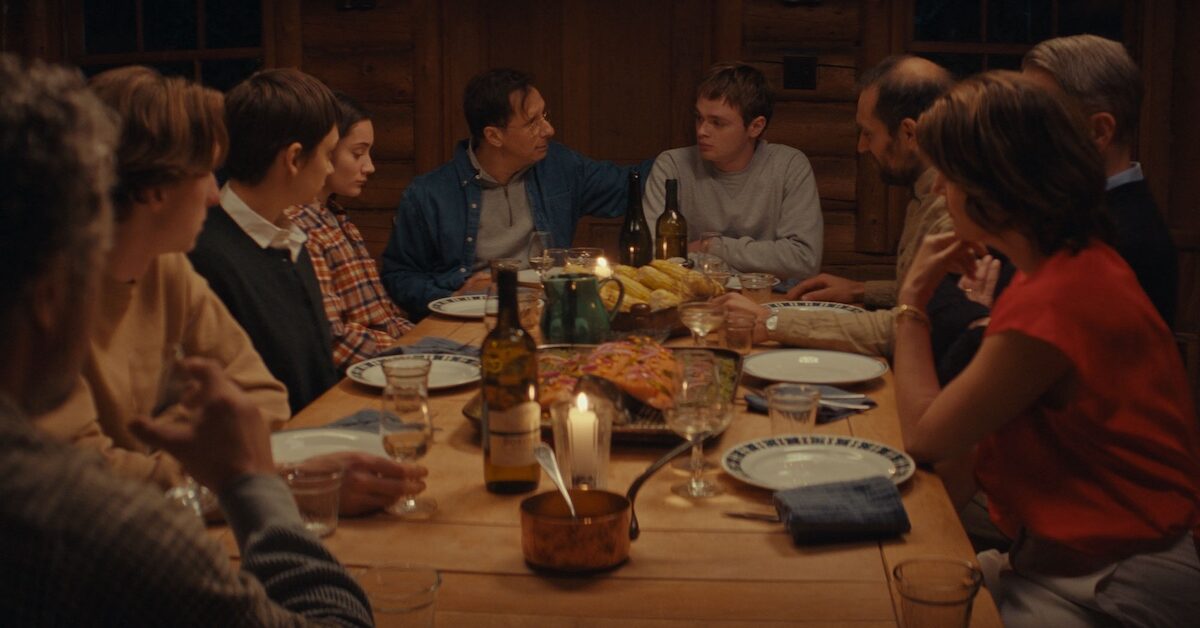
Québécois writer and director Philippe Lesage knows how to build atmosphere. In Who by Fire, which opens at Lincoln Center in New York on March 14, he builds almost unbearable walls of tension that he then shatters with loud bursts of hostility and violence. Known primarily for his coming-of-age films The Demons and Genesis, here Lesage assembles a multigenerational pack that he traps together in a secluded cabin in the woods. We experience the action through the eyes of Jeff (Noah Parker), a young would-be filmmaker invited to stay at the log cabin of famous director Blake Cadieux (Arieh Worthalter) by his friend Max (Antoine Marchand), whose father (Paul Ahmarani) wrote the screenplays for Blake’s early films. Jeff is also in love with Max’s older sister, Aliocha (Aurélia Arandi-Longpré).
Almost immediately, long-simmering rivalry and resentments erupt between Albert and Blake. Blake is the alpha male—the best filmmaker, hunter, fisherman, the guy who gets the girl—and Albert the victim/drama queen who provides the perfect foil to his mean-spirited antics. In a series of long, masterful dinner scenes, everyone in the house is subjected to their raging battles, which later play out on rugged expeditions that grow progressively more treacherous. Lesage’s film is a master class in sustaining tension and mining thorny, complex relationships, especially between Aliocha and Jeff, young people struggling to figure out who they are in the face of outrageous misbehavior on the part of their “role models.”
The riveting film—named after the Leonard Cohen song based on a Yom Kippur prayer about death and the vulnerability of life—won the Grand Prix from the Generation 14plus International Jury at the 2024 Berlin Film Festival, which hopefully will drive greater attention to future work from its beyond-talented director. Andrea Meyer met Lesage via Zoom to discuss toxic masculinity, bad mentors, and the importance of hope.
A Q&A with Director Philippe Lesage on ‘Who By Fire’

The unsettling opening scene sets the tone for the rest of the film. Jeff’s anxiety and wandering hands establish the awkward unrequited love storyline and the layered, drawn-out scenes that will provoke intense emotions in both the characters and viewers.
I like films that take the time to establish characters. It’s very 70s-ish, like The Deer Hunter, which we were inspired by in terms of the camera by Vilmos Zsigmond. The films I like plunge me into a very strong mood. The beginning draws us into this tension, then something happens that is important: They’re on the road and you can obviously see there’s something going on with the two young characters, Aliocha and Jeff, probably more in the head of Jeff. Then the car stops and Aliocha goes into the woods to pee, and she discovers a wood mill in the middle of this beautiful landscape where nature seems completely untouched by destructive human beings. She discovers this gigantic wood mill, and it tells us we shouldn’t trust appearances. The forest is being destroyed. If you take a look at the forest in Canada from overhead, you see huge chunks that are being completely shaved, but it looks beautiful from the road.
The scene also reminded me of the opening of The Shining, another film about cabin fever and people letting their true, most vicious selves rage when cooped up in an isolated location in the woods. Were you aware of that?
No! That would have been too obvious to me as both a cinephile and filmmaker to make a scene that’s a direct homage to a film everyone has seen. If there’s a wink, it’s more toward the opening of Gerry by Gus Van Sant. It’s more or less the same car, an old Mercedes, and that’s what I was thinking about for that shot.
This is a coming-of-age film in which young adults’ emotions and decisions are affected by the petty rivalries, resentments, and raging emotions of the adults around them. What was your original idea for the film?
I was surprised to learn that for a lot of people the film is more about the two grownup friends reuniting than coming of age. It’s a label I’ve had a hard time getting rid of, because my previous films explored my own childhood and teenage-hood. Demons and Genesis really were based on my childhood. Here I wanted to have this intergenerational film where the young people and the grownups meet and you see the grownups through the eyes and the sensitivity of the young protagonists. That was my goal. It’s starts like a coming-of-age film and becomes something different. It’s a take on how adults are often clueless in terms of providing a model—or security or trust—for the younger generation.
You’ve said the story was shaped by your own experience. Are there autobiographical elements?
The film is based on a story that happened to my brother, where he was invited to spend a couple of days in the big lodge of a famous Canadian filmmaker, but of course I put a lot of myself and situations I’ve experienced into it. Even though I do fiction, I believe that fiction isn’t as interesting as reality. When you steal from life, it’s always more original—and when you’re honest about what you are trying to express. In this film, characters do terrible things, but I try not to be judgmental. I’m not trying to separate the good guys from the bad guys, because that’s boring. That’s not how life is.
It takes a while to realize this is Jeff’s story. In simplest terms, it is a film about the danger of meeting your heroes and also the loss of first love.
It’s up to you as a viewer to decide who you care for and from whose perspective you see the film. I didn’t have any specific point of view I wanted to explore. The premise that happened to my brother 40 years ago was just a really interesting place to start. I’m not at ease defining the themes. It’s up to you. Of course, there’s that thing about being deceived and disappointed by meeting someone. I was in a festival recently in Sweden and I had a co-juror who’s a great filmmaker and teaches as well, and she mentioned she has wonderful relationships with so many mentees. It’s so different when it’s between women. I find men can feel easily threatened by a young, new talent. I always use the same comparison or metaphor. When you look at the history of wars, it’s always grownups, older men, white men sending young flesh to be killed. There’s some symbolic sexual competition. I’ve never witnessed that between an older female teacher and a younger student. The film is attacking the patriarchy and masculinity. And deconstructing it. I don’t want to paint all men in black. That would be stupid, but I’m very critical of men because I am a man. I allow myself to do that and also think back to times I suffered when I was younger. I’m getting revenge by exploring these themes.

You’re obviously exploring toxic masculinity and the rivalry between Blake and Albert, but then there are the women. Aliocha is exploring the power of her sexuality. She presents herself as sophisticated and grown up, but in the scene by the fire, she seems so young and innocent, like a wounded bird. And the other women want to keep the peace. Émilie soothes everyone by pointing out the bright side and then Hélène says essentially it’s not you guys being assholes, it’s just cabin fever, making everyone laugh and calming their nerves.
Like I said, one part of my aim was to be very tough with masculinity. It’s really upfront in the film, but I read the comments on Letterboxd and people don’t really get that. They don’t get the irony. It’s not like I’m saying, oh, poor white guys, I pity them. I’m being ironic and critical.
Blake is a monster!
Yes, you can take it that way. The women have a level of distance and maturity that the men don’t have. As a viewer you can see the film through their perception as well. They’re not the servants of Blake, like his male entourage, and they are above the brawl. Aliocha is at an age when she’s aware of her powers, sexual and otherwise. They’re all creative people, but she’s the only one creating, the only one who’s writing and reading during this trip. Yes, we start with the perception of Jeff, but there’s a kind of switch. The more the film goes on, the more we’re getting in Aliocha’s head. This is what happens in the scene you were talking about when she sings, and it shows that she’s not indifferent to what’s going on. She’s her own person with her own thoughts and feelings, and she takes control of the last 30 minutes of the film.
In a way the women are shown to be more open, nurturing, and capable of kindness.
Yes, but if I said yes, I’d be accused of putting that stereotype on women. It’s not only about that, for me it was important that Aliocha is not a victim. She does stuff that’s extremely powerful—when she throws the water glass at Blake—but then also she has the strength to push Blake out of the bedroom. He went too far. There’s no way she could accept the way he humiliates her father, but what was clear for me was that she’s the one who’s going to write this story.

What do the kids learn? What do they gain? Their eyes are opened… to what?
I am hopeful for my young characters, even if they experience tough things. It’s something I value. I do coming-of-age to keep hope intact. The important thing when you’re growing up is to maintain a pure, generous heart and not be too afraid, trying to protect yourself and becoming angry, bitter, and mistrusting. We have all experienced being hurt. We have all had heartbreaks and humiliations, and I think it’s important not to be crushed by these things. It’s also about keeping the door open to love again with the same kind of generosity, and going toward the thing we’re passionate about without the fear of failure. This is what I want for my characters in all my films. The people who hurt you win if you become an old bitter person who refuses to love because you’re afraid of being hurt. My characters will be able to create and to love.
Who by Fire opens at Lincoln Center in New York on March 14, followed by a national release courtesy of KimStim.
Andrea Meyer has written creative treatments for commercial directors, a sex & the movies column for IFC, and a horror screenplay for MGM. Her first novel, Room for Love (St. Martin’s Press) is a romantic comedy based on an article she wrote for the New York Post, for which she pretended to look for a roommate as a ploy to meet men. A long-time film and entertainment journalist and former indieWIRE editor, Andrea has interviewed more actors and directors than she can remember. Her articles and essays have appeared in such publications as Elle, Glamour, Variety, Time Out NY, and the Boston Globe.


