
The situation in Syria during the Syrian Civil War from 2011-2024 has been, and continues to be, a humanitarian crisis of epic proportion, one which Americans have managed to somehow keep out of their rearview mirrors. This, despite the fact that the U.S. Military actually entered that conflict, leading an international effort with a bombing campaign directed at ISIS in 2014. We also supplied ground support and supplies to the Syrian Democratic Forces during the war. Eventually, and perhaps not shockingly, the U.S. was accused of human rights violations and massacres in the fallout at the end of the conflict (along with Iran and Russia, both key players in supporting Bashar al-Assad, the Syrian dictator who used chemical weapons on his own people).
To even try to expound upon the complicated atrocities in Syria, and all of the internal and external influences, would be a fool’s errand, and one I am not educated enough to even try. But I can tell you this: What happened in Syria was so horrific it has created one of the world’s largest refugee populations–ever. Over 14 million people were displaced. Over half of those refugees were scattered far away, with many arriving in Europe. Though Germany took more refugees than any other European nation, France was not far behind. There are currently at least 80,000 Syrian refugees in France.
Jonathan Millet’s Les Fantômes

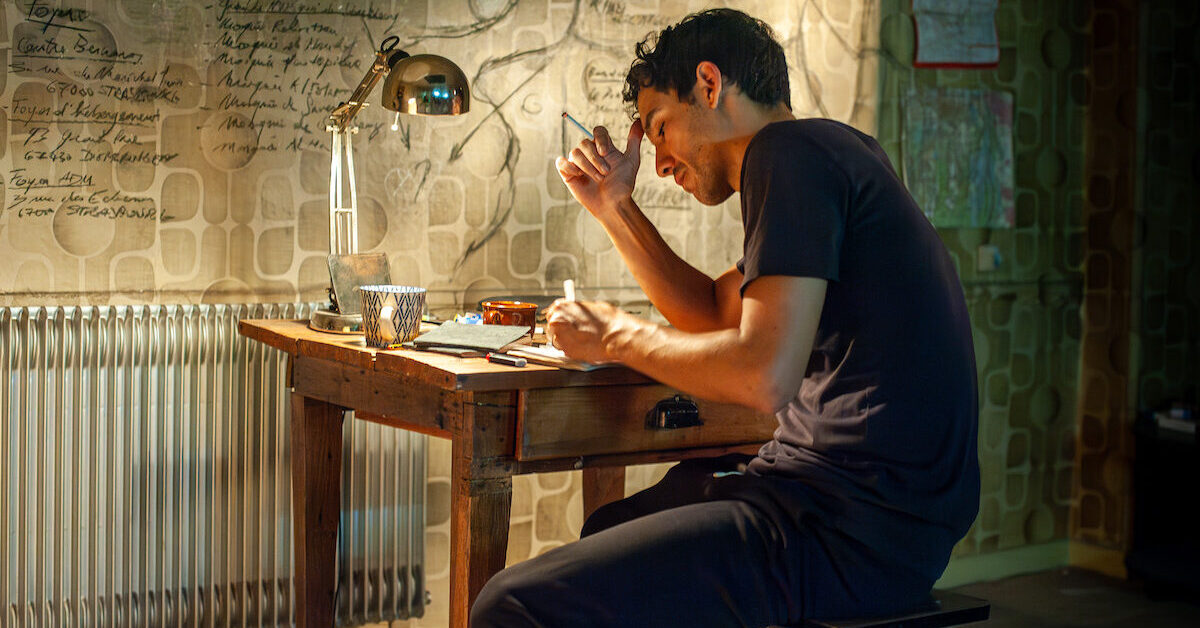
This is the background of a haunting new movie called Ghost Trail (Les Fantômes, in French), from director Jonathan Millet. For anyone who watched Le Bureau des Légendes (The Bureau), the intense French espionage thriller starring the mind-bogglingly brilliant actor, writer, director, and producer Matthieu Kassovitz, you will remember that that show delved into the situation in Syria in Season Three. It attempted to capture how Assad’s government was affecting the region, and by extension, France. My husband and I got to that season, which indeed takes place on the ground in Syria, and got to the scenes with the dog (you know what I mean if you watched that show) and our nervous systems couldn’t handle any more. I think I had nightmares for a week. I have another friend who said he watched the entire series, except the very last episode. He knew what was coming and couldn’t do it. Snowflakes we may all be, especially given that not a single thing on screen could ever possibly approximate the real human suffering and devastation in Syria. Suffice it to say, however, that I was grateful, when watching Ghost Trail, that Millet showed some mercy and took it easy on his viewers by allowing us to understand the trauma of Syria through memory, as articulated through voice recordings, without putting us through it all visually as well. What we learn by listening is bad enough; Millet trusts that our own minds can do the rest. And they do.
Ghost Trail follows a Syrian refugee in Strasbourg named Hamid (played movingly by the French-Tunisian actor, Adam Bessa) who is now an undercover agent working covertly in a spy cell of other Syrian refugees to bring government operatives from Assad’s regime, who have managed to flee Syria and obtain new identities abroad, to justice. These agents are convinced that an Assad government operative who is guilty of violent torture has found safe harbor in France, where he is working under the false identity of a chemistry student in Strasbourg.
Saying that Ghost Trail is a spy thriller does not do the film justice. It is more complicated and nuanced than that narrow definition could possibly imply. What this is, actually, is a movie about the incredible torment living can be for a person who has survived the very worst, while simultaneously losing everything that matters to him. Not only is Hadim a walking ghost, but the ghosts of the the people he loved and the home he has lost eat at his soul, like the chemicals that were applied to his back as a means of torture.
Ghost Trail is Millet’s first fiction feature film, though it is based on a true story. His background as a documentary filmmaker, who once lived in Aleppo and has been interested in the immigrant and refugee experience since then, comes to the fore here. This is not a filmmaker interested in taking liberties with the truth for the convenience of his audience. Everything from the refugee camp in Beirut where Hamid’s mother lives, to the scars on Hamid’s back, to the brilliant use of a multiplayer video game as a method of communication between spies, is managed with a distinct respect for accuracy rather than expediency.
Adam Bessa Shines as Hamid

In the end, what makes this movie most memorable is the haunting and bravura performance by Adam Bessa, whose huge almond shaped eyes, outlined with long, dark lashes, are so communicative of the subtlest of emotions, that the viewer trusts him implicitly from the first second we look into them. I will never forget his face in this role, the pain in it, the beauty in it, the nihilistic quality of having nothing more to lose, allowing him to move like a ghost into all situations. To say Bessa is incredible is an understatement.
This past weekend, in the funny synchronicity of the world, as I was driving back home from an exercise class on Saturday morning, Scott Simon’s trustworthy and relatable voice entered my world from NPR’s Weekend Edition as he introduced a story about a Damascus firehouse. In this story, we learned about firefighters who were on opposite sides of the Syrian Civil War. I had just finished Ghost Trail a few nights before. I pulled into my driveway, put the car in park, and listened, with tears in my eyes. If I hadn’t just watched Ghost Trail, and hadn’t believed in Bessa’s character of Hamid the way I did, I might not have understood so deeply what the men in that firehouse had to overcome to work not only next to, but with each other. This is what the best art can do: bring the human experiences of people who are an ocean and many deserts away into our consciousness.
Thanks to Jonathan Millet’s Ghost Trail, another little corner of my heart is cleared and expanded for Syrians; and it will be forevermore. This is just additional evidence in the proven lesson that a greater understanding of others, and some empathy for the journeys they walk, makes our own lives more meaningful and, eventually, all of us much better people. At least, I still hope that is the case.
Ghost Trail opens in theatres across the U.S. this week.
Caitlin Shetterly is Frenchly’s Editor-at-Large. She is the author of the novel, Pete and Alice in Maine, Harper Books, 2023.


