
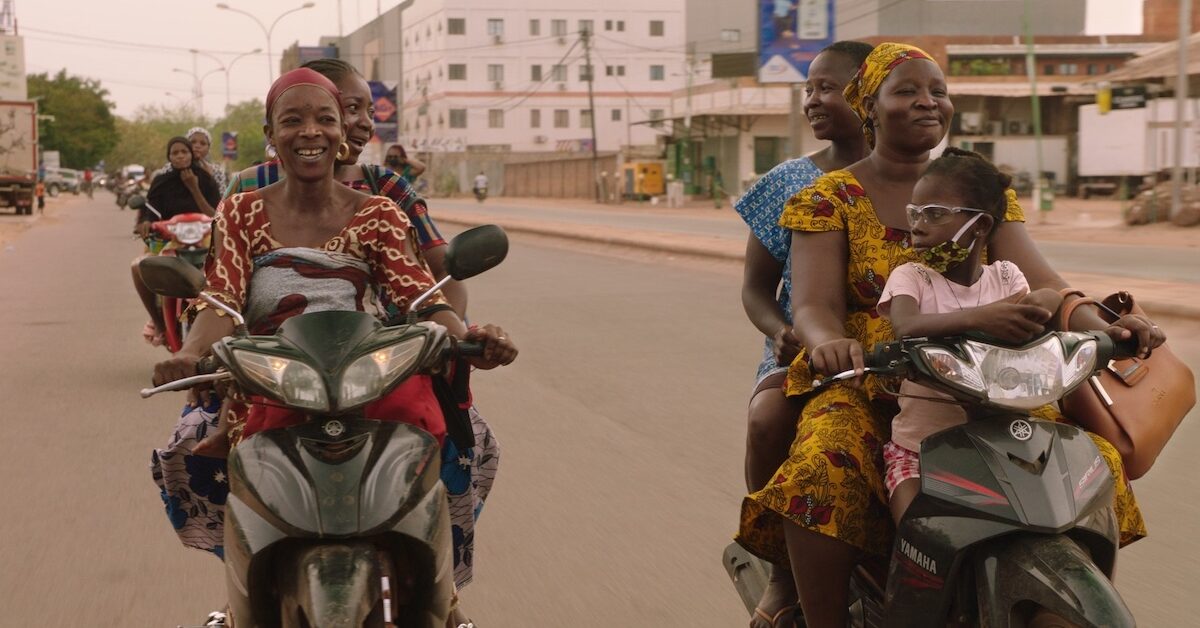
Now in its 32nd year, the New York African Film Festival will take place at Film at Lincoln Center between May 7-31. This annual showcase of narrative features, documentaries, and shorts that celebrate and interrogate Africa and its diaspora also includes filmmaker talkbacks, panels, and programs that expand upon the Festival’s theme, “Fluid Horizons: A Shifting Lens on a Hopeful World,” which looks back at Africa’s history while also looking towards its future.
This year’s program opens with Freedom Way, an intense debut film by director Afolabi Olalekan about the interconnected lives of a ride share start up, a driver, a corrupt cop, and a doctor. At the end of the run, it will close with a shorts program featuring films by and/or about African women. In between, there are 100 films, several of which are in French or co-produced by France, including Black Tea, a narrative feature about an African woman in China from director Abderrahmane Sissako, whose 2014 film, Timbuktu, was nominated for an Oscar.
Several older French-language films consider Africans in Belgium—Identity Pieces (1998), directed by Mwezé Ngangura; Juju Factory (2006), directed by Balufu Bakupa-Kanyinda; and Mzewe (2020), a documentary by David-Pierre Fila. There is also a shorts program “Centennial Legacies” which features three French-language films, including two directed by Paulin Soumanou Vieyra—It Was Four Years Ago (1954) and Ousmane Sembène: The Making of Ceddo (1981), plus The Draughtsmen Clash (1996), directed by Balufu Bakupa-Kanyinda.
Some highlights from this year’s Festival include the U.S. Premiere of two French features and several shorts, one of which is also having its World Premiere. Here is a rundown of what to watch.

1. Ndar, Saga Waalo, directed by Ousmane William Mbaye
91 minutes; May 11, 6:30 pm, Elinor Bunin Munroe Film Center
Ousmane William Mbaye’s nimble and absorbing documentary, Ndar, Saga Waalo, takes viewers on a guided tour as it chronicles the history of Saint-Louis, an island in northwest Senegal that was colonized by the French in 1659. By the mid-1800s, it was an administrative, military, and tourist district, and half of its 12,000 inhabitants were captives. The film presents an informative discussion of slavery, colonization, and human trafficking through interviews and images, including footage of shackles that were used on slaves, to illustrations from books and other sources that depict slavery.
Ndar, Saga Waalo also investigates the island’s history as a trading post, along with the influence of the French colonizers and local Muslim populations on education, religion, and cultural diversity. There are many accounts of biracial and mixed-race people on the island, as French men would often marry women from Saint-Louis and have children. In addition, the island’s language was a mix of French, Wolof, and Arabic, which also suggests that Saint-Louis identities are complex, complicated by the island’s history.
The film is highly engaging as the interviewees provide details about Saint-Louis’ fascinating history, but Ndar, Saga Waalo is best when it addresses the efforts to decolonize, most notably though the removal of the statue of Louis Faidherbe, a French general who is seen as “the father of Senegal,” but who exacted and killed many St. Louisians as well. As the current residents debate Faidherbe, the film shows how his statue is removed, although one man claims—ahem—”a wind blew it down.”
Ndar, Saga Waalo ends by looking at the future of Saint-Louis, but the film’s strength is how it emphasizes a past that needs to be remembered, not ignored.
Ndar, Saga Waalo is represented by Autoproduction; no U.S. release has been set.
2. The Tree of Authenticity, (L’Arbre de l’Authenticité), directed by Sammy Baloji
89 minutes; May 12, 6:00 pm, Elinor Bunin Munroe Film Center
This dense but rewarding experimental documentary by Congolese photographer Sammy Baloji takes an unusual but also fascinating approach to addressing issues of power, racism, war, greed, and control, as well as climate change. Filmed almost entirely in artfully composed static shots—but featuring a fantastic opening sequence that uses a drone—the film recounts decades of history from the Yangambi INERA Research Station.
Baloji presents meteorological observations and information from the station’s herbarium, along with images from extracting latex to a noisy woodpecker. But much of the film is dedicated to two scientists who worked at Yangambi.
The first episode, set in 1909, recalls the experiences of agronomist Paul Panda Farnana (voiced by Edson Anibal), the First Black colonial officer. He experiences racism and fights injustice before dying in mysterious circumstances. (That could be its own documentary.) The second chapter, set in 1941, features the white Belgian scientist, Abiron Beirnaert (voiced by Diederik Peeters), who has a more privileged position.
The final act of The Tree of Authenticity is cannily told from the point of view of Lileko, the 300-year-old titular tree that acts as a witness to these men and senses their “ambitions, anger, and frustrations,” providing much food for thought.
Baloji’s film opens with text from a 2017 article from The Guardian that emphasizes why the Congolese rainforest is critical in the fight against global warming, and later describes colonialism as “rationalized vandalism.” The resulting film provides a necessary call to action.
Twenty Nine Studios is distributing The Tree of Authenticity; no U.S. release has been set.
3. Le Grand Calao, directed by Zoé Cauwet
27 minutes; Shorts Program 4: In the Arms of the Mother; May 13, 8:30 pm, Elinor Bunin Munroe Film Center
This marvelous short depicts six women (and their four young children), who spend an afternoon by the pool at the titular lodge in Ouagadougou. The friends are all part of a Women’s Association, and they have arranged to go to Le Grand Calao to cool off from the oppressive heat, eating, drinking, teasing, gossiping, and supporting each other. Their laughter is infectious, and it is joyful when Aïcha (Aïcha Compaoré) urges that, “Today, everyone must live their best life.”
However, these women have problems which are mostly kept off-screen—a decision that wisely lets viewers draw their own conclusions about their lives. Nevertheless, episodes like a woman getting in trouble with the staff for wearing pants in the pool, or another getting a buzzkill of a call from her husband, magnify the solidarity between these women.
Most of Le Grand Calao is a hangout film, and the action unfolds in a leisurely manner, allowing you to really sit with the characters. Director Zoé Cauwet creates a wistful tone through details like an insect in the water, or a wet footprint on the ground.
By the time the day comes to an end, and the women take a group photo, viewers have come to understand the main characters through their interactions as well as the actresses’ lived-in performances. Arguably, the film’s most poignant moment has Aïcha remarking about the last bite of her food: “It’s not over yet, and I miss it already.” It is hard not to feel the same melancholy as Le Grand Calao ends.
Le Grand Calao is represented by Manifest Pictures; no U.S. release has been set.
4. Sira, (aka Langue Maternelle) directed by Miriame N’Diaye
24 minutes; Shorts Program 4: In the Arms of the Mother; May 13, 8:30 pm, Elinor Bunin Munroe Film Center
This impressive short has a Malian woman, Sira (played by writer/director Mirame N’Diaye), living in France with her husband (Djibril Sangaré) and young daughter Abi (Amina Soumbounou) in the early 1980s. Sira dotes on Abi, but she disapproves when their daughter sleeps in their bed. “The French do this,” her husband explains, dismissing her.
But Sira does not want to “be French.” She is adamant about only speaking in Soninké, their native language. When Abi’s teacher recommends that the girl take a specialized class to learn French, Sira objects—even more so when Sira is asked to take the class as well.
Sira shrewdly addresses assimilation and how some immigrants (Sira) are reluctant to give up their culture in a new land while others (her husband) see migration as an opportunity to reinvent oneself. N’Diaye handles these themes with care and intelligence; a scene where Sira serves her family a meal and her husband prefers to eat with a spoon, rather than his hands, is quite telling.
Abi is soon torn between the two people she loves, and Sira is given an ultimatum: learn French or return to Mali, alone. The decision, which creates the film’s tension, is nicely underplayed. N’Diaye is not looking to create a big, heartbreaking moment, rather she is illuminating how Sira copes in a country where she does not feel at home—or even want to.
The filmmaker dedicates Sira to her parents, a fact that makes this short even more bittersweet.
Sira is a Golgota Productions film; no U.S. release date has been set.

5. Profiling, directed by Zaza Mon Amour
15 minutes; Preceding the feature Rising Up at Night; May 9 at 8:30 pm, Elinor Bunin Munroe Film Center
Tackling the topical issue of racial profiling, this gritty short, set in contemporary Marseille, opens with two young men wanting revenge after the death of one’s brother. Overhearing their conversation, a man invites the guys into his bar to tell them a tragic story, seen in grainy flashbacks, of three young friends whose lives were changed after an incident with the police one night.
Director Zaza Mon Amour uses different visual styles to convey the emotional arcs of these “different but inseparable” friends who are introduced and seen hanging out, swimming, and partying. An early sequence features the guys talking with each other, but only the narrator’s voice is heard; later scenes include their voices, which add another layer of meaning.
When the friends reunite after years apart, their fun evening out turns into misfortune when a BAC team (cop car) follows them and pulls them over late at night, suspecting something illicit. How the trio react reveals much about the dynamics between the police and these young men of color.
Profiling quotes Baudelaire on good and evil, which helps Mon Amour articulate the social realities and power dynamics in cases such as the one depicted here where stereotypes lead to segregation. This potent, cogent short recommends listening and learning to create understanding, not hate.
There is no current distributor or U.S. release date for Profiling.
Gary M. Kramer is a freelance film critic whose work appears in Salon, Cineaste, and Senses of Cinema, among other publications. He is the coeditor of Directory of World Cinema: Argentina, Volumes 1 and 2, and a contributor to Directory of World Cinema: France. He is the moderator of Cinema Salon, a weekly film discussion group, and teaches “Short Attention Span Cinema” at the Bryn Mawr Film Institute.


