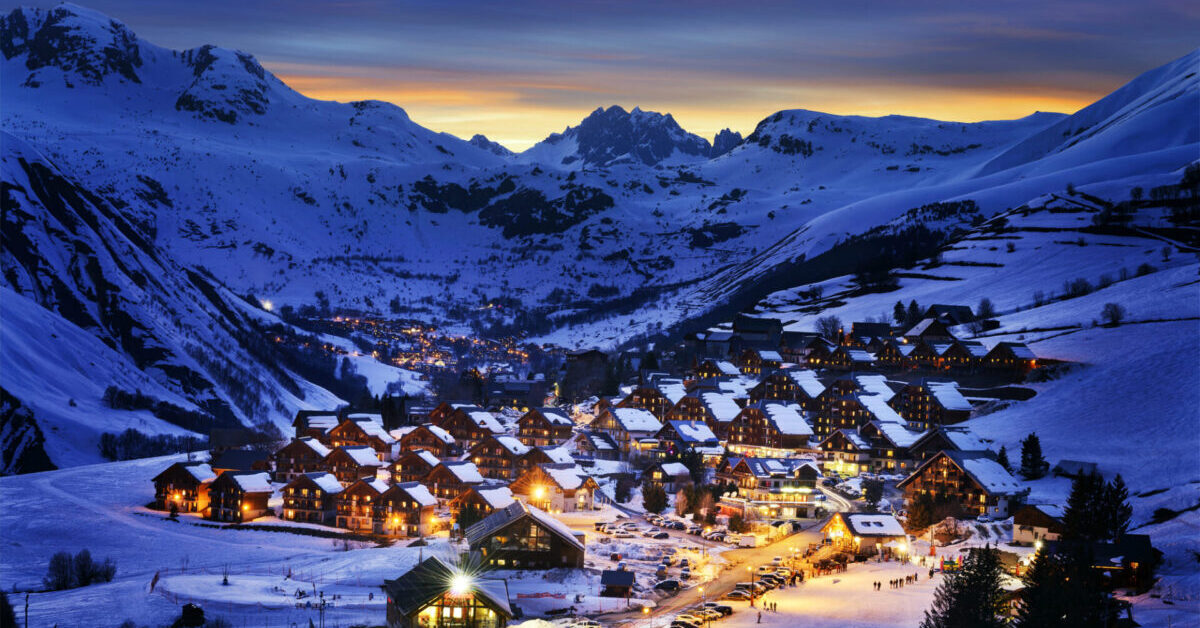
Winter in France has a quiet kind of magic. As the crowd retreat, the country’s villages reveal their most intimate selves: cobblestones glistening under frost, chimneys breathing into the cold air, cafés glowing with candlelight. Away from the busy sidewalks or Parisian boulevards, these small towns offer a gentler rhythm. From Alpine hamlets wrapped in snow, to medieval hilltops and serene seaside escapes, these are some of the most charming destinations to explore during winter in France.
Bonneval-sur-Arc (Savoie)

Deep in the Haute-Maurienne valley, Bonneval-sur-Arc feels like a storybook village come to life. In winter, the snow piles high on slate roofs and stone chalets, and the air smells of pine and woodsmoke. Set within the Vanoise National Park, it’s one of the most remote and best-preserved mountain villages in France—so untouched it almost seems suspended in time. Days unfold slowly here: skiing at nearly 10,000 feet, wandering the silent lanes, or savoring melted cheese in a rustic auberge. Bonneval’s centuries-old architecture and tranquil setting make it a haven for those who seek the purity of an Alpine winter far from the crowds.
Saint-Véran (Hautes-Alpes)

At over 6,500 feet above sea level, Saint-Véran is often called the highest village in Europe—and in winter, it feels as close to the sky as you can get. Nestled in the Queyras Regional Park, its wooden chalets, sundials, and steep roofs create a picture of old-world mountain life. On snowy mornings, the only sounds are the creak of shutters and the crunch of boots on fresh powder. Locals gather around the hearth with melted Mont d’Or cheese or slices of Tomme de Savoie, while skiers explore the gentle slopes shared with Molines-en-Queyras. When night falls, the village’s observatory opens to a canopy of stars unspoiled by light—a rare gift in the winter.
Colmar (Alsace)

Colmar in winter feels like stepping into an illuminated painting. Its pastel timbered houses and canals sparkle beneath twinkling lights, and the smell of cinnamon and cloves from December’s markets lingers long into January. Even after the holiday rush fades, this Alsatian town stays irresistibly warm—locals chatting in ski pants over steaming choucroute or tarte flambée, and windows adorned with candles and ivy. Snow dusts the rooftops along “La Petite Venise,” a nickname that references the city’s many canals, while inside, museums like Unterlinden and cozy chocolateries invite long, unhurried afternoons. With a glass of Riesling and a view of the frosted façades, Colmar proves that winter is its most beautiful season.
Pérouges (Ain)

Perched on a hill above the plains of the Ain, Pérouges is a perfectly preserved medieval gem that turns enchanting in winter. The cobblestones glisten with frost, the old timbered houses glow under soft light, and fog wraps the ramparts like a memory. When the tourists disappear, the village’s stillness becomes its greatest luxury. Locals open their doors to the smell of freshly baked galette de Pérouges—a thin, buttery pastry dusted with sugar—best enjoyed by a crackling fire. Wandering its winding alleys in the cold months feels like traveling back to the 15th century, where time slows, and every stone tells a story.
Soulac-sur-Mer (Gironde)

In summer, Soulac-sur-Mer hums with beachgoers; in winter, it breathes. This elegant seaside town on the Atlantic coast transforms into a sanctuary of wind, waves, and silence. The Belle Époque villas stand quietly behind dunes, their shutters closed against the salt air, while the horizon stretches empty and silver under winter skies. Locals embrace the calm, with long walks along deserted beaches, coffee and oysters in small cafés, or afternoons exploring the pine forests that border the coast. Winter in Soulac is for those who love the sea’s wilder moods—when the ocean roars, the light softens, and solitude feels luxurious.
Lucéram (Alpes-Maritimes)

High above the French Riviera, Lucéram glows like a Christmas storybook in winter. Each year, the hilltop village becomes famous for its Circuit des Crèches—hundreds of handmade nativity scenes hidden in courtyards, windows, and even fountains. But beyond this festive wonder, Lucéram offers the quiet charm of a Provençal winter: stone houses dusted with frost, olive groves bathed in pale light, and winding alleys that echo with stillness. Visitors can warm up with local Fougasse (olive oil bread) or Soupe à la châtaigne (chestnut soup) before watching the sunset over the Maritime Alps. In Lucéram, winter turns simplicity into something sacred.
Saint-Cirq-Lapopie (Lot)

Perched high above the Lot River, Saint-Cirq-Lapopie might be one of France’s most romantic winter escapes. The village’s medieval lanes, carved into limestone cliffs, fall silent under the soft weight of fog. Without the summer crowds, its poetry resurfaces—in the play of light on old stone walls, or the sound of the river far below. A wander through its tiny galleries and cafés reveals the spirit that once inspired poet André Breton. Hikers can explore the trails of the Causses du Quercy, while others settle into a fireside meal of duck confit and a sweet Gâteau aux noix (walnut cake).
Carcassonne (Aude)

Behind its monumental walls, Carcassonne in winter feels like another world. The double ramparts, towers, and castle appear almost spectral under the morning mist, and the cobbled streets inside the citadel fall into an eerie calm. This is the best time to feel its true medieval soul—without crowds or noise, just the echo of footsteps and the scent of rain on stone. Visitors can explore the Château Comtal, sip vin chaud in a centuries-old tavern, or gaze over the frosted vineyards of the Aude Valley. Winter strips Carcassonne of spectacle and leaves only atmosphere—pure, mysterious, and timeless.
Arêches-Beaufort (Savoie)

Nestled in the Beaufortain mountains, Arêches-Beaufort is an Alpine postcard that comes to life each winter. Wooden chalets capped with snow, ski trails winding through fir forests, and the sweet scent of melted Beaufort cheese drifting from mountain inns—this is the Savoie at its most charming. Visitors can spend their days skiing or snowshoeing, then visit a local cooperative to taste the famous AOP cheese that defines the region.
Argentière (Haute-Savoie)

Set at the foot of the Aiguille Verte in the Chamonix Valley, Argentière offers all the Alpine grandeur with half the crowds. In winter, the village sits under a soft silence, its wooden chalets buried in snow and its church bells echoing through the cold air. It’s a paradise for skiers—the Grands Montets slopes rise dramatically nearby—but also for anyone who loves the raw beauty of the mountains. After a day outdoors, visitors gather in cozy lodges with tartiflette and vin chaud to unwind.
Abondance (Haute-Savoie)

True to its name, Abondance overflows with warmth even in the depths of winter. Nestled near the Swiss border, this small Savoyard village is surrounded by pine forests and snowy pastures that glow under crisp sunlight. Its medieval abbey and wooden chalets give it a timeless grace, while the Maison du Fromage celebrates the village’s namesake cheese—nutty, fragrant, and perfect melted on bread. The nearby slopes of Les Portes du Soleil invite gentle skiing, while quieter moments can be spent snowshoeing or exploring local heritage trails.
Megève (Haute-Savoie)

This Haute-Savoie village, reinvented by the Rothschilds in the early 20th century, shows off the understated glamor of the Alpine region. The cobbled streets are lightly dusted with snow, boutiques glow with soft light, and horse-drawn sleighs jingle through the square. Beyond its 250 miles of ski slopes, Megève offers cozy cafés serving thick hot chocolate, restaurants proposing fine dining, and art galleries hidden behind old wooden façades. Yet despite its refinement, the village remains deeply connected to its mountain roots. As dusk falls and Mont Blanc turns rose-gold in the distance, Megève feels like the very soul of a French winter—polished, serene, and unforgettable.
Valentine Marchou is a French journalist with a keen eye for culture, lifestyle, and society. After honing her skills in several French newsrooms, she now aims to tell stories that bridge French and English-speaking worlds through art, food, and everyday life.