We set out by foot from the 11th arrondissement of Paris. Destination: Briançon, a medieval town deep in the Southern French Alps, for some high-altitude hiking and rustic meals. I was traveling with my friend Stacey, who was curious if skeptical about the journey I had organized.
Our mission was to travel to the Alps by night train, arrive early, hike, fill our urban lungs with cool mountain air and our bellies with local cuisine for three days, and then return to Paris without ever stepping foot in a car. Then do it all again after a proper break in Paris, only this time we’d head to the Côte d’Azur to swim in the sea and lounge under an umbrella. To my mind, we would be living the French tourism ideal as depicted in those magical vintage travel posters.
At the station, we pulled up our e-tickets on the SNCF app, showed them to the conductor and strolled down the platform to find our sleeping car.
Our sparkling-clean first class cabin had a pair of comfortable red and grey bunk-beds on either side of a large picture window, each bunk with a large fluffy pillow and a plush billowing white-linen-covered duvet packed in plastic, airplane style. Small shelves were provisioned with water bottles and a handsome little sack with night shades and ear plugs.
I was thrilled to find the window actually opened a bit to let in the cool breeze as we pulled out of the station. Although smartly renovated, I later learned our train car dated to the 1970s, before more modern trains were hermetically sealed. Yet, when the novelty of the noisy breeze wore off, I was equally pleased to discover powerful and quiet AC upon closing the window. There were also well designed reading lamps and plenty of electrical outlets for charging devices. The sliding door to the corridor had a double lock, though the train always felt perfectly safe.
We made up our own beds, drew down our window shade, and settled in after a brief visit from the conductor. We knew we would have the entire cabin to ourselves because, months earlier, we had booked the four-bunk cabin as an Espace Privatif.
We opted for the bottom bunks and exalted in the possibility of raiding the top bunks for their pillows but, in reality, that would have been overkill: each pillow was enormous. Otherwise, there was nothing strikingly luxurious about our cabin. But it was roomy and the bunks were comfortably wide for a good night’s sleep.

One bathroom and a separate changing room were down the corridor. Given the number of people in the car who relied on these facilities, I was impressed by their cleanliness throughout the journey. Clearly, the train crew were doing their jobs.
At a few stops in the Paris suburbs, conductors blew old-fashioned sounding whistles to signal “all aboard.” Then the gentle rocking of the train and the rhythmic clickety-clack of the tracks did their job as we drifted off. Before falling asleep, I checked our speed on my phone: 52 miles per hour. That was good, I figured. Anything faster and we’d get to the mountains too early.
Our glimpse out the window at about 7 am revealed green fields, mountains in the distance, and a bright June sun trying to break through the clouds. There was no breakfast service, but a few cars away there was a little espresso station, nothing like the cafe cars found on a Eurostar or TGV. A rather grumpy attendant was struggling with a finicky espresso machine in a tiny booth.
As I waited, I sucked in my body against the counter to get out of the way of bleary eyed passengers squeezing past for the restrooms. Nothing first class about this. Still, the aroma of coffee, mixed with the pretty scenery rolling by and the promise of the day ahead, lifted my spirits. I jammed two cellophane-wrapped brioches in my pockets and carefully maneuvered my two tiny paper cups of hot espresso back to our cabin.
We arrived more or less on time, a bit before 8:30 am. We donned our packs for the 20 minute walk to our hotel. Morning traffic whizzed by as we trudged along a nondescript stretch of road.
Briançon, the Highest City in France
Briançon is the highest stop on the French national railroad. The station and immediate town around it dates only to the mid-19th century, when Briançon became a coal mining and textile center. The town, while quaint by American standards, has little in common with more famous and chic mountain resorts such as Chamonix or Val d’Isère in the northern French Alps.

Still, in winter, the night train is filled with skiers headed to the massive downhill skill terrain of Serre Chevalier. Briançon serves the resort with a gondola that leaves right from the center of town. With the warming climate, though, many choose to stay higher in the mountains for easier access to more dependable snow. The rest of the year, Briançon has become a sporty Mecca for hiking, kayaking, and history buffs. It’s also often along the route of the Tour de France bicycle race.
Encircling the medieval town on all sides and at varying elevations are a network of imposing military fortifications constructed in the 17th and 18th centuries under the direction of King Louis XIV. Designed by military architect Sébastien Le Preste de Vauban, they include an imposing wall around the gated Old Town, a covered walkway connecting the forts, and the solid yet graceful Pont d’Asfeld over the Durance River. Fort des Salettes, Fort Dauphin, Fort del Randouillet, and the largest, Fort des Têtes, sprawl out on various ledges, once creating an impregnable shield from the threat of Austrian and Italian armies a short distance across the border. The entire collection of fortifications were designated a UNESCO World Heritage Site in 2008.

Our cozy lodge in the center of town, Hôtel de la Chaussée, has remained under the same family management for five generations, according to our host, though it is now part of a larger network of hotels. The place has the whimsical look of something from a Wes Anderson film. It’s decorated with carved wood animals seemingly staring at you from every angle: deer, rabbits, bobcats, sheep, cows, ibex, and marmots. Faux fur blankets cover the bed and are draped over deep red leather arm chairs. A tiny bunk bed in an alcove, apparently designed for children, is tricked out to look like its own little cabin. The room was fresh and clean, somehow feeling both antique and modern.
After checking out the main street with its bookshops, boulangerie, and somewhat faded-looking town square, we were ready to hike. Our host sent us on the most direct route up the mountain to Porte Embrun, the lower drawbridge entrance to the old Cité Vauban, built on a steep mountain slope. That was technically correct, but poor advice as we spent the next 20 minutes laboring up a punishing incline on a straight-as-an-arrow main artery, breathing in car and truck fumes. (Only the next day did Stacey learn there is a parallel way up a far more scenic and bucolic path that borders a stream and forest before crossing a centuries-old viaduct on its way to the medieval district.)
We passed an ancient fountain fed with cool mountain water. A few children played about, but otherwise we saw only an errant cat and a dog or two.
All very charming, but it was already past 2 pm, and not a single restaurant was still open for lunch. It wasn’t until we walked the half mile or so up the main street and out the very beautiful Porte de Pignerol, then over another ancient drawbridge, that we found life again in the form of a modern thoroughfare, a parking lot, and a series of roadside cafes.
The moat under the drawbridge, rather than flowing with water, brimmed with wildflowers. In the other direction, up the mountain, was our destination in the distance, the Croix de Toulouse overlook, about another three or so miles up the mountain face via switchbacks rising 2,000 feet.
During our (by now very late) lunch, we fell into conversation with a retired French couple sitting at the table next to ours. They were touring the surrounding Briançonnais mountains in their RV. They politely made it clear that they felt our plan to eschew car travel was quaint yet flawed, depriving us from seeing the diversity and natural beauty of the valleys that spread out like spokes of a wheel from the center of Briançon.
We spent so much time discussing their adventures, and all the places we might have gone had we had a car, that our own afternoon expedition was delayed even more. By the time we got hiking it was already well past three o’clock.
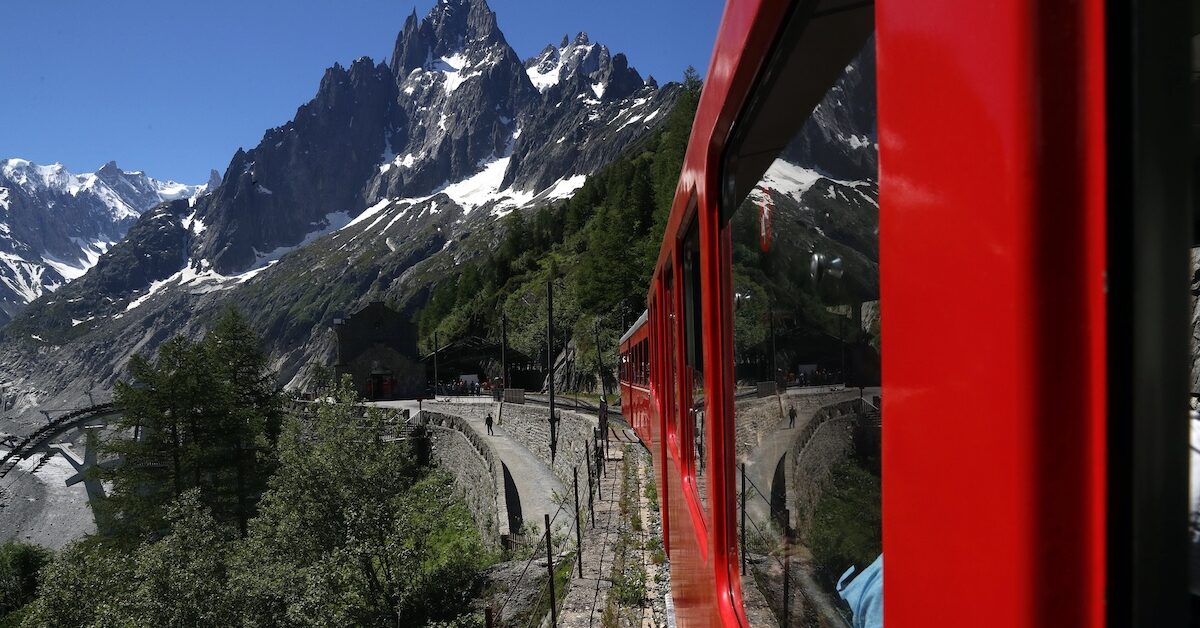
Our late afternoon climb took us past Fort des Salettes, which was closed, and through a fragrant pine forest dotted with wildflowers, a few running streams, and distant views of pretty villages, each with their own distinct church steeple. Beyond in all directions were the glistening snow-capped high peaks. When we finally reached our lookout point, we were rewarded with sweeping views of the two Briançons—old and new—far below, and the distant railroad tracks that had delivered us.
The next morning we strolled along rue Centrale, this time visiting some of the shops. The “new” town, as opposed to the medieval enclave up the side of the mountain, retains an Alpine yet somewhat intellectual aging-hippy vibe, a little frayed at the edges. Old time locals, Parisian expats, and hikers strolled the sidewalks.

There are plenty of shops for tourists, as well as specialty stores for serious hikers and rock climbers. There’s also a high ratio of excellent book stores.
Not to be missed is a stop at La Craquante, a boulangerie specializing in artisanal breads, including huge loaves made with Khorasan wheat. We walked by earlier to find a line streaming out the door and down the street, but later in the afternoon it’s easy to walk right into the cavernous space, ovens looming in the back, and past an array of pies, tarts, cakes and croissants. The scent was sublime. We walked out with a chocolate and coffee éclair, and, out of curiosity, an over-sized American-style chocolate chocolate chip cookie. We were not disappointed.
Just a few steps away, we stumbled upon Le Bloc Erratique, a tiny bookstore jammed up to the ceiling. What looked to me like a disorganized jumble was in fact a meticulously organized treasure trove to the manager, who knows every book in the store, where it is, and why you might just love reading it. He pointed out a memoir of conservationist Émile Carles, who was born and raised in a tiny Briançonnais farming village. As an adult in the 1970s, she successfully organized against the French government’s plan for a massive road and mining project that would have destroyed the valley. I walked out with it and a few other tomes.
The next day we abandoned our pledge of no car travel and hired a taxi for the 30 minute drive to our trail head in Nevache, a small hamlet deep in the Vallée de la Clarée. (Though as we later discovered, Briançon and Nevache are also linked by bus service.) On the way our driver pointed out Carles’ childhood farmhouse.

Nevache, nestled on the edge of a stream roiled by spring snow melt at the time we visited, centers around a church built in the 1400s. Walking through the original wooden carved doors reveals a truly beautiful and intimate space that is strikingly ornate and rich, in sharp contrast to its rural village setting. Across an ancient wood-planked floor is an intricate gilt-leafed altar, with stained glass windows above it. Regardless of your spiritual bent, the space is deeply soothing and worthy of unhurried contemplation.
Our plan was to grab a sandwich or a baguette and some cheese and take a picnic lunch on our hike. But the sole boulangerie was closed and there were no other shops in sight. Fortunately, one restaurant was open. While our hopes for a quick provisioning were dashed, we were happily surprised by Un Brin Sauvage, a lucky find on this quiet weekday in early spring.
Set deep inside the ground floor of an ancient farmhouse, the restaurant is run with the precision and attention to detail you’d expect from a chef whose background includes stints serving in the French air force and working for Air France. Ludivine Nougaret is not only chef de cuisine, but also calls herself “chef of foraging,” since much of the healthy fare on the menu is made with wild mountain plants that she and her family collect on hikes.
We started our lunch, for instance, with nettle soup. Pretty good. A main course of local trout, served whole, came with wild yarrow. Very good. Yet the most delicious flavors came from a sort of lasagne made not with wide pasta, but with whole-wheat layers of crepe filled with local mountain spinach.

Nougaret likes to invoke the expression that we are all what we eat. So it seemed like a good time to bond with the mountain that had just fed us. This time we set out for a more modest hike along the valley floor, passing a little farm and into meadows and forests full of spring wildflowers. We spent a few hours meandering up a gentle incline, roughly following a raging stream until, just below a pretty waterfall, we realized it was time to turn around and get back to the train station in Briançon.
The Gare Briançon is a quiet place in the evening, lacking a cafe or sandwich shop. I knew the train would have no cafe or dining car so, in the spirit of foraging, I crossed the street to a very rundown and desolate-looking bar-tabac, a place that was perhaps lively 30 years ago with its now-deserted game room. An elderly bartender looked at me quizzically when I asked for a couple of jambon-beurre sandwiches, as if no one had asked for such a thing in several decades. But he went off to make them after pouring me a couple of shots of whiskey. This, and a couple of Snickers bars, would be our dinner.
The train left at 7:57 pm, and the summer light made for a scenic ride down the mountains until we could stay awake no longer. Just before drawing the shades I snapped a photo of an empty country lane on a rolling hill, clouds looming. It was 9:34 pm.

We awoke early the next morning to a bustling station in Paris and asked, bleary eyed, for directions to the showers, a perk of our first class ticket. Our expectations were low given the current unglamorous state of Gare d’Austerlitz—once elegant, then faded, and now in the middle of a major and messy renovation.
The Benefits of a First Class Sleeper Train Ticket to Paris
It turns out the shower and lounge were among the snazziest moments of our night train adventure. Welcomed into the lounge, we were given big fluffy towels and pointed in the direction of two open shower rooms. Inside my spacious and modern bathroom was a spotless extra large walk-in shower, sink, well lit mirror, changing area, luggage rack, and toilet. There is no time limit for showers, which were hot and well pressurized, but a sign urged reasonableness in the interest of the environment and fellow passengers who might be waiting.

After our showers, we met up over espresso in the small lounge area. The staff were surprisingly warm and welcoming, all the more impressive given that they are, after all, working for the SNCF, not usually known for its warm and fuzzy service culture.
Before setting out for our day in Paris, we still had one more stop to make. We put on our backpacks and walked for five minutes over the Seine to Gare de Lyon to have a leisurely breakfast at the famed Le Train Bleu restaurant. The meal was fine, if pricey, but the real show was high above us on the ceiling of the ornate Belle Époque dining hall. There, gazing down on us, were gorgeous oil paintings of French tourists of a bygone era, enjoying iconic views along the Côte d’Azur and other destinations once served by France’s long-gone luxury trains. Among the scenes of Paris, Lyon, Marseille, and Cannes, I spotted the ancient fortress walls of Antibes, and the Mediterranean stretching out beyond. Antibes, as it happened, would be our next night train destination.
Rick Schine is a travel writer and has been a lifetime Francophile since his first night train voyage from Paris to Agay at the age of five. In addition to travel, he has reported on politics, business, and economics for the Los Angeles Times, Bloomberg Businessweek, The New Republic, and Harper’s Magazine.