
Paris is an inexhaustible cultural gold mine, as my wife Daniele and I rediscovered when we moved to France five years ago. We visited countless museums, venues, events, theaters, and concert halls—enjoying them all, but favoring none. That is, until my aunt Ariane visiting from New York introduced us to the Théâtre des Champs Élysées (or TCE, as it’s known to its growing legion of fans).
With its rich history, striking design, superb acoustics, broad programming, and an inarticulable yet very palpable sense of place, it’s hard to single out any one reason that makes it so special. Here are ten reasons why anyone who hasn’t yet discovered this gem (and even those who have) should be sure to put it on their Paris cultural bucket list.
1. A Celebrated Performing Arts History

“The Théâtre des Champs-Élysées has remained one of Paris’s most daring and influential cultural institutions,” notes incoming Artistic Director Baptiste Charroing. When it was built in 1913, “it quickly became home for modernist innovation in music, dance, and opera.”
In its first year, the theater premiered Igor Stravinsky’s Rite of Spring (whose revolutionary style nearly set off a riot). Pablo Picasso and Jean Cocteau collaborated on sets and costumes for Sergei Diaghilev’s famed Ballets Russes. Over the years the likes of Richard Strauss, Maria Callas, and Leonard Bernstein graced its stage. In a city that was never short on concert halls and theaters, it speaks volumes that Claude Debussy, who conducted his own Prelude to the Afternoon of a Faun at the venue’s inaugural concert, would go on to call the Théâtre des Champs-Élysées “the house of music.”
Then, in October 1925, history was made (and a star was born) when the 19-year-old American expat Josephine Baker took the stage at the Théâtre des Champs-Élysées—launching her into international stardom.
2. Josephine Baker Tribute (September 24–October 5)

Josephine Baker felt at home from the moment she arrived in Paris, as she must have at the Théâtre des Champs-Élysées, where she debuted her La Revue Nègre (The Black Revue). In the audience were Picasso, Cocteau, and Ernest Hemingway, who famously called her “the most sensational woman anyone ever saw.”
Her sensational feats extended well beyond the stage: decorated by President Charles de Gaulle with the Legion of Honor and the Croix de Guerre for her work as a WWII resistance spy, she also stood alongside Martin Luther King, Jr. at the 1963 March on Washington.
Despite experiencing racism on her U.S. tours—being refused hotel rooms and restaurant service as late as 1951—she found permanent refuge in France, raising her “rainbow tribe” of 12 adopted children in the Dordogne. In 2021, President Emmanuel Macron enshrined her legacy by inducting her into the Panthéon, making her the first Black woman to receive what is arguably the greatest posthumous honor in France.
In the first of what will become an annual celebration of international artists, the Théâtre des Champs-Élysées honors Josephine Baker’s legacy this fall, exactly 100 years after her debut at the theater.
Highlights include:
- World premiere of Josephine, a dance portrait choreographed and performed by Senegalese grande dame of dance Germaine Acogny, with costumes by the iconic French fashion house Chanel, whose namesake founder was another creative luminary of Paris when Baker first graced the stage here.
- A revival of Stravinsky’s Rite of Spring with dancers from 14 African countries performing Pina Bausch’s legendary 1975 choreography.
- Gala Josephine Baker (October 4), featuring soprano Pretty Yende, English National Ballet soloist Precious Adams, and a repertoire ranging from classical music to cabaret and jazz.
3. The Majestic Art Deco Building

Designated a monument historique, every inch of the theater is alive with art. With the Théâtre des Champs-Élysées, architects Auguste and Gustave Perret built one of the first Art Deco (and reinforced concrete) buildings in Paris. A series of five animated bas-reliefs by pioneering Modernist sculptor Antoine Bourdelle (student of Rodin, teacher of Matisse and Giacometti) adorns the façade. Two more Bourdelle bas-reliefs sit at the foot of the lobby’s twin stairs, which feature a remarkable art deco balustrade. The theater’s visual pleasures also include some fabulous paintings—it was on the walls of the mezzanine foyer that I discovered Jacqueline Marval, one of the few prominent women painters of the early 20th Century.
4. The Stunning Auditorium

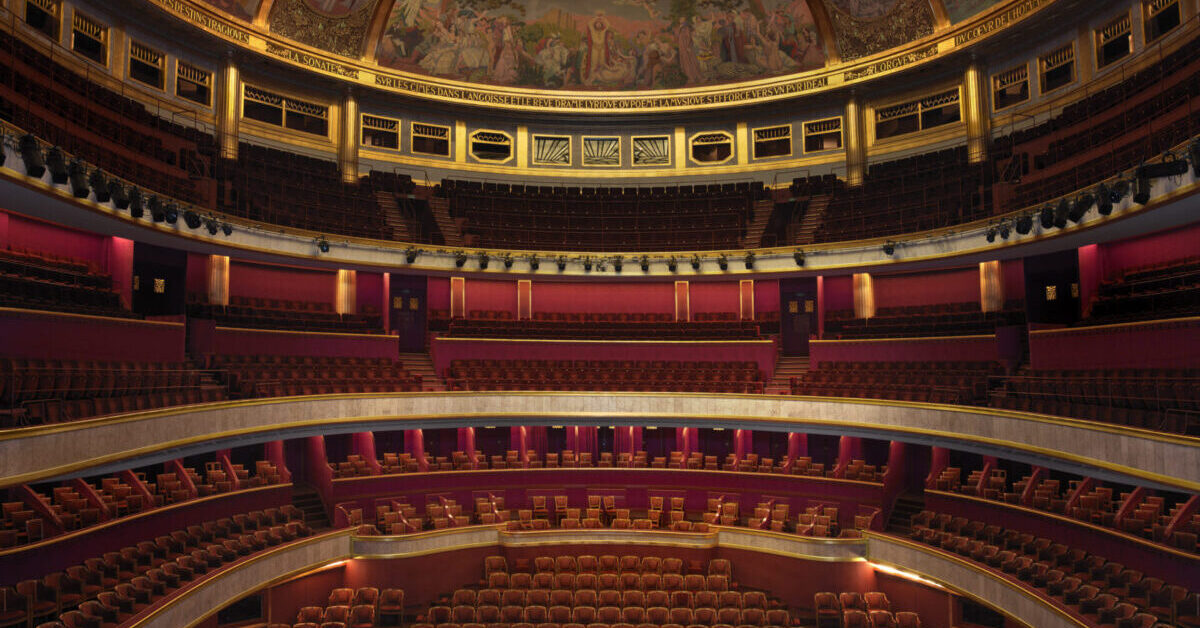
At the theater’s heart is a feast for the eyes as well as the ears: the newly restored glass-and-steel dome light with its rose-patterned center—unlike any other in the City of Light—mounted like a crown jewel in the ceiling. The commanding dome serves not only as lighting (now in alternating colors), but also to enhance the theater’s acoustics by diffusing sound to the dress circle and balconies. Encircling the dome is a spectacular 1200-foot canvas by Maurice Denis, who was tasked with illustrating the history of music in art.
5. A Wide Range of Styles

“The Théâtre des Champs-Élysées is like the Carnegie Hall of Europe,” says Marifé Hernández,, Co-Chair of the International Circle of the Théâtre des Champs-Élysées (a passionate group of patrons). “It’s the only theater that produces symphonic concerts, jazz, ballet, modern dance, staged opera, and opera in concert—all at the highest level.” Her Paris-based Co-Chair, Jean-Marc Daillance, adds: “It’s a magical place, with fantastic acoustics and a uniquely diverse program [performed by] the world’s most prestigious orchestras.” In fact, The Vienna Philharmonic has made “the house of music” its home in Paris.
6. Top Tier International Programming

The Théâtre des Champs-Élysées embraces both innovation and tradition. For example, we attended a memorable performance by renowned Polish breakdancing countertenor, Jakub Józef Orliński—timed to coincide with breakdancing’s debut at the Paris Olympics. Then there was a fresh and delightful staging of Mozart’s Magic Flute by director Cédric Klapisch (known for his films such as L’Auberge Espagnole).
In the 2025–2026 season, the theater will present over 80 performances, ranging from Mozart’s Requiem to Gounod’s Roméo et Juliette, Bellini’s Norma, and Offenbach’s Robinson Crusoe. The theater also offers an impressive selection of family-friendly programming.
7. A Location in the Heart of Paris

Ironically, the Théâtre des Champs-Élysées isn’t located on its namesake boulevard, but rather on the fashionable Avenue Montaigne. One popular explanation is that resentful Champs-Élysées business owners had the theater’s license to build there pulled. Undeterred, they relocated the building site, and achieved immediate success regardless. Perhaps as a gesture of proud defiance, or as a constant reminder to their nay-sayers, they decided to keep the name.
When stepping onto Avenue Montagne in the flow of exiting theater-goers still abuzz with the excitement of an extraordinary performance, look up. Chances are you’ll be greeted by the spectacular light show of the near-by Eiffel Tower, glittering with 20,000 blinking lights. Stroll one block over to the Pont de l’Alma, where midway across the Seine you’ll find one of the best photo-ops of Paris-by-night.
8. A Tight-Knit Theater-Loving Community

The Théâtre des Champs-Élysées is also a community, a great place to make new friends who share, among other things, a love of music. We’ve met so many interesting people, both French and international, many of whom have become TCE patrons (who get access to VIP events, cultural tours, meet-and-greets, and such). One really cool patron event is the Dîner Sur Scène (dinner on stage), a memorable music-filled meal prepared by a French celebrity chef, where guests are seated at elaborate tables alongside renowned artists who get up between courses and perform throughout the dinner.
9. Great Dining (and Drinking) Options

The theater offers snacks and drinks at the two balcony bars (with plans to expand the food and beverage experience, which will also be open for walk-ins from the public). The new Champagne Box, a six-seat loge where one can enjoy champagne and hors-d’œuvres, is a salute to the heyday of theatergoing of the past.
There are a number of good places nearby to meet before (or after) a show. Just a three-minute walk away is Le Bar des Théâtres, a favorite gathering place for the city’s performers, technicians, and theater-goers. This is an ideal spot to go after a show and immerse yourself in the authentic Paris theater scene. Looking like a 60s-inspired stage set, the Restaurant Monsieur Dior (in the Christian Dior boutique) sets the stage for a delightful pre-theater repast. The boutique’s garden cafe is pricy, but think of it as a reasonable price to pay for front row seats to the city’s best people-watching.
10. Access to Shopping Along Avenue Montaigne

Avenue Montaigne is the epicenter of luxury and fashion in Paris (with Chanel, Dior, YSL, Louis Vuitton, and Hôtel Plaza Athénée all in one place). Whether you’re binging or on a budget, window shopping the elaborate vitrines here is always fun, and during the holiday season the stunning window displays and street lighting are especially delightful. Two blocks away at 5 Place de l’Alma at La Pistacherie you can find countless scrumptious pistachio confections—grilled, spiced, sweet, in pastes, energy bars, and chocolate covered—making it an ideal stop for gifts.
Getting There
The Théâtre des Champs-Élysées is located at 15 Av. Montaigne in Paris’s 8th arrondissement. The theater is a half a block from the Alma Marceau metro station (number 9 line), and there are more bus routes than you can count on both hands within a four block radius.
For tickets and information: Théâtre des Champs Élysées
Philip Ruskin is an External Lecturer (ESSEC Bus. School), Consultant (food & travel marketing), writer, drummer and regular contributor to Frenchly. He loves to bike around his adopted hometown of Paris. Find him here, on Instagram. All photographs by the author, except where indicated.


