
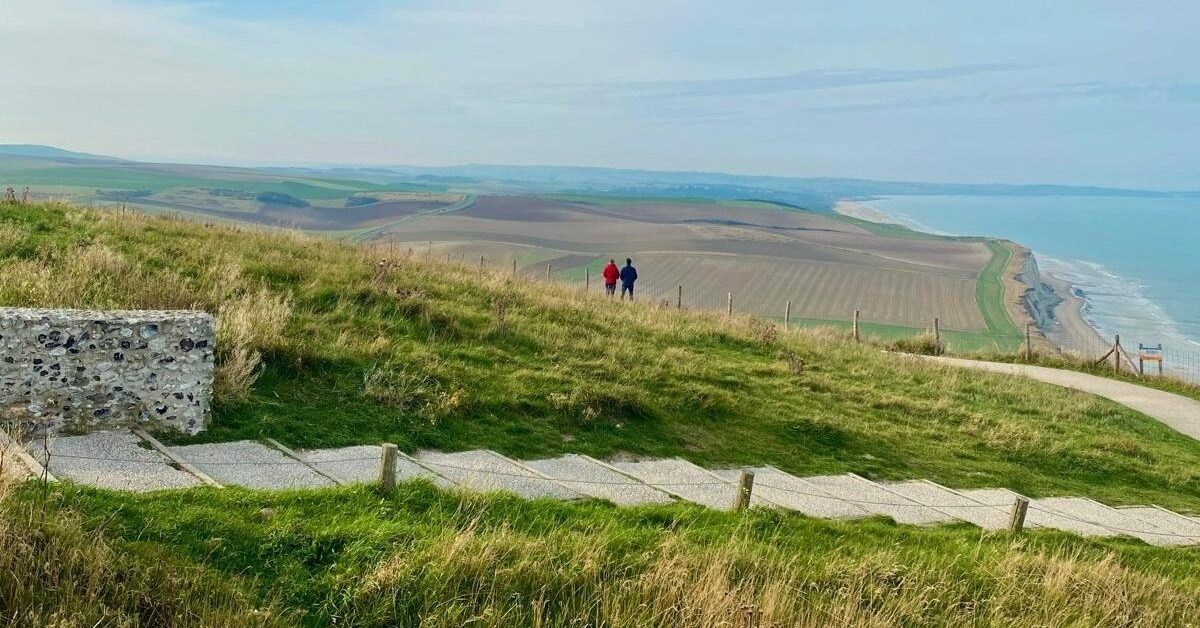
With its majestic fossil cliffs, the seaside town of Sangatte is one of the most striking natural landscapes in Northern France. Located about 61 miles (99 km) from Lille, it offers an ideal escape into nature during your stay in the Flemish city. Marked by war and the many attempts to connect France and England, Sangatte is a place where history, memory, and landscape constantly overlap. Welcome to this gem of the Opal Coast, the northern coastline named in 1911 by the painter Édouard Lévêque, who compared its ever-changing colors to the opal stone.
Take a stroll along the five-mile (8 km) stretch of fine sandy beach beneath Sangatte’s 2.6 million-year-old cliffs. On clear days, you can spot England across the Channel. Look carefully at the cliffs beside you and you’ll discover something just as fascinating: ancient fossils embedded in the rock, bearing witness to past fluctuations in sea level. This site is particularly appreciated by geographers, as it illustrates several thousands of years of natural evolution.

Long ago, France and England were connected by a chalk land bridge, which today would have linked Calais (just five miles from Sangatte) to Dover. Around 450,000 years ago, massive floods caused by the bursting of glacial lakes washed away this natural passage. The sea filled the valley, separating the two countries. This event shaped the white cliffs visible today on both the French and English coasts, two lands that remain deeply connected through a long and intertwined history.
Theirs is a history shaped by rivalry (such as during the Hundred Year’s War) but also by the aspiration to bring the two nations closer. This desire is visible in several ambitious attempts: the first Channel Tunnel projects launched from Sangatte in 1875 and again in 1974, and Louis Blériot’s pioneering flight across the Channel in 1909. Today, the beach in Sangatte bears his name, commemorating the moment a French aviator connected the two shores.

Let’s continue our walk along the coastline, and through time. Here, you can admire the remains of the Dover Patrol, a Franco-British naval force of 25,000 ships whose mission was to keep German vessels out of the Strait of Calais during World War I. Thanks to this patrol, British and French forces were able to coordinate freely, without enemy interference. A few months after the Armistice on November 11, 1918, a monument dedicated to the Dover Patrol was erected.
The Atlantic Wall
In 1940, during World War II, the Dover Patrol monument was destroyed by German troops who had occupied the Opal Coast. It was later rebuilt and inaugurated in 1962. It now stands at the Cap Blanc-Nez viewpoint, where you can feel the sea breeze on your face and hear the sounds of the seagulls above.

From this same period remain traces of shell impacts, marking the Atlantic Wall that Sangatte was part of. Ordered by Hitler, this vast defensive line extended along the coast to prevent any Allied landing. The bunkers and shell holes from Allied bombings are still visible today.
But Sangatte’s history does not end with World War II. The town returned to the spotlight in the early 2000s when it hosted a migrant camp run by the Red Cross, among other organizations. Hundreds of people hoping to reach England passed through this site, making Sangatte a point of political tension between France and the United Kingdom. The camp was eventually closed, but its memory remains part of the complex identity of this landscape.
A ‘Grand Site de France’
Today, Sangatte is part of the Grand Site de France des Deux-Caps, a protected area covering 7,500 hectares and 14 miles (23 km) of coastline.
“Grand Site de France” is a national label awarded to exceptional natural and cultural landscapes. It acknowledges beauty and guarantees preservation through sustainable tourism practices. The management plans limit the environmental impact of visitors, and protect historical features. Only 21 places in the entire country currently hold this label, according to the French government and the Grands Sites de France network, including La Rochelle and the volcanoes of Auvergne.

This shift toward sustainability marks a significant change compared to the 1990s, when Sangatte experienced its tourism peak: a vast parking lot dominated the landscape, and the site welcomed nearly two million visitors per year, according to Jean Scol, lecturer in physical, human, economic and regional geography at University of Lille. Since then, the goal has been to restore the environment, reduce pressure on the cliffs and dunes, and allow visitors to experience the coastline in a more respectful way.
Practical information: the site is accessible and free of charge all year round, and dogs are welcome.
Lison Mesnil is a French journalism student based in Lille, with a Bachelor’s degree in history. She also studied in Portland, Oregon, for nine months, where she developed a fondness for sharing her culture with Americans.


