France is home to nearly 2,000 cheeses, and most of the best-known, from Brie to Comté, are governed by the same system behind the well-known platitude that you can’t make Champagne outside of the Champagne region. The Appellation d’Origine labels, pioneered in 1924 by Châteauneuf-du-Pape, now govern nearly 400 wines, not to mention three butters, a handful of hams, and a lentil. And in the world of cheese, Roquefort was the pioneer of this system exactly 100 years ago.
This assertive sheep’s milk blue is nothing if not divisive. Its crumbly texture and bitter, sheepy funk led French philosopher and encyclopedist Diderot to dub it “the king of cheeses,” but many are put off by its strength, salt content, and trademark veins of blue Penicillium mold. But whether you love Roquefort or not, its Appellation d’Origine was undoubtedly a turning point in the history of French cheese. When it earned the AO designation on July 26, 1925, Roquefort cheese gained a unique legal status facilitating its protection in international treaties and even its export. And, perhaps most importantly, it cemented Roquefort’s identity, rooted in the unique terroir where it was born.
How Roquefort Cheese Earned its AOP Status
The history of Roquefort cheese far predates the 1920s; some trace it as far back as antiquity, others only to the 6th century. Either way, the cheese is inextricably linked to the village of Roquefort-sur-Soulzon, population 502, located in the heart of the rocky, windy Causses du Larzac, described as “the place where neither vines nor grains of wheat grow” in a royal decree passed by Charles VI in 1411.
For Sébastien Vignette, General Secretary of the Roquefort Confederation, the cheese is the stuff of legend—literally. One story recounts that it became Charlemagne’s favorite when the local bishop, aghast at seeing the emperor carving out all of the blue veins, exclaimed, “But my Lord! You’re taking out the best part!” Perhaps the most popular tale linked to Roquefort is that of a shepherd who took refuge in a cave high in the mountains to eat a bit of rye bread and soft curd cheese, only to become distracted by a local maiden. Upon returning to his snack several days later, he found it had gone moldy. Resigned to eating it anyway, he found it particularly delicious and resolved to recreate it again and again.
The reality is probably far less easy to summarize, according to Vignette. “No one can situate its origin precisely,” he says. “The only thing we’re fairly certain of is that there were written traces of it beginning in the 11th century, in tithes demanded of the villagers by the local lord.”
The cheese’s name appeared once more in a 15th century document forbidding the seizure of the cheese for payment of debts, and the 1666 judgment of Toulouse indicating that Roquefort wheels aged anywhere other than the cellars of Roquefort were counterfeit—a precursor to the protection ultimately granted in 1925.
For Vignette, the golden age of Roquefort cheese was undoubtedly the 19th century, when, thanks in part to the arrival of train transport in the 1870s, it became the “bourgeois cheese par excellence.” Producers pioneered techniques to ensure the cheese’s stability and consistency, such as wrapping it in foil to prevent over-aging. It was Antoine Roussel of the nearby Auvergne who invented the technique of piquage, a process of inserting needles into blue cheeses to guarantee them their blue-veined allure—a technique Roquefort producers quickly adopted.
But by the early 1920s, counterfeit Roquefort had become commonplace, with Corsican and even Danish versions appearing on the marketplace. Roquefort producers decided to band together and request a label protecting their heritage: a cheese made exclusively with the milk of Lacaune ewes, collected from farms in a 100-kilometer radius around the village and inoculated with Penicillium roqueforti, a blue mold cultivated on rye bread in the natural microclimate of the caves surrounding the village. It is in these natural cellars cut through with fissures known as fleurines that the cheeses are aged for a minimum of 14 days under the watchful, expert eye of dedicated chefs de cave, who maintain the ideal temperature and atmospheric pressure to coax the cheeses to perfect ripeness. These strict rules were adopted by the AOC that replaced the original AO in 1979, and finally by the AOP in 1996.
“These elements anchor the product,” says Vignette. “That’s what an AOP is: a territorial rootedness that gives a product its flavor identity.”

Roquefort Cheese Faces Tariffs
Protecting a product’s consistency naturally excludes some producers, and this was certainly the case with Roquefort. Before the AO, the cheese might have been produced with the milk of any animal, be it cow, goat, or sheep, depending on the producer and the season. The proviso that only Lacaune sheep’s milk be used literally bastardized other versions, relegated to aging in caves bâtardes. It wasn’t until 1953 that Bleu des Causses, the cow’s milk version of the same cheese, made in the same region, earned its own AOC.
Roquefort’s early protection also earned it distinction on the international stage, notably in the U.S., where it was imported beginning in 1860. “The history of Roquefort is quite linked by its exportation to the U.S.,” explains Vignette. “It was one of the products, like Champagne and Cognac, that became symbols of excellence in French gastronomy and agriculture.”
But its renown also made Roquefort the perfect poster child for punitive American tax policies. After more than 100 years of successful trade, 469 tons of Roquefort were being sold in the U.S. in 1999—the very year a devastating 100% sales tax was levied on the cheese following France’s refusal to accept hormone-laced American beef imports. There was even talk of a 300% tax during the Bush administration, which thankfully never materialized. In 2009, an accord was found with the Obama administration to dismantle the original tax, and in 2024, Roquefort exports to the U.S. had nearly reached their pre-tax volumes.
Roquefort’s presence on the American market was also a boon for cheese lovers, when, in 1948, the FDA was on the brink of outlawing all raw milk imports. It was industrial producers of Roquefort who called in the experts to testify that two months’ aging could ensure the safety of the product. It’s thanks to this effort that Americans today have access to raw milk Comté, Parmiggiano Reggiano, and, of course, Roquefort.
The Roquefort AOP Today
Today, over 14,000 tons of Roquefort are made each year, making it the third-most-produced AOP cheese in France. It’s also one of France’s most well-travelled cheeses, with over a quarter of its production exported to 120 countries around the world.
Most of that cheese is produced by Société, a company founded in 1842 by a group of local agers and resellers, uniting cheesemakers and dairy farmers alike. The company was purchased by Lactalis in 1992; today, it produces 52% of all Roquefort and is the largest employer in southern Aveyron, with about 1,000 locals directly employed by the company, not to mention the 900 local sheep farms with which it works to source its milk. Lactalis has invested significant research and development into the local sector, notably with the development of Cave Saveurs, a type of plastic box often seen in the cheese aisle in French supermarkets, which serves to keep the delicate cheese perfectly conserved in the fridge.
The presence of large industrial groups like Lactalis is an essential element contributing to the continued popularity of Roquefort, both in France and abroad. But the presence of large industrial groups has also significantly consolidated Roquefort production. While in the 1930s, according to Kathe Lison, author of The Whole Fromage, there were still 800 dairies making Roquefort, today, there are just seven. Alongside Lactalis, the other two major players are the agro-industrial company Sodiaal, the group behind the La Pastourelle brand; and Savencia, which owns Papillon. The four smaller producers share what’s left of the pie (or, should I say, wheel).

The Best Types of Roquefort Cheese
Each Roquefort has its own personality, a quirk born of the fact that every producer cultivates their own strains of Penicillium roqueforti. Lactalis alone produces four different Roqueforts, each named for one of the company’s cellars. The Baragnaudes is a bit creamier, with a stronger, sheepy flavor and paler veins; the Templiers, meanwhile, is so powerful it rarely makes it out of the region. The classic 1863 Caves Abeille Roquefort is the most balanced of the lot. “It’s really going to have a lot of nuance,” says Anne-Julia Goutte, Markering Director of Lactalis AOP & Terroirs. “The texture on the knife, and on the palate. And of course the taste.”
The newest arrival is Société Douceur, released this past April, after three years of research and development. It’s lower in salt than its siblings and has a less pronounced flavor and an even creamier texture.
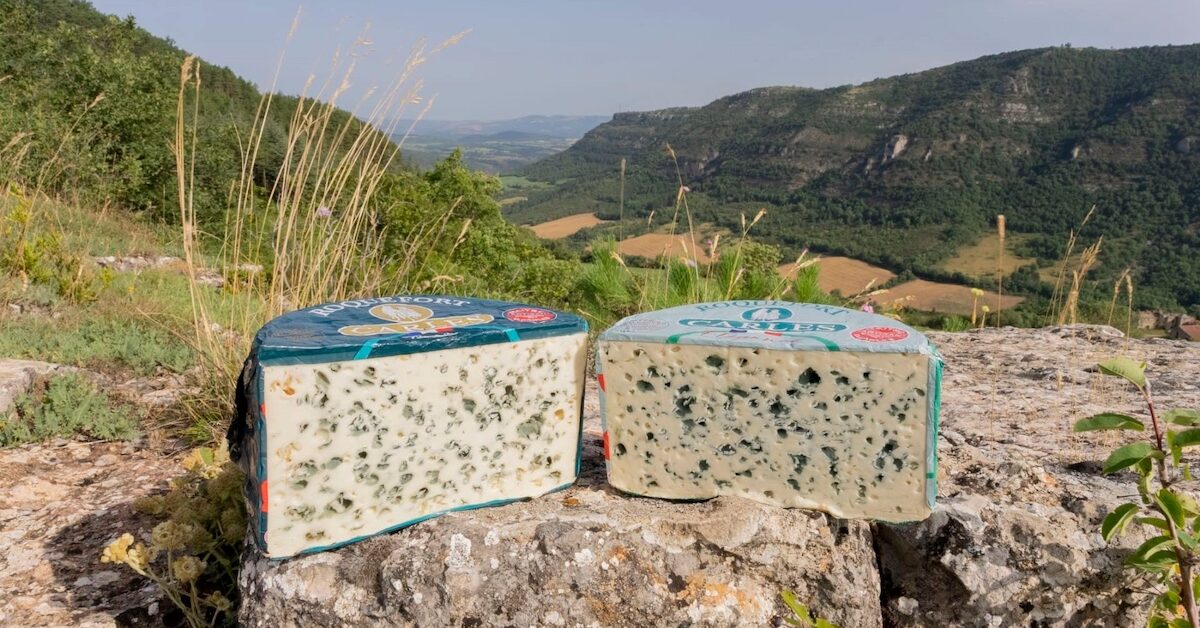
But while the Penicillium lending each cheese its unique flavor may have originally come from an ancestral cellar, most industrial producers take advantage of lab processing to create an easy-to-use liquid version of the mold. The outlier is Carles, which makes just 1% of the entire Roquefort production according to time-tested tradition.
First, the milk is collected from a dozen-or-so local dairy farmers. “We only work with the milk from that day,” says third-generation producer Delphine Carles, “and that changes a lot, because milk is a living thing.” By working with raw, fresh milk, barely any starter cultures are needed, and since the curd must be soft enough for her team to cut it by hand, the resulting cheese is suppler, crumblier, and far lower in acidity than most, allowing the core ingredients of the cheese—sheep’s milk and Penicillium roqueforti—to shine.
The Penicillium itself is cultivated in her cellar on rye-wheat loaves made according to her grandfather’s time-tested recipe, and baked in wood-burning ovens until they develop a thick crust and a tender crumb, the perfect breeding ground for the flavorsome blue mold. When the entirety of the bread has been devoured, it’s cut, dried, and reduced to a powder that’s sprinkled directly on the curd. The cheeses are then formed into wheels, drained, and pierced to create the pockets for veining to form. Finally, they’re aged on pine shelves in natural cellars until they’re ready to be sold and enjoyed.
These artisan techniques understandably make Carles’ Roquefort more expensive than most. It’s for this reason that Carles doesn’t see the industrial producers as a threat.
“Our clientele is high-end,” she says. “It’s specialist cheesemongers, high-end markets, and Michelin-starred restaurants.” It stands out from less expensive, industrial Roquefort, which is sold at supermarkets at a far lower price point. More irksome, she says, are smaller producers who claim they’re working according to traditional methods but are taking shortcuts, like aging on plastic or using liquid Penicillium and displaying mold-riddled rye breads just for show.
“It’s not artisanal. They’re playing with the words,” she says. “They say they’re family-run, but if you go that way, you could say Lactalis is family-run. There’s two of them—a brother and a sister. That’s a family.”

Roquefort Will Always Be A French Icon
Several weeks before Roquefort’s official birthday, on the weekend of June 7th, the village of Roquefort-sur-Soulzon will come together in a celebration of its long history, complete with visits of the famous aging cellars, street concerts, and loads of Roquefort to taste. Carles plans to dress as Red Riding Hood in an ode to Roquefort Chaperon Rouge, which her product was called before it eventually took on the family name. And of course, there will be chefs. After all, according to both Goutte and Vignette, recipes are the best way to bring Roquefort into the kitchens of younger consumers.
According to Goutte, despite significant investments in advertising, Roquefort consumption continues to decline in France, where younger consumers have all but abandoned the traditional French cheese course, and tend to shy away from the intensity of Roquefort. In collaborating with both social media influencers and top chefs like Michelin-starred Sébastien Bras or Nina Métayer, International Union of Bakers’ 2023 World’s Best Pastry Chef, producers hope to tap into a long tradition.
“Historically, it was used a lot to make Roquefort sauces,” says Goutte, noting that with the rise of milder cow’s milk blues in the 20th century, the sheep’s milk blue lost its starring role. “Our desire, in the short term, is to bring back these culinary uses.”
For Carles, an even simpler initiation is perhaps the better way to go. “Children love Roquefort,” she asserts. “It’s parents who go, ‘Oh, no, he won’t like that.’ But when kids try it, they love it.”
Whatever one’s path to discovery, one thing is certain: A century after its official protection, Roquefort’s prestige remains indelibly linked to its Appellation. “It’s a great source of pride,” says Vignette.“People see the AOP, today—and they’re not wrong—as a means of protection, defending the product and its name,” he continues. “But that’s just the consequence. Because above all, it’s a promise of authenticity, of savoir-faire, and of the passing on, too, of this savoir-faire. It allows us to transmit and to preserve this diversity of flavors. And all of that is linked to a rootedness in this terroir. In other words: Roquefort cannot be produced anywhere else, or any other way than the way that’s outlined in its cahier des charges, and that’s what gives it its identity.”