
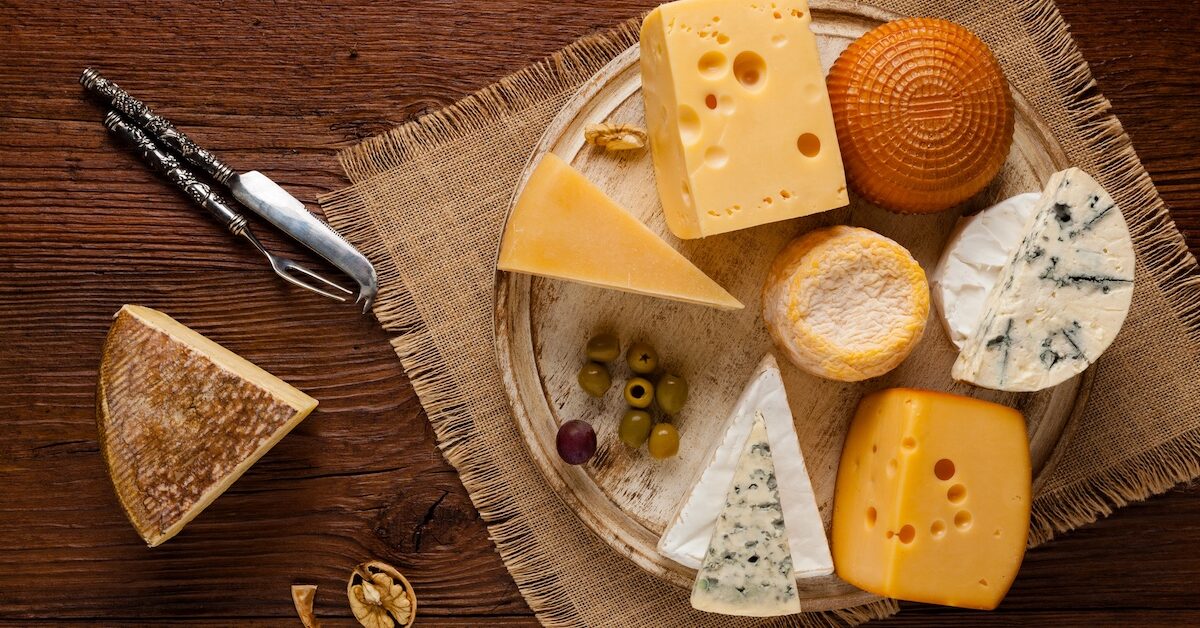
From the succulence of a summer tomato, to the brightness of spring peas, from the slight sweetness of autumn’s pumpkins to the heartiness of winter crucifers, there’s perhaps nothing more satisfying than eating with the seasons. But did you know that seasonality doesn’t just affect produce? Cheese has a season too, and in France, home to hundreds of varieties, you could easily try a new seasonal specialty every day of the year. Here’s how to put together the perfect French cheese plate, no matter what time of the year it is.
Seasonal French Cheeses for Spring

Spring is a time of rebirth. Once-fallow pastures explode in a bounty of green grass and flavorful flowers, and new calves, kids, and lambs are born across the Hexagon. And while fresh cheese can be made with the milk of any animal, in France, spring is synonymous with chèvre, with its creamy texture and fresh, floral flavor punctuated by a barnyard twang.
The seasonality of goat cheese doesn’t just come down to its flavor. Unlike cows, which can ovulate at any time of year, goats typically only breed in-season, between August and March, unless incited to do so artificially. But in spring, there’s no forcing required, so fresh goat cheeses like Mothais-sur-Feuille from the Loire Valley or nutty Rocamadour from the southern Lot are at their peak.
If you’re not a goat cheese fan, however, spring cheese boards are also primed to welcome other delicacies. The richness of the newly-grown pastures suffuses the milk of grazing animals with even more flavor, so there’s more aromatic potential for bloomy-rinded cow’s milk cheeses like Brie and Chaource. By late spring, these cheeses, typically known for their rich texture and muted flavor profile, exhibit lovely mushroomy notes and balanced acidity.
The Perfect French Spring Cheese Board
You’ll need a fresh goat’s milk cheese like Rouelle du Tarn from the South of France, with a dense, creamy interior surrounded by a runny layer naturally redolent with fresh herbs like thyme, rosemary, and lavender. Add in a fresh ewe’s milk cheese, such as Berrichon from the Loire Valley, known for its fluffy, almost marshmallowy texture. (In Paris’s Montmartre, expert ager Chez Virginie bedecks hers with beautiful fresh flowers for a pop of color and a lovely floral note.) Finish with a mushroomy double-cream P’tit Saint-Faron from the Brie region, whose buttery, lactic flavor pairs perfectly with spring garlic pesto.
Seasonal French Cheeses for Summer

Fresh goat cheeses continue to be delicious in summer, and given their lightness in both flavor and texture, it’s understandable that chèvre remains a go-to. But the warmer months can also be the prime time to explore some other regional delicacies that were made with herbaceous, full-flavored spring milk, and have since had ample time to ripen to perfection. Three-month-old semi-soft cheeses like Auvergnat Saint-Nectaire are at their peak in late summer. The same goes for the Basque sheep’s milk cheese Ossau-Iraty, which at three to four months begs to be paired with jammy black cherries.
Speaking of which: While the French don’t tend to get too maximalist with their cheese boards, seasonal summer fruit can also guide you to some great options. Figs, for example, are perfectly paired with the salty pungency of blue cheese, and floral cantaloupe is a natural with saltier chèvres like firm-textured Charolais.
The Perfect French Summer Cheese Board
Start with 120-day-aged Morbier, a pressed-and-uncooked cheese from the Jura with a distinctive line of ash down the middle. This semi-soft cheese boasts a nutty, lactic flavor and slight funk. Then, some Ossau-Iraty, a pressed ewe’s milk cheese from the Basque region, paired with black cherries or black cherry jam to balance its slightly salty character. Finally, add in some Roquefort, a blue ewe’s milk cheese from the Aveyron with a slight bitter edge and a pronounced saltiness, best served with fresh figs.
Seasonal French Cheeses for Fall

When the dog days of summer have come to a close, it’s time for the regain. This brief period of regrowth following the first seasonal rains brings pastures to their densest and most aromatic, lending even more intensity to personality-driven soft cheeses. Because of this, bloomy-rinded Camembert and Brie, aged between two and twelve weeks, are at the peak of perfection in autumn, boasting heady, mushroomy aromas that echo the flavors of fall produce.
Washed-rind Époisses and Livarot boast odiferous rinds of the exact color of the season’s burnished leaves. And no matter which soft cheeses you choose, given the season’s cooler temperatures, they’re sure to be oozy and soft without transforming into puddles on the plate.
The Perfect French Fall Cheese Board
Bring on some bloomy-rinded Coulommiers, a cow’s milk cheese from the Brie region, with its oozy texture and flavors of mushroom, roasted root vegetables, and nutty cauliflower. A washed-rind Époisses, a cow’s milk cheese from Burgundy with a tacky orange rind and a meaty, fruity flavor, is also sure to be welcome. And to switch things up, add a goat’s milk Crottin de Chavignol, smoked in-house at Quatrehomme in Paris to marry the chèvre’s caprine notes with an evocation of cozy wood fires. Pair it with a few apple slices or a bunch of black grapes.
Seasonal French Cheeses for Winter

Winter is the time to dig into the fruits of the summer’s labors: After 18 long months of aging in cellars, pressed mountain cheeses like Comté and Beaufort are at the pinnacle of fruity, nutty perfection.
But while it’s easy to applaud the rich, grassy flavors of cheeses made at the height of summer, don’t turn your nose up at winter milk, which is naturally richer in fat due to a variety of factors including the change in the animals’ diet. Three-month-old Raclette, for example, is at its best in winter, and locals in both Switzerland and France enjoy melting the rich cheese and scraping it over piles of potatoes and charcuterie.
Mont d’Or, however, may be the king of winter cheeses. This cow’s milk creation is lightly washed for a touch of funk, and is aged wrapped in spruce bark, which lends the cheese a woodsy character. Its AOP only allows for the cheese to be made from August 15 to March 15—and sold from September 10 to May 10—but it’s best enjoyed in winter, when locals in the know stud it with garlic, drizzle it with white wine, and bake it until it’s melty enough to be spooned over potatoes and veg.
Aside from cheeses intended to be eaten hot, the winter holidays pave the way for a host of luxe dairy delicacies perfect for the holidays. Seek out special ultra-aged Comtés or truffle-infused Brie to lend special-occasion flair to every board.
The Perfect French Winter Cheese Board
Comté aged for 18 months is perfect in winter, as the grassiness of the summer milk is balanced by the nuttiness lent by aging. The very best 18-month-old Comtés will be studded here and there with tyrosine crystals, which explode in a crunchy firework of pure umami with every bite. For a little luxury, triple-cream Brillat-Savarin is the perfect buttery blank canvas for black truffles. Some cheesemongers will split the bloomy-rinded cheese down the middle and sandwich it around a mix of truffle and mascarpone for a creation perfectly paired with Champagne. There’s also Manigodine, a unique creation from Savoyard affineur François Paccard. The agers take a page out of the books of their Comtois neighbors, wrapping a massive Reblochon in spruce bark, which serves as a woodsy corset for the gooey, rich final product.
Emily Monaco is a journalist, international cheese judge, and culinary tour guide based in Paris. Her writing has appeared in the BBC, Saveur, Food & Wine, and the Infatuation. Find her writing and musings on life and food in France in her newsletter, Emily in France.


