
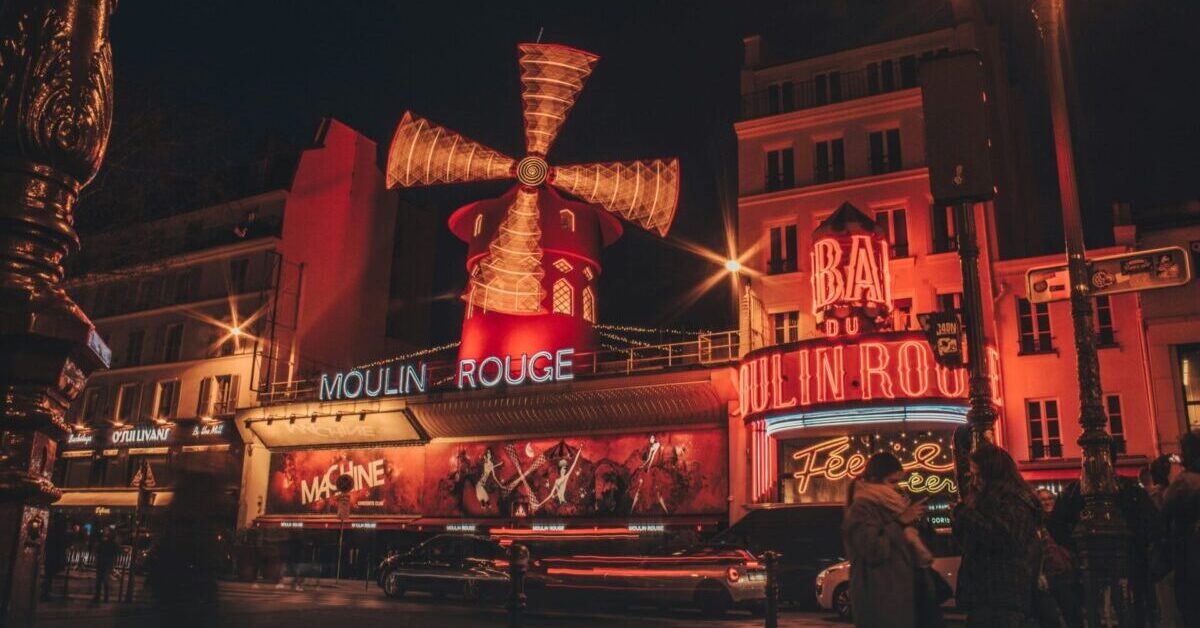
Pigalle has always felt like it exists entirely under neon lights. It’s where Paris lets its guard down—where cabaret, sex shops, and late nights have long defined its reputation, equal parts spectacle and survival. For decades, it was the city’s most visible encapsulation of excess, a place many Parisians passed through with blinders on, or avoided altogether.
What’s shifted over the past decade isn’t so much a transformation as a recalibration. Pigalle was never cleaned up, not really. The neon still hums, the sidewalks still feel slightly chaotic after dark, and the energy hasn’t softened. But layered into that is a different rhythm, driven by natural wine bars, independent boutiques, and a restaurant scene that’s become one of the most exciting in the city.
And then, almost abruptly, the quartier changes. A turn off the main streets, a staircase you nearly miss, and the neighborhood gives way to something else entirely—the lower edge of Montmartre. Here, Pigalle dissolves into the village above it: cobblestoned streets, pastel houses, pockets of greenery, and a stillness that feels almost out of place this close to the boulevard. The buzz gives way to the quiet brushstrokes of artists with their easels set up in the open air. No neon—just a calmer, older rhythm up on the hill. It’s this proximity, this constant shift between intensity and calm, that defines Pigalle today.
Things to Do in Pigalle
When in Pigalle, start with the obvious, but don’t stop there. The stretch around the Moulin Rouge and Boulevard de Clichy is loud, crowded, and exactly what you expect—but it’s only the top layer. Look up at the façades, step onto the side streets, and notice how quickly the energy shifts. Pigalle reveals itself in fragments.

Enjoy the Nightlife
Pigalle’s identity has long been tied to nightlife, but it wasn’t created overnight. In the late 19th century, the neighborhood began to take shape as a center of entertainment, anchored by places like the Moulin Rouge, which opened in 1889. The cabaret drew a mix of locals, artists, and visitors, and helped establish Pigalle as a place where performance and everyday life overlapped. Artists like Henri de Toulouse-Lautrec documented this world in a way that still informs how the area is perceived today. Its location at the base of Montmartre also played a role. Pigalle naturally became an extension of the artistic community uphill, with people moving between studios, cafés, and nightlife venues, creating a neighborhood that felt active at all hours.
Today, Pigalle is one of the few places in Paris where the night still feels local and doesn’t always require a cover. It doesn’t begin at a fixed hour and rarely follows a plan—apéros stretch, people stay, and one place folds into the next. Most nights start simply, with a glass at a local bar, but can end anywhere from a dive bar to a drag cabaret.
Nightlife is everywhere in Pigalle. Le Carmen draws a mixed crowd into its ornate, slightly surreal interior and great vibes. Set in a historic mansion once owned by Georges Bizet, this is one of Pigalle’s more dramatic nightlife spaces. Not far away, Madame Arthur carries Pigalle’s cabaret tradition forward in a way that still feels rooted in the neighborhood with live music, drag, piano, and a room that doesn’t take itself too seriously. For something more low-key, Le Mansart sits on the edge of Pigalle with a steady, local crowd and a promise of a good time. Nearby, Chez Moune, once a women-only cabaret, is the spot for a nightcap.
See a Show (At Least Once)
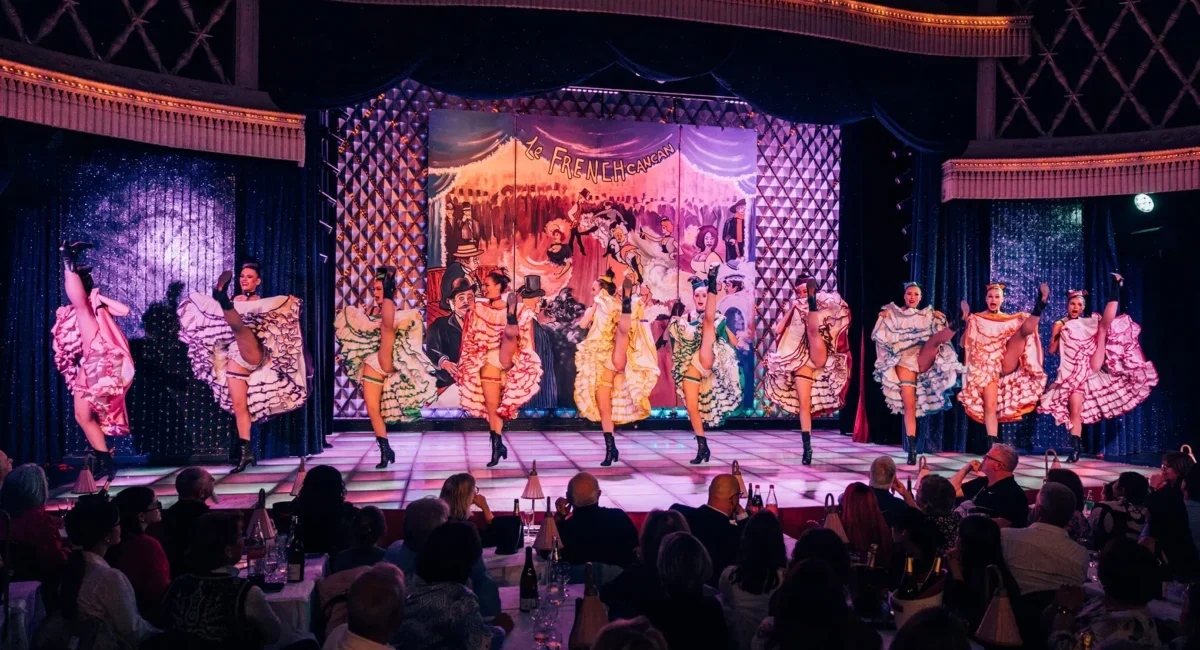
Pigalle’s performance culture hasn’t disappeared; it’s just more layered now. The Moulin Rouge is still the neighborhood’s most recognizable landmark, but smaller cabarets and theaters around the area offer something a bit less formal.
- Théâtre Le Bout sits right in the heart of Pigalle and is known for its compact size and improvisational comedy. It is actually one of the oldest small comedy venues in the city, with a focus on emerging talent and stand-up.
- Nearby, Théâtre de Dix Heures has a long-standing reputation for comedy programming in an intimate and understated setting, perfect for a first date.
- For something even more pared back, La Petite Loge is one of Paris’s smallest theaters, more a room than a venue, with a sharp eye for future stand-up talent. For just €20, you might just be one of the first people to discover a promising new comedian.
- A little further up toward Montmartre, La Manufacture des Abbesses offers a more contemporary, independent program, focused on new writing and smaller productions that feel connected to the city’s current creative scene. You can watch musicals, performances, and even comedy shows here.
- La Nouvelle Ève offers a classic cabaret experience—think Moulin Rouge, but much more earnest and intimate. Opened in 1898, the Belle Époque theater has evolved through decades of historic performances, like Paris’ first nude review, and now hosts polished cancan shows in a historic, cinematic setting.
- Madame Arthur, founded in 1946, is a Pigalle institution known for its iconic cabaret. Under the direction of the legendary drag queen Michou for decades, it became a defining space for Parisian drag.
Walk the Red-Light Strip
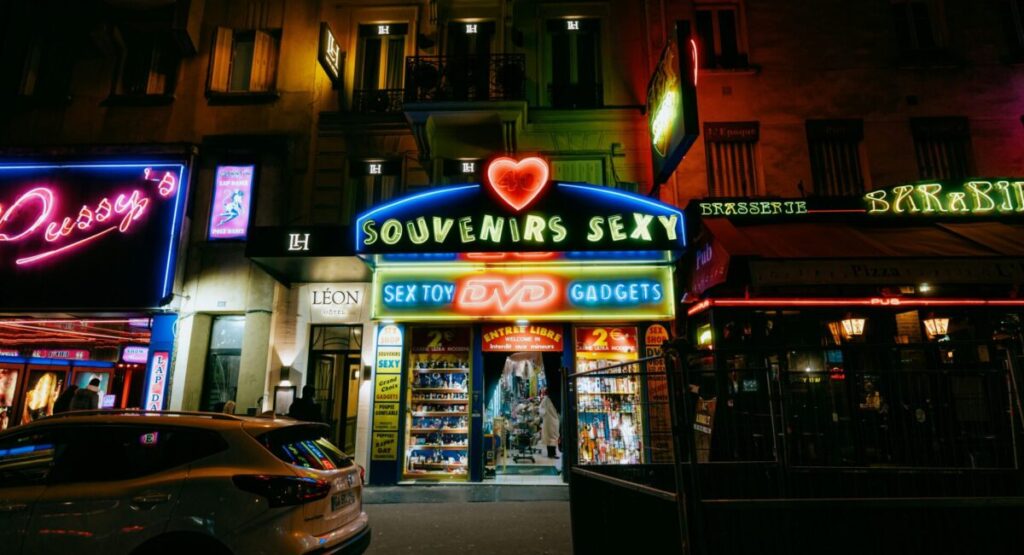
Boulevard de Clichy is still the spine of Pigalle’s red-light identity, and it’s worth experiencing with a bit of curiosity. The strip is lined with sex shops, neon-lit façades, and storefronts that haven’t changed much in decades—some almost frozen in time, others slightly updated but still unmistakably part of the same ecosystem.
You’ll find everything from old-school boutiques with window displays that feel intentionally retro, to more contemporary, design-forward stores that approach sexuality with a different lens. It’s not about going in with a plan—step inside one or two, see what’s there, and move on.
- You’ll pass places like Sexodrome, one of the largest and most visible stores on the boulevard, known for its scale and theatrical displays.
- Clara Morgane Store feels slightly more polished, with a curated approach to lingerie and accessories, while Toys Palace and Toys Star lean more into the classic Pigalle format—bright windows, kinky lingerie, and stacked inventory.
- Souvenirs Sexy sits somewhere in between, stocked with its novelties and souvenirs, very much in line with the area’s visual language.
Slip Behind the Gates
Pigalle holds onto one of Paris’s quietest contradictions: Avenue Frochot. Marked by a discreet gate and voie privée signage, this hidden street conceals a cluster of historic villas, wisteria-covered facades, and an almost surreal stillness just steps from the chaos. You can’t really enter, but even catching a glimpse through the gate is enough. It’s a reminder that Pigalle has always had a second life—one that exists just out of reach.

Follow the Music
Pigalle has long been tied to music, and that still holds. Stores like Balades Sonores continue that legacy, mixing new releases with deep cuts and a loyal local crowd. A few steps away, Superfly Records leans more niche, known for funk, soul, and rare grooves.
Spend Time Around Place Saint-Georges
A few minutes away, Place Saint-Georges offers a clear contrast to Pigalle’s pace. Residential, understated, and slightly removed, it’s the kind of square where you feel the shift immediately. Café Saint-Georges sits right on the square, a classic, unfussy café where you can sit outside and watch the neighborhood move at its own speed.

Restaurants in Pigalle
Previously, Pigalle couldn’t rely on its cuisine, but in recent years it has become one of Paris’s most compelling places to eat—not in a polished, destination-driven way, but in how naturally good restaurants fit into the neighborhood’s daily life.
Le Pantruche: A Pigalle classic, known for precise, seasonal French cooking that feels elevated but never overworked. The room is lively, local, and consistently full.
Les Canailles: Old-school bistro energy with a sharper edge, known for generous plates, strong sauces, and a convivial atmosphere.
Django: A warm, lively restaurant near Moulin Rouge serving Mediterranean-inspired cuisine built for sharing, in a former guitar shop that still feels very tied to old Pigalle.
Pink Mamma: Big, theatrical, and always busy, but still one of the area’s most reliable spots for Italian comfort food in a dramatic setting.
Bouillon Pigalle: The go-to for classic French dishes at accessible prices. It’s fast-moving, doesn’t take reservations, and there’s always a line, but part of the appeal is how efficiently it all works.
Le Richer: A modern bistro that helped define the broader area’s restaurant scene, with seasonal, market-driven cooking and relaxed, trendy vibes.
Frenchie Pigalle: A more casual address from the Frenchie group, focused on shared plates and a lively dinner atmosphere.
Luz Verde: Who doesn’t want tacos? A more contemporary addition with a lighter, produce-forward approach and a room that stays easy and relaxed.

Bars, Cafes & Bakeries in Pigalle
KB Coffee Roasters: One of the anchors of Pigalle’s coffee scene, known for its terrace, steady crowd, and reliably good espresso. It’s busy, but that’s part of the appeal.
Noir Coffee Shop: A more minimal, design-forward option with a slow pace and a strong focus on quality coffee.
Buvette: Small, always full, and built for lingering. Coffee in the morning turns into wine by the evening, without much transition in between.
Dirty Dick: A cult cocktail bar with a tropical lean that never feels gimmicky. Dark, loud, and very Pigalle after dark.
Glass: Low-lit and fast-paced, known for serious cocktails and a crowd that knows what it’s doing. No reservations, no fuss. Inside Le Pigalle hotel.
Maison Souquet Bar: More intimate and quietly opulent, set inside a former maison close. Velvet, low lighting, and cocktails that lean classic rather than experimental.
Mamiche: A neighborhood favorite for pastries and bread, with lines out the door and a reputation that’s entirely deserved.

Where to Stay in Pigalle
Hôtel Hoy
The Mexican-founded Hotel Hoy in Paris is located just off Pigalle. It brings together a yoga studio—House of Yoga, as the name suggests (and fittingly, hoy means “today” in Spanish)—alongside plant-filled interiors and a fully vegan restaurant, creating a space that feels intentional but still lived-in. Rooms are minimal and calming, designed for rest, and the atmosphere carries a softer, more grounded energy than much of the surrounding neighborhood.
Le Pigalle
Le Pigalle is a classic for a reason. It feels like a direct extension of the neighborhood itself—unpolished in the right ways, but deeply considered underneath. Built around the idea of locality, much of what you see inside comes from Pigalle: books, objects, music, even the stories woven into each room. Some feature freestanding tubs that make them feel more like someone’s apartment than a hotel stay.
Hôtel de Rochechouart
Hôtel Rochechouart, part of Orso Group hotels, sits right on the edge of Pigalle, with a slightly more structured, old-school Parisian feel that still nods to the neighborhood’s energy. Housed in a 1920s building, it leans into its Art Deco roots with clean lines and warm tones. Rooms are simple but well-proportioned, some with balconies looking out over Montmartre. The real draw is upstairs, where the rooftop opens onto wide views of the city.
Airbnbs in Pigalle
While Airbnb options in Paris are still widely available, stricter regulations in recent years have made them rarer—and noticeably more expensive. Prices now often sit close to those of hotels, but the trade-off can be worth it: more space, a kitchen, and the feeling of living, even briefly, like a local. In Pigalle, the range is surprisingly broad. You can rent something as unique as Georges Braque’s Studio—a former 1911 artist’s loft with 13-foot ceilings and a quiet courtyard entrance—for around $190 a night. A quaint one-bedroom between Pigalle and Montmartre, near Rue des Martyrs, averages closer to $160, while a more elevated, design-forward apartment with Eiffel Tower views can reach $240 or more. It ultimately depends on how you want to experience the neighborhood.

How to Get to Pigalle
Located between the 9th and 18th arrondissements at the base of Montmartre, how you arrive in Pigalle shapes how you experience it. The most direct entry is Pigalle Metro Station (Lines 2 and 12), which places you right into the center of it all—steps from Boulevard de Clichy, with the neighborhood unfolding in every direction. If you want to arrive at something a bit calmer, Saint-Georges Metro Station (Line 12) brings you in from a more residential side, closer to quieter streets and cafés.For a slightly more elevated, Montmartre-adjacent entry, Abbesses Metro Station (Line 12) drops you uphill, where you can walk down into Pigalle through smaller streets and staircases. Alternatively, Blanche Metro Station (Line 2) places you right by the Moulin Rouge—arguably the most immediate entry point.
Angelika Pokovba is a writer and longtime Francophile originally from NYC, now based in Mexico. She’s into food, wine, skincare, and all things French—especially summers in the South and pharmacy finds she stocks up on way too early


