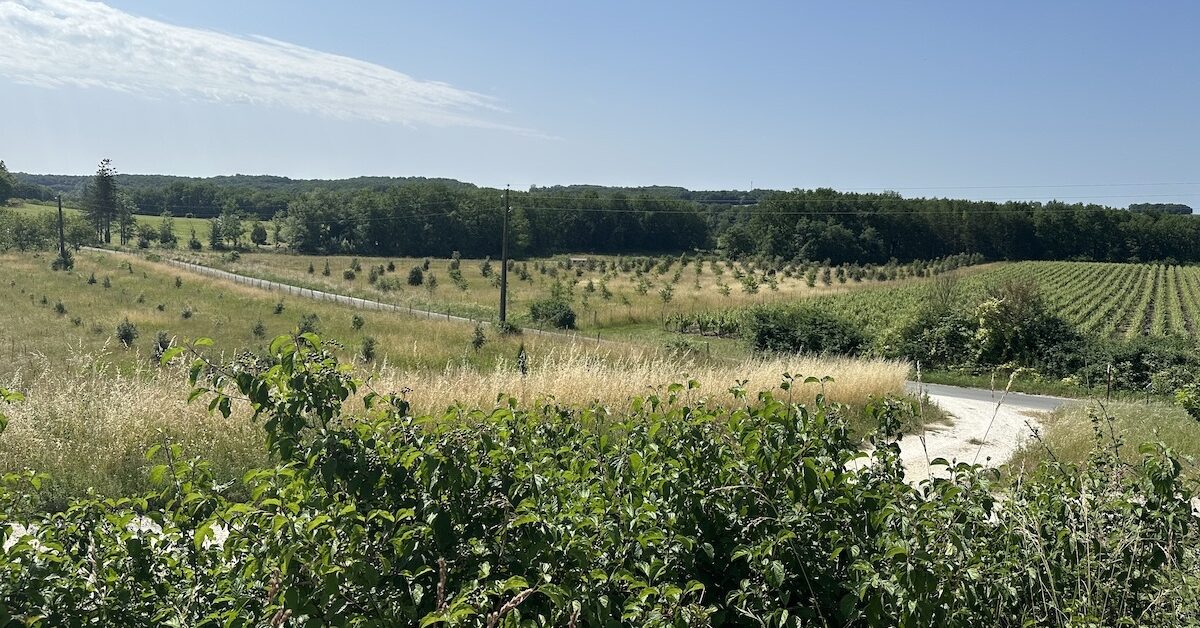
Visiting the Dordogne region of southwestern France is like taking a step back in time—not in terms of its historic châteaux and tiny medieval villages (of which there are many), but in terms of the attitude with which its inhabitants approach life. This is farm country, where an intermingling of truffle-studded woods and sloping vineyards can stretch on for miles before you encounter so much as an old windmill. The towns themselves are often no more than a few half-timbered houses clustered around a one-room mairie.
And this is exactly what the local Périgordins, who take their moniker from the region’s ancient name, Périgord, love about their home. They have no interest in big city life, the nearest “big city” being tony Bordeaux, with its scant quarter-million population. They live for springtime’s fresh strawberries, and the village festivals that pepper the summer season. When the days get too hot, they cool off with a dip in the Dordogne River, one of the cleanest in France thanks to its designation as a UNESCO Biosphere Reserve.
There is a unique connection to the land in the Dordogne, one which has been preserved over hundreds of years, passed from generation to generation of farmers, vintners, and local artisans. Périgordins know that the land can provide them with everything they need to care for it and themselves, which is why this corner of France has become known as both a haven for gastronomes, and a poster child for sustainable agriculture. Duck, foie gras, truffles, and other rich culinary treasures are served alongside Bergerac wines made using both traditional savoir-faire and innovative practices, which showcase local terroir while making sure the land will survive and thrive in a changing climate.
Making Organic Wines in Bergerac

More than a third of the region’s vineyards are certified organic, or are in the conversion process, and nearly three-quarters of them have obtained Haute Valeur Environnementale certification. “Biodynamie is adapted to the place you are,” explains Margaret Delbeke, the Responsable Administrative & Commercial for Château Monestier La Tour. At this organic vineyard, vines are treated not with pesticides, but with natural teas made with various plants. Willow and valerian, which naturally contain salicylic acid, are used to treat vines for early frost, while horsetail fights mildew and antioxidant-rich nettles are used as fertilizer. An entire tisanerie of these plants are grown on-site, so that every change in the weather or environment can be treated immediately. Meanwhile silica powder, made from the ground up horns of neighboring cows, is spread across fields at the end of the day to attract light and improve photosynthesis.

“The main thing in Dordogne is the respect of nature… I grew up in Périgueux, and we were used to dealing with nature,” Delbeke tells me, referencing the iconic novel Jacquou le Croquant, which takes place in the region and focuses on a young peasant’s revolt against a corrupt nobleman during the Bourbon Restoration. “They were poor, but they did with what they had.”
Going Back to the Land in Périgord
This agricultural legacy has resulted in a region untouched by the heavy industry of other parts of France, including nearby Bordeaux. At Domaine Albert de Conti, winemaker Guillaume de Conti describes the ideal Bergerac customer as, “People who like adventure, who don’t want to be on the highway, but want to go down little paths.” He recalls the way his grandparents made nearly everything they needed on the farm, rarely purchasing anything aside from a bit of beer or coffee. And while he might outsource a few more things these days, he still prefers natural approaches when possible, using ecological materials like giant sandstone amphoras. “I like to work with something sensual,” he says. “It’s not like stainless steel. It’s from the earth.”

Just a couple miles away, Guillaume’s cousin Margaux de Conti lets the land speak for itself at Château Tour des Gendres. Everything here works in symbiosis, with the vines bordered by oak and hazelnut trees planted to encourage truffle growth, around which the grass is allowed to grow long, so that birds will nest there and eat pesky bugs that might go after the precious vines—a necessity in an organic vineyard.
Luckily, the region seems tailor-made for organic farming thanks to its continental climate, in which heavy moisture, which can lead to fungal infections of vines, is less of a concern than in nearby Bordeaux. There is also a stronger focus on permaculture, which makes vineyards more sustainable by increasing water retention and reducing erosion, among other benefits. Yet near-identical terroir means that Bergerac can produce fantastic wines on par with its more-recognizable neighbor—after all, the same limestone vein that runs through St. Émilion, the prestigious appellation on Bordeaux’s Right Bank, also runs through the Bergerac appellation of Montravel. “If you were to blind taste this and compare it to some St. Émilion, I guarantee you it would blend right in, and it’s half the price,” says Frank Magiera of Château La Ressaudie, located in Montravel. Magiera uses the same grapes grown on the Right Bank (Merlot, Cabernet Franc, Cabernet Sauvignon, Malbec), but puts his own spin on the end product, favoring bold, chewy red wines like the kind he enjoyed during years spent living in California.
Other vintners, like Thierry Daulhiac of Château le Payral, are looking towards the lighter styles of wine that have become more popular over the past couple of decades, including white, rosé, and sparkling wines, in addition to lighter reds. “Right now, I really want to make wines that are more fresh and easy to drink, with less alcohol,” Daulhiac tells me, insisting on the importance of the soil in terms of manipulating the grapes towards his ideal end.
The Future of Bergerac Wines

With the climate changing, paying attention to the shifting terroir has become far more important, with Bergerac winemakers beginning to plant grape varietals more common in the South of France, which can withstand the hotter temperatures now flooding the region.
“The spirit of Bergerac is a blend of tradition—doing things like our parents and grandparents—and modernity, making new things and having fun,” Guillaume de Conti explains.
The result is a fascinating variety of wines, as vintners in Bergerac explore the full potential of this beautifully preserved region. From Magiera’s full-bodied, concentrated red wines, to the pét-nats and bright, zingy rosés of Guillaume de Conti, each winemaker’s character shines through their finished product, reflecting a people deeply attuned to the land which provides them their livelihood.
Catherine Rickman is a writer, professional Francophile, and host of the Expat Horror Stories podcast. She is currently somewhere in Brooklyn with a fork in one hand and a pen in the other, and you can follow her adventures on Instagram @catrickman.