
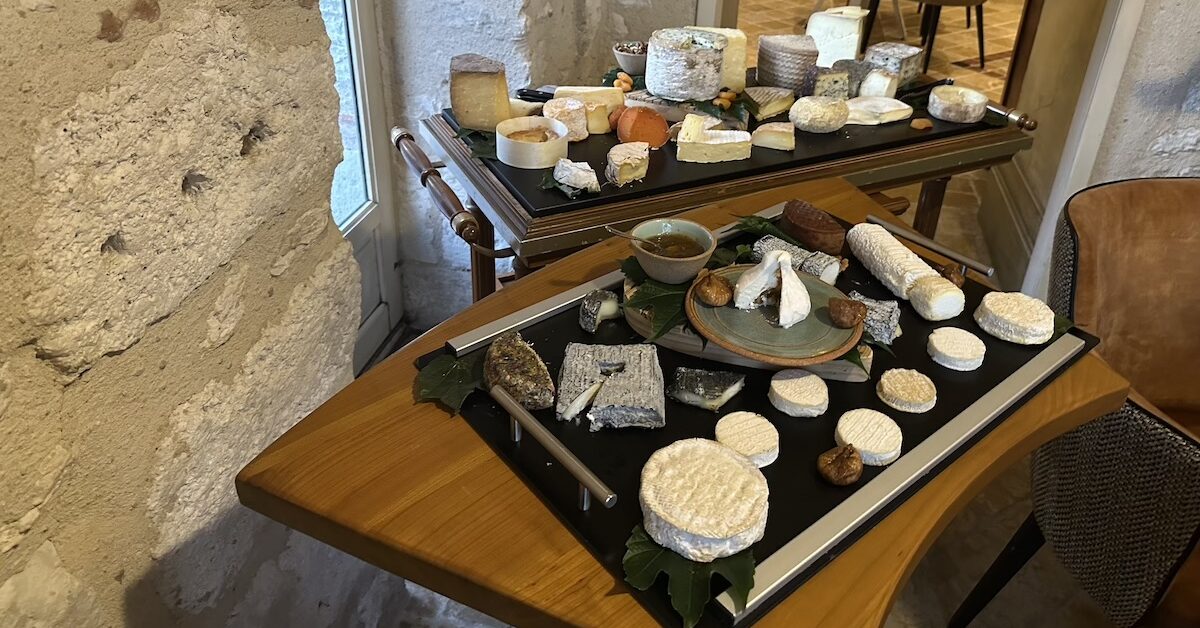
While foodies in France may flock to the Michelin-starred restaurants of Paris, or the lauded bouchons of Lyon, those in-the-know head to the country’s southwest, where the Dordogne region offers some of France’s richest culinary traditions. This area, also known as Périgord, is traditionally an agricultural region, its lush landscapes providing a bounty of wine, produce, and animal products at bargain prices. So here is what to stock up on if you happen to find yourself in this verdant corner of France.
Duck & Foie Gras

Périgord has a long history of raising ducks, which are used for magret de canard (duck breast), rillettes de canard, and confit de canard, as well as foie gras. The latter, which can also be made from goose liver, is found throughout France—but most of it is produced in the Dordogne. It can be purchased in many forms, mainly entier (whole) or as a bloc (a brick of foie gras composed of the livers of multiple ducks). Foie gras entier is the most expensive variety, though you’re more likely to come across a bloc of foie gras, which may be flavored with black truffle or local sweet wine, such as Monbazillac, which is the perfect pairing for this rich dish.
Strawberries

You’ll find a lot of fantastic seasonal produce in the Dordogne, but from April through October you’ll discover that the Périgordins have a particular love for the strawberry. There are a few types of strawberry that qualify for the IGP status of “Fraises du Périgord,” including Garriguette, Mara des bois, Darselect, and Cirafine varieties. Whether in a tartelette aux fraises, soup de fraises, or strawberry sorbet, there is no avoiding these little berries when they are in season.
Walnuts

In the many copses that break up the Dordogne’s farmland, walnut trees drop their bounty for the Périgordins to enjoy. In fact, walnuts have been growing here for 17,000 years! To that end, they have a special place in local culinary traditions, particularly huile de noix, or walnut oil, which has IGP status. There’s even a walnut museum in the small town of Saillac, which also hosts a walnut festival every October in celebration of the harvest. Enjoy these walnuts whole, or buy a bottle of walnut oil, the delicate nutty flavor of which is excellent mixed into salad dressings or topping a scoop of ice cream. You should also make sure to try Vin de Noix, a sweet, nutty liqueur made from unripened walnuts, similar to Nocino.
Truffles

Périgord truffles are known as the gold standard in the mycological world, and it should come as no surprise that their name comes from this region. These fragrant black truffles are foraged along oak and hazelnut trees that often grow at the edges of the Dordogne’s vineyards, using special dogs of the Lagotto Romagnolo variety. You will find them in many forms here, either fresh, jarred, or incorporated into any number of dishes.
Sweet Wines

While most Americans turn their noses up at sweet wines, for the Périgordins, traditional sweet wines are both a tradition and an art. Saussignac, which is produced in a tiny appellation by barely 15 producers, is produced with Sauvignon, Sémillon, Muscadelle, and Chenin grapes. It has notes of apricot and honey, with a silky texture and high acidity to balance out the sugar content. Drink it alongside a slice of pain d’épices topped with Roquefort, for a sweet-salty-funky combo that works against all odds.
There is also Monbazillac, which, similarly, is produced with Sauvignon, Sémillon, and Muscadelle grapes. Young Monbazillac, with its tropical and white flower aromas, also has apricot-honey flavors in its first few years, then takes on nutty notes of almond and walnut as it ages for the next 10 or 15. Serve younger Monbazillac wines with bittersweet chocolate cake, and older ones with caviar from Nouvelle Aquitaine. Both Saussignac and Monbazillac pair fabulously with the region’s famed foie gras, and can be enjoyed as a pre-dinner apéritif, or a post-dinner dessert wine.
Cabécou

Every part of France has its own bounty of local cheeses, and one you will find often here is Cabécou. This goat cheese is shaped into small discs, and usually consumed young. The skin of this cheese is so delicate that biting into it is reminiscent of eating a perfectly-roasted marshmallow, the fragile exterior giving way to a soft, luscious interior. Cabécou goes perfectly in a salad with Périgord strawberries.
Trappe d’Echourgnac

Trappe d’Echourgnac, which is also typical of the region, is a cow’s milk cheese made at the Abbaye Notre-Dame de Bonne Espérance. Its rind is washed with Vin de Noix during the aging process, adding a smoky, savory, nutty flavor to this otherwise mild and supple cheese. Enjoy it at room temperature alongside a glass of Bergerac wine, or as a tasty ravioli filling.
Catherine Rickman is a writer, professional Francophile, and host of the Expat Horror Stories podcast. She is currently somewhere in Brooklyn with a fork in one hand and a pen in the other, and you can follow her adventures on Instagram @catrickman.


