As America prepares to celebrate its semiquincentennial, France is gearing up to pay homage to 250 years of Franco-American friendship, through a variety of events and exhibitions. One of these is “Lafayette Between France and America: History and Legend” at the National Archives in Paris, which honors the “hero of two worlds” who was an integral figure in both the American War of Independence and the French Revolution.
“We wanted to show what Lafayette did throughout his life and his importance for French history and American history, and for the Franco-American friendship,” explains the curator, Professor Olga Anna Duhl of Lafayette College.
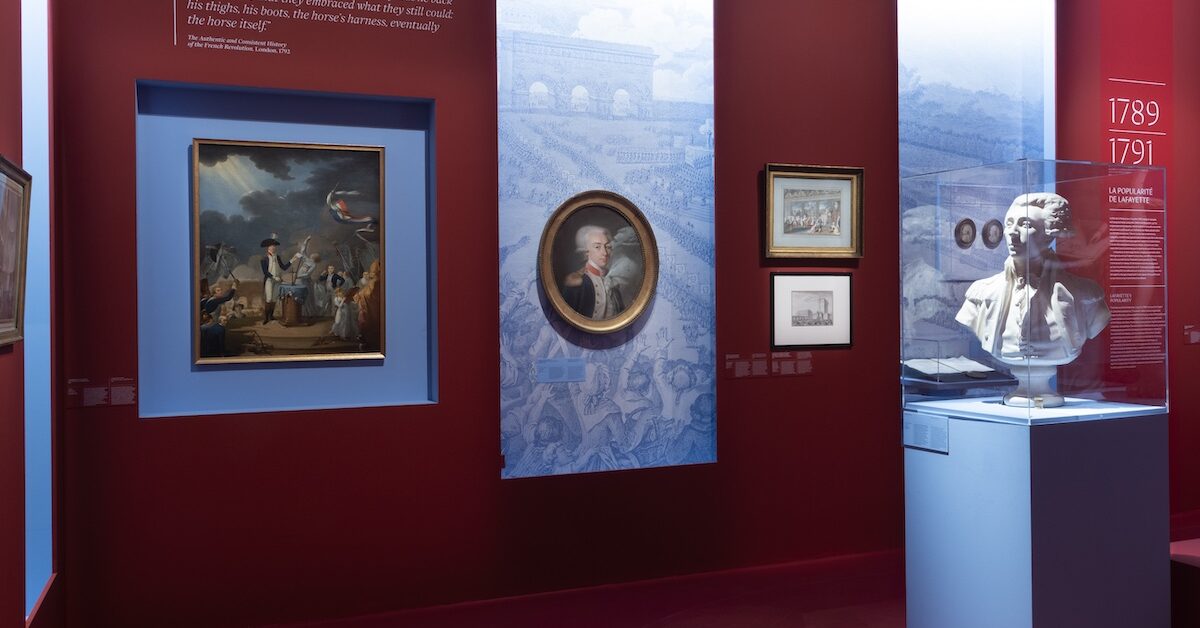
The bilingual exhibit, which has panels and labels available in both French and English, takes up six rooms of the converted hôtel particulier in the Marais, each containing artifacts and illustrating stories from the Marquis de Lafayette’s life.
“It was exciting to get to show French people how important Lafayette was for the two countries, because believe it or not, Lafayette is lesser known in France than he is in the States,” says Duhl.
From One Revolution to the Next

Lafayette grew up in a wealthy and well-connected family in France, but absconded to the U.S. at only 19, drawn by the revolutionary ideals of the colonies. He joined the Continental Army in 1777 and began developing a close relationship with George Washington, who eventually became a sort of father figure to him. When Lafayette joined the National Assembly following the French Revolution, he sent the key to the Bastille prison to Washington as a symbol of the demolition of the French monarchy, and it remains at Mount Vernon to this day. Lafayette even named his son George Washington de Lafayette to honor his friend and mentor. Letters between the two men are featured in this exhibit, and serve as evidence of one of the earliest Franco-American friendships, and one that went on to shape both nations.
Lafayette returned to France in 1778 to obtain more French support for the war effort, before commanding American forces in Virginia, which led to the defeat of the British at the Siege of Yorktown.
He later brought what he’d learned in the American Revolution with him back to France, where he penned the initial draft of The Declaration of the Rights of Man and of the Citizen (now part of the permanent collection at the National Archives), which was inspired by the Declaration of Independence and the writings of Thomas Jefferson. He was instrumental in the French Revolution, but fled in 1792 during the Reign of Terror, after which his fortune was seized, he was imprisoned in Austria, and many of his family members were guillotined. He finally returned to France in 1797, but refused to serve in Napoleon Bonaparte’s government, rejecting the autocracy as antithetical to his commitment to the liberation of the French people. Lafayette thus remained a political target until Napoleon’s defeat and abdication in 1815. In the following years, under the Bourbon Restoration, Lafayette continued to advocate for democratic policies and freedoms under the monarchy, and fought again in the July Revolution of 1830 to overthrow King Charles X, who had attempted to restore an absolute monarchy in France.
Lafayette the Abolitionist

“Lafayette was really ahead of his time, and his democratic ideals were carried throughout his entire life,” Duhl says. “He was a friend of the Protestants, he was a friend of the Jewish people in France, he tried to get equal rights within France for all these minorities. He sympathized with the rights of women, and was also friends with Native Americans whom he met on his first trip to America.”
In addition to being a revolutionary leader, “Lafayette is really the first abolitionist who did something about emancipating enslaved people,” Duhl says. “Other people, contemporaries of his, did write a lot about it, but nobody did anything about it.” After failing to convince Washington to emancipate enslaved people in the U.S., Lafayette took it upon himself to purchase a plantation in French Guiana and enact a “gradual emancipation project,” in which laborers were educated, then paid a salary for their work, before being liberated completely. Unfortunately those same workers were enslaved again only a few years later when Napoleon reinstated slavery in the French colonies, but Lafayette’s efforts are still worth mentioning, and the National Archives exhibit has an abundance of documentation of the French Guiana project.
Enlightenment Ideals Meet Revolutionary Actions

In 1824, nearly half a century into America’s existence, Lafayette returned for a grand tour of the new nation, where he received a hero’s greeting, and was invited to be the first foreign national to give a speech to Congress, in which he praised America’s progress, both ideological and technological. Visitors to the National Archives can read his speech in its entirety at this exhibit, and reflect on how much of Lafayette’s influence can still be found in both France and the U.S. today.
As Duhl reminds us, Lafayette was a product of the Enlightenment, and “the ideals of the French Revolution, liberty, equality, fraternity, and these were in Lafayette’s DNA.” Through his close relationships with figures like George Washington, Thomas Jefferson, and Alexander Hamilton, these Enlightenment ideals became embedded in the very fabric of the U.S., serving as an omnipresent thread of connection between France and America. Even as political relations between the two countries have changed over time, they remain built on a shared foundation. “I think, 250 years later, that’s why this exhibition, and the anniversary are so important for our understanding of what democracy meant then, and what it could mean today, globally.”
“Lafayette between France and America: History and Legend” runs from April 1 to July 14, 2026.
Catherine Rickman is a writer, professional Francophile, and host of the Expat Horror Stories podcast. She is currently somewhere in Brooklyn with a fork in one hand and a pen in the other, and you can follow her adventures on Instagram @catrickman.