Artists have been moving to Paris for centuries to find inspiration, and to immerse themselves in the city’s rich cultural heritage. It’s a well-worn stereotype of the American in Paris, come from afar to write poetry on café terraces and paint in the Place du Tertre. But what is it like to be an expat artist in Paris in the era of TikTok and tariffs? How does one make space for themself, build community, and break through the mess of French bureaucracy?
For a number of artists, these answers can be found through Paris Heretics, an independent creative label focused on supporting Anglophone poets and artists. Run by Jason Stoneking, a multidisciplinary artist originally from the U.S., “the label likes to create spaces—books, films, exhibitions, or concerts—that challenge the propriety of artistic delineation,” explains Carrie Chappell, who worked with Paris Heretics on the 2022 release of her book Loving Tallulah Bankhead, a collection of poems dedicated to the infamous Southern actress. “No one that has been produced by Paris Heretics is just one type of artist, and that’s what’s stunning about working with them.”
Take Leslie McAllister, a painter and sound artist who uses the stage name Lesteria, who grew up under the influence of French and France-based masters like Monet, Matisse, Sargent, and Van Gogh. She was an early collaborator with Paris Heretics, producing a number of projects for other artists under the label before embarking on her own. “I’ve seen the workings of Paris Heretics from the inside out, and it’s been an inspiring thing to be part of,” she says. “It has created opportunities for me to collaborate with other artists, and become part of a community, which has given me energy and support to reach for bigger things.”
Alison Grace Koehler, who refers to herself as a “stained glass poet,” also found the label a valuable space in which to explore non-traditional artforms. Her work involves making stained glass pieces in front of a live audience while reciting original poetry, often accompanied by music. She published a book, Stained Glass Poetry, with Paris Heretics in 2020, which then evolved into a spoken word album called “Stained Glass Arrangements,” in which Koehler narrated her poems, alongside instrumentation and evocative soundscapes.
France as a Haven for Artists

There are a number of reasons why this city in particular would offer opportunities for such a wide range of artistic pursuits. While French bureaucracy can be a challenge for foreigners looking to apply for grants and permits, overall France offers strong support for the arts, both in terms of funding, and the availability of broader social benefits. “I have found and maintained the courage to pursue the work I care about, at least in part because of this systemic support,” Koehler notes. “I can still see a doctor even if my earnings are modest or absent, so what excuse do I have to not take that risk?”
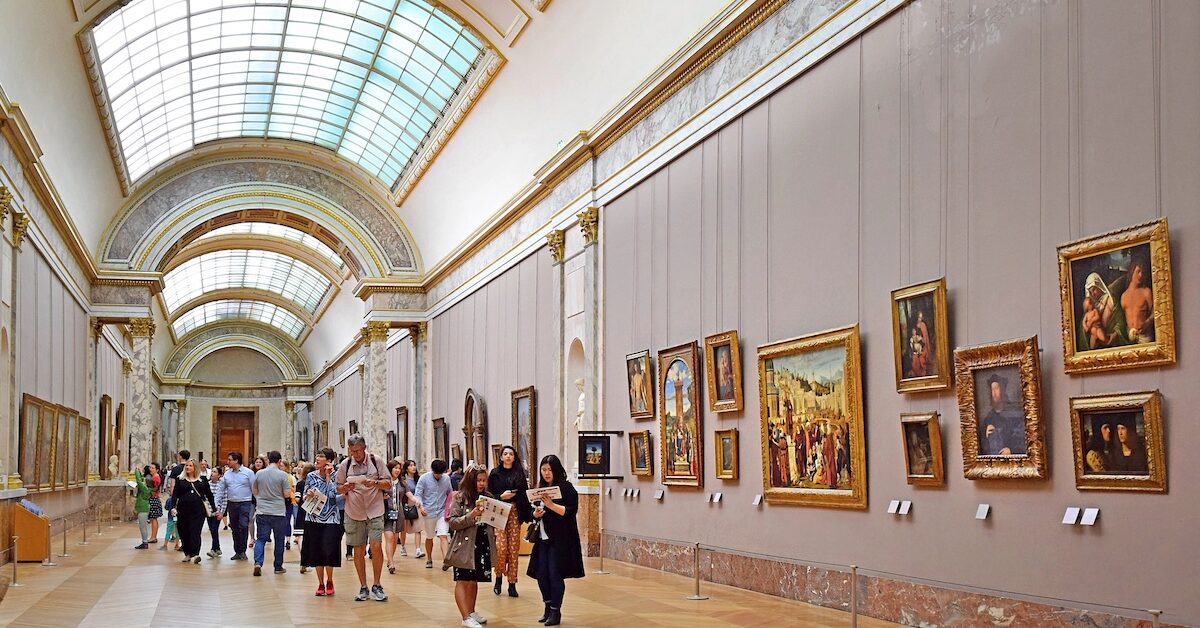
There is structure in place to encourage artistic expression in France, something that is often lacking in the U.S. This is in part because the importance of the arts is baked into the French educational system, and in Paris, in particular, you could practically throw a rock and hit a masterpiece. “There’s so much of art history that took place here, so there’s inspiration everywhere,” McAllister tells me. “And people have been exposed to a wide range of ideas about art, so it’s easy to find people to give constructive feedback about your work, even if it’s experimental or outside the norm.”
How, then, does this prevalence of art all around you impact the way that French people interact with art? According to Koehler, it does have its limitations: “I think it is very tied to tradition… There is a coolness, a pride, and a lack of accessibility, openness, and surprise.” However, she says, “This also gives my own desire to create something other than what I see around me a particular flavor of meaningfulness.”
Chappell, who is a doctoral candidate in research-creation at a French university, noted her curiosity at how the French art world will evolve with the advent of new programs in higher education that focus on the arts in ways more akin to U.S. MFA-style degrees: “I do think the institutionalization of ‘creation’ by French schools will significantly impact who, what, and how artists are being talked about.”
Navigating American Identity in French Art

Of course, for writers and artists for whom language is integrated into their work, producing pieces in English can be a challenge. The language barrier can make it harder to advertise your work in French media, the audience for English-language work is smaller, and being an American artist in France can influence what people expect from your work. “But,” McAllister offers, “if you do manage to get your work in front of people somehow, the people will engage with it.”
Chappell, whose work is distinctly tied to her upbringing in the American South, touched on the ways in which we can slip into certain pre-determined categories according to where we’re from, in effect caricaturizing ourselves in order for our work to be more easily digestible. Some expat artists might choose to French-ify themselves and their work, while others might lean into their Americanness or Britishness. Chappell herself tries to embrace the spaces in-between: “I think there is a tendency from some French people, but honestly from some my fellow Americans, to want my work to answer to their strangest wonderings about what being ‘from Alabama’ looks, sounds, and feels like,” she says. “On the opposite side, I feel that sometimes my American readers are more responsive to work that is more typified by a kind of ‘American in Paris’ experience. They want that peek in.”
These dichotomies can be as freeing, however, as they are restrictive, at least according to Koehler. “I think there is a special freedom to find, as someone living within and in between two countries,” she says, “including an ability to step around certain sets of rules and presumptions.”

Catherine Rickman is a writer, professional Francophile, and host of the Expat Horror Stories podcast. She is currently somewhere in Brooklyn with a fork in one hand and a pen in the other, and you can follow her adventures on Instagram @catrickman.