
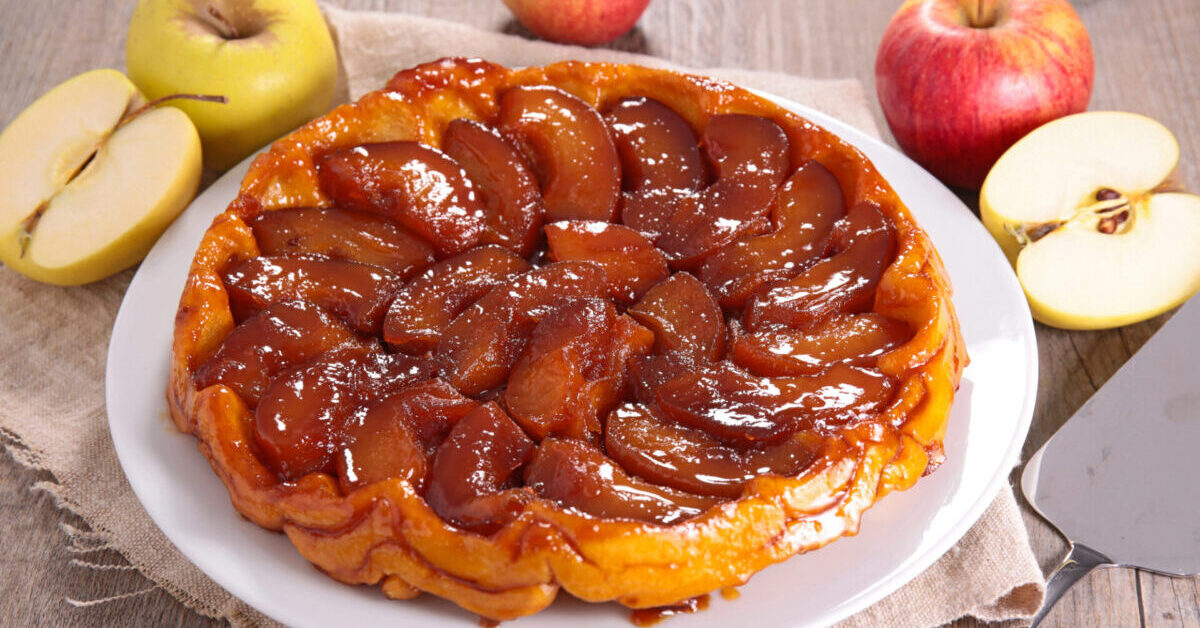
Tartes have been around in France for hundreds of years, likely dating back as far as Medieval times, or even earlier, when knights, yeoman and farmers took a convenient slice of a meat pie and wrapped it in a napkin for on-the-job lunches or dinners. I wrote more about the history of tartes a few weeks ago in my Frenchly guide, Tarte Tips from a Pie Professional, where I provided a little history and some tips for your butter, salt, and oven temps. A tart (or pie), I am the first to tell you, is a wonderful thing: It’s a labor of love and trust, as you tuck your ingredients between two crusts and hope for the best. Pies and tarts can be simplified or made more fancy and delicate–either way, they take time and patience.
But the tarte Tatin, despite its family name, is refreshingly the opposite. In fact, this pan tarte is just down and dirty, fast and scrumptious; it’s, frankly, a holiday game changer.
The story of the first tarte Tatin goes something like this: In the late 1800s, two elderly and unmarried sisters, Caroline and Stéphanie Tatin, ran a hotel just across from the train station in the small town of Lamotte-Beuvron, southeast of Paris. The town is in the Loire Valley and sits on the Beauvron river, a tributary of the Loire, in the Sologne region of France. The inn was frequented back then by mostly hunters and weekenders from Paris.
One October day, the legend goes, the Tatin sisters had an inn full of hungry hunters. Stéphanie was hard at work cooking and, while busy, either accidentally left sugar, butter and apples cooking for too long on the top of the stove, caramelizing the apples, or she actually forgot a bottom crust for a pie she was making. Either way, hiding her mistake, she threw a pie crust on top of the pan, tossed the entire thing into the hot oven, and then, taking it out and inverting it onto a plate, she—perhaps inadvertently—created a now famous and very delicious French accident.

I say “perhaps inadvertently” because there’s a fly in the sticky caramel of this story: Before the tarte Tatin there was the “tarte Solognote,” named for their region of Sologne, which is, essentially, the exact same thing. This was probably what Stéphanie was making all along, busy or not. Indeed, the sisters called their own tarte Tatin the “tarte Solognote,” which makes one think there was no convenient accident that created this dish. Either way, pretty soon the eponymous tarte that was eaten, chez les Tatins, gained fame, the recipe making its way up to Paris and the famous Maxim’s restaurant.
And the rest, as they say, is history. The tarte Tatin was sealed into French culinary history, and, ever since, pastry makers the world over have been chasing the holy grail of one perfect, flaky crust perched atop an unfussy-yet -delicious filling with the most humble of ingredients—apples, sugar, butter. (Or, eventually, even onions and beets–but I’ll get to that shortly.)
The Tarte Tatin is a Holiday Hero
You’ve probably seen a tarte Tatin even if you’ve never made or eaten one: It’s most often made, as I’ve said, with apples and served on a regular plate instead of in a pie tin. And it’s the kind of dessert that is best eaten after a long meal, straight from a hot oven. It has this magic quality of bringing the coziness of a farmhouse to even the most stark and cold of apartments. Another bonus: If there were ever a dessert which you can be sure will never ever have a soggy bottom, it is this one, because the crust is on top.
To make this recipe, you need are some apples, a stick of butter, some sugar, a little salt, and a pie crust—just one. (Save the second one for when you make it again the next night.)
Tarte Tatin Recipe

To gather: If you have it, a good cast iron pan. You can see that I always use cast iron for mine. Cast iron works because it holds the heat well and evenly distributes it. A low-sided Le Creuset works or a regular frying pan. Try not to use non-stick coated pans in general, as Teflon is toxic, and because you will be putting this pan right into the oven. You’ll also need a good spoon and a sharp knife.
- 1 stick of butter
- 1 cup of sugar (I like to use brown for the molasses-y notes)
- 4-8 apples, depending on size
- 1 tsp vanilla or lemon juice
- One pie crust. Don’t worry if you made it with your worst butter or margarine, or bought it at Trader Joe’s. You can level it up with my pie crust techniques, here.
- ½ tsp salt
Roll out your crust. Wrap it in parchment paper and put it back in the fridge. Heat the oven to 375 degrees Fahrenheit. Peel and core your apples and cut them, as best you can, into quarters, so they have rounded little backs; don’t worry too much about this, as they will be fine however they end up. Throw them in a bowl and toss them in 1 tsp vanilla or lemon and 1 tbsp sugar. Melt your butter on medium heat in your cast iron pan. Stir in the rest of your sugar. Start to dissolve the sugar and butter together and let it get golden. Add in your apples and salt. Don’t worry what this looks like, just keep stirring on medium heat until the apples are caramelized and the caramel takes on a deep amber hue, about ten minutes.
Pull the pan off the heat, turn your apples with tongs or your spoon so the rounded sides are on the bottom of the pan and the ragged sides face you. Place your cold crust on top of the fruit, folding it around the sides. Use a fork to make a few gentle holes in the crust. Bake for 22 minutes or until your crust is golden brown and puffs up. Pull it out of the oven, let it sit for ten minutes. Now, invert your tarte onto a plate or pizza pan. Serve with mascarpone, crème fraîche, Chantilly whipped cream, or ice cream.
Make a Tarte Tatin with Any Fruit
It doesn’t have to be apples! You can make a tarte Tatin with peaches, apricots, pears; it can be bananas (which I love), or pineapple, persimmon, thinly sliced blood oranges or Meyer lemons, frozen raspberries or fresh cranberries. You can grate in a little lemon zest or nutmeg (especially for the bananas). You can also add in a tablespoon of Calvados or Bourbon for flavor. When it comes out of the oven and you flip it, try it with a little fleur de sel on top. Voilà!

Try a Savory Tarte Tatin
Okay, so here’s where this gets really wild: You can make a tarte Tatin with onions, or better yet, shallots. Or with beets—just throw in some thyme, rosemary or lemon peel (or all three!). Try carrots or parsnips cut in long thin pieces, or even fennel. In many of these cases you will want to use less sweetener than my recipe above—more like a few tablespoons—and a little acid, like a tablespoon of apple cider vinegar, but play around until you figure out what you like. I love a lot of the savory tarte Tatin ideas here on Géraldine Levard’s page.
Take Some Tips from Julia
So you’ve made your family and guests happy this holiday. Now, you’re ready to watch Julia Child on PBS make the famous tarte Tatin her way, which is a little different and includes Cognac and an apricot glaze. This is nothing like the happy-out-of the oven accident of Stéphanie Tatin. This one, my friends, is for a cold winter night when it’s just your nearest and dearest and there’s snow outside and you feel totally content taking your time to make something radiant.
No Soggy Bottoms
If you take the time to have a few pie crusts in your fridge, you can make both savory and sweet tartes Tatins in minutes. They make wonderful last-minute breakfasts (just imagine beet tarte Tatin with goat cheese on New Year’s Day!), desserts, appetizers, or easy dinners with salad. This time of year, a tarte Tatin is so welcome, homey, and shamelessly easy, I promise. I will be making two this weekend myself when guests descend!
Caitlin Shetterly’s new novel, The Gulf of Lions, is set in France and will be published in May of 2026. Check out her made-to-order pie company, Pretentiously Pious Pies, on the coast of Maine, where she lives.


