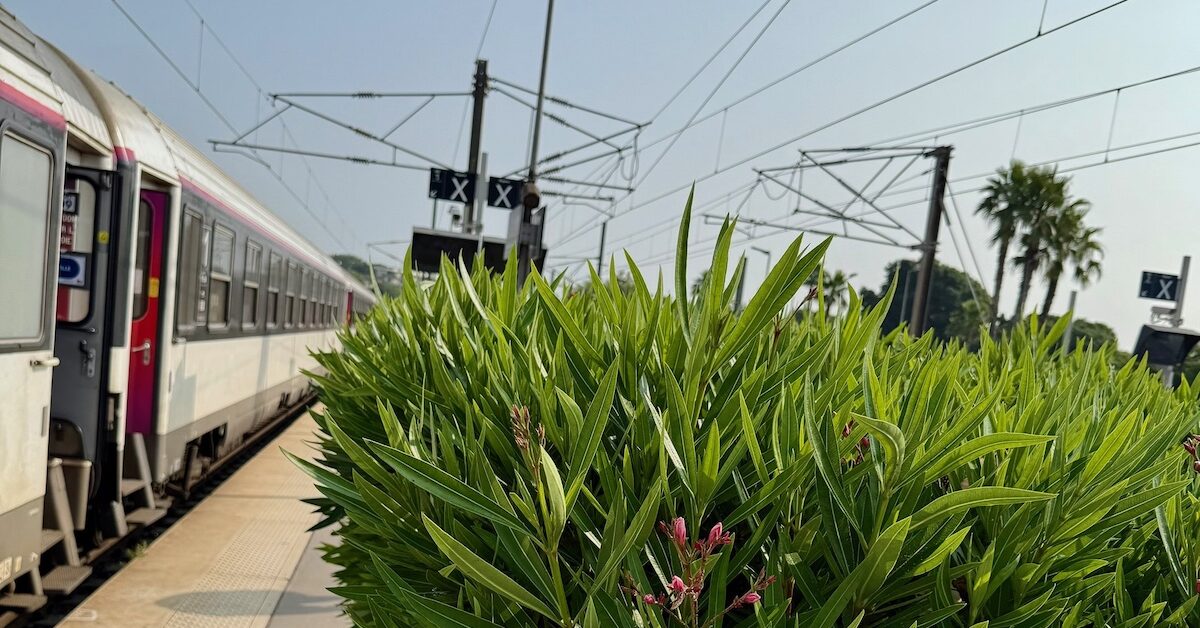
After spending four days in Paris, we were heading again to Gare Austerlitz for our next night train escape to the country. Only, this time, instead of a hiking trip to the French Alps in Briançon, we were off to the beach for a few days of sightseeing along the Côte d’Azur.
Feeling like old pros having just taken the sleeper train a week earlier, Stacey and I flashed our e-tickets from our phones and promptly found our first class couchettes.
The night train to the Alps and the Côte d’Azur starts off as a single train in Paris, then later splits in two during the wee hours of the night, with some cars veering off to the Alps, and the rest continuing south to Nice by way of Marseilles, Saint Rafael, and Cannes. The coastal route also makes several stops at smaller destinations, including Antibes, where we had booked an Airbnb for two nights in the old city.
The Sleeper Train from Paris to the South of France

We took our places, stretching out on our two reserved lower bunks. This time, we hadn’t reserved the entire cabin for ourselves with the Espace Privatif option as we had done on our trip to Briançon. Minutes before the train rolled off at its 8:57 pm departure time, another couple showed up and, hellos exchanged, they climbed the ladder to their bunks.
The newcomers, it turned out, were Canadians on their way to Nice, and had come directly from the airport. Zonked out from their flight, they soon went to sleep, but not before we worked out a few friendly points of night-train protocol. Since they needed the space clear between the door to the corridor and the ladder, we agreed to keep our packs tucked on the floor on the other side of the ladder, near the window. The individual reading lights were directed enough that keeping ours on didn’t bother our slumbering cabin-mates above. And the ample height of the car allowed enough distance between the top and lower bunks to give a sense of privacy in a shared space, something akin to business class capsules on an airline.
Still, sharing a train compartment, even with considerate cabin mates, had an entirely different vibe than luxuriating in total privacy. Bedtime chatter and laughing à deux was replaced with stifled murmurs and brief and respectful exchanges with strangers. In the morning, a comical kabuki of politesse ensued when we all discovered we had long been awake, though no one had dared raise the big picture window nightshade until minutes before our arrival in Antibes.

Earlier in the morning, I had slipped out to inspect the train, curious to have a good peek inside a second-class car. There, the cabins were arranged in the familiar two rows of triple-decker berths. They seemed much plusher than the couchettes I recall from my student days decades ago. The people who lined the corridor to make room for others coming and going (or just to enjoy the view of the pretty coast) struck me as a mix of well-dressed foreign tourists and French travelers, not the rag-tag hordes of American college students from my youth. Sure, the space was a bit more crowded than first class, but pleasant enough.
We arrived in Antibes on time at 8:43 am, well rested though temporarily blinded by a brilliant and already hot sun. Instead of Briançon’s snow-capped mountains and cool morning breeze, we were greeted by palm trees, bougainvillea, and a hint of salty sea air.
A 10-minute walk down a gentle slope, with a massive marina—the largest in Europe, I later learned—visible on our left, put us into the small winding lanes of the Old Town, where we tracked down our Airbnb. Our first reaction was disappointment. Past an initially inviting old wooden blue door, a dank, dark stairway with sheets and towels drying on the banister led to our tiny second floor room. Upon opening the door, I was dismayed to see the one window appeared to open onto an airshaft.
Wrong. In fact the window opened onto the main pedestrian thoroughfare upon which we had just walked, with its cheerful shops and little restaurants. It was just that the street was so narrow you felt you could reach your arm across and touch the other side. The little room itself was sparkling clean and newly renovated, with a tiny kitchen built into a cabinet across from the foot of the bed. The bathroom area was equally pristine and well designed for maximum use of a small space.

Our host, Pascal, was proud to show off the third-floor duplex loft which he said he had recently renovated with his own hands, as he had done earlier with our room. After showing us a spot under the stairs where we could stash our packs, he piled us up with a beach umbrella and chairs and sent us on our way through a labyrinth of narrow alleys toward the main square, Place Nationale. There, we found a lively and classic-looking cafe by a fountain. Finally: coffee, tartine, and a croissant. We also ordered an omelette for good measure as it was getting late.
Everything was meeting my expectations of the perfect French seacoast vacation spot. True, there was no sense of the working fishing village where Picasso once lived, but at least the upscale shops were stylish and inviting.
Yet as we got closer to the medieval ramparts that separated the Old Town from the marina, the atmosphere became decidedly more touristy. We passed a restaurant called, simply, Brooklyn, serving burgers, pizza, pasta and, for good measure, sushi. Just across the street was Chez Jules, a Disneyesque version of a French-themed restaurant. We hurried past both. (Though on our way back from the beach, both were filled with happy-looking clients having drinks and early dinners.)
Our destination was the town beach, Plage de la Gravette, accessed via a big arch cut through the massive city walls, part of the 16th Century Forte Carré, later updated and expanded by the same military engineer, Sébastien Le Prestre, Marquis of Vauban, who designed the forts in and around Briançon.

The small beach occupies a pretty sweep of sand from its point to the base of the city built on the cliff above. The water was crystalline blue, and was a delicious temperature the day we swam in early June, protected on both sides by long jetties that swept toward each other. We swam out to the opening of the sea, where buoys marked the end of the protected area, and revealed half a dozen magnificent pleasure crafts at anchor: antique classics mingling with intimidating and monstrously futuristic mega-yachts.
Back on the beach, the crowd seemed more local than touristic. High-school aged kids gathered in groups, lazing in the sun or kicking around soccer balls. Families cracked open their picnic lunches. We stayed all day, swam several times, read our books, and ate only a bag of roasted nuts purchased from a hawker passing by. There are no restaurants on the beach, though the Old Town, with restaurants aplenty, is less than a five-minute walk away. A couple of outdoor showerheads sprouted from the middle of the sand near the water line, a convenient way to wash off the salt water. Otherwise the only services on the beach were a bank of small lockers at the entrance and few public toilettes.
Later, when we were ready for drinks and dinner, we were happy to blend in with the other tourists at a pleasant and lively outdoor restaurant, Cafe Brun, which took up much of a pretty square up the hill from the beach. After dinner, we walked over to the marina, Port Vauban, for a look at the hundreds of docked yachts, many of them meticulously maintained classic wooden sailing boats.

From there, we returned to the Old Town at dusk, climbed the ramparts and strolled the length of the magnificent Promenade Admiral de Grasse. Out at sea, a few large sailboats bobbed on their anchors under a moonlit sky. All along the promenade, which passes the back of the famous Musée Picasso, people strolled, leisurely admiring the public art on display and the serene Mediterranean beyond.
At the end of our walk along the ramparts, I was struck by the beauty and the impossibly perfect setting of Les Vieux Murs, a restaurant with a gorgeous dining room and an expansive terrace that looks out over sky and sea. With a little more time and money in my pocket, I would surely return there, though the reviews online are wildly mixed. But with a view like that, who really cares?

On our way back to our Airbnb, we were drawn to what sounded like the best party in town. Just off the covered marketplace, the Marché Provençal, a small crowd of smartly dressed revelers clustered around the entrance of the Bar Absinthe, where a serious session of karaoke was in full swing. The small space down a crooked set of ancient stone stairs was packed, and there was little chance we’d ever get in, but we lingered for a while, enjoying the high spirits. Clearly a lot of absinthe had already been poured.
Adventures in Grasse
On day two, we quit Antibes for a short trip to the town of Grasse, situated high in the hills above Cannes. Once surrounded by fields of flowers to supply a burgeoning perfume industry, today Grasse is a popular destination for day trippers making the pilgrimage up the hill from the coast to take the tour of the Fragonard factory or visit the Musée International de la Parfumerie.
We had a different goal: render homage to a certain Admiral de Grasse, a somewhat forgotten French naval historical figure, whose 18th century exploits are memorialized in his hometown’s little-trafficked Musée de la Marine.
It seemed odd that visiting a maritime museum required a 45-minute local train ride up swooping inclines, followed by a 15-minute city bus ride to get even higher up the mountainside. But Grasse is a lovely little city worth a visit in its own right.
We celebrated our arrival by taking in a splendid view of the hills below and the hazy sea in the far off distance, then visiting a busy open air market in the Place du Cours Honoré Cresp, perched on the edge of a steep incline. We surveyed the enticing offerings and selected four succulent nectarines for a few euros. That only put us in the mood for more refreshments, starting with a citron pressé, which soon morphed into lunch, at a delightful terrace restaurant called the Café des Musées across from the entrance to the Fragonard tour and museum.
Then it was time to get down to business. I’ve long held a fascination for the admiral’s glorious rise and swift fall after learning about his pivotal role in the American Revolutionary war. At the decisive battle of Yorktown, Grasse’s massive naval blockade allowed Washington’s struggling army to defeat the British, thus winning the war of American Independence. But that world-changing victory was soon followed by Grasse’s ignominious defeat to the British in a particularly bloody naval battle off the coast of Guadeloupe. Perhaps because of that defeat, Grasse has long been relegated to relative obscurity, unlike the far more famous Marquis de Lafayette.
Finding a maritime museum in a city devoted to perfume proved challenging. We assumed we were on the right track when, after climbing a pedestrian staircase, we saw “Musée de la Marine,” clearly engraved on the side of a stately 19th century building. As we rounded the corner and entered the courtyard, we found only locked doors and construction. Across the courtyard was the entrance to the international perfume museum. When we asked for tickets to the maritime museum, the receptionist laughed and said it hadn’t been in this location for years. She wrote down the address of the new location on a yellow Post-it and sent us on our way.
Back down the hill he went, until we entered a side street with a faded wooden sign pointing us through a weedy rose garden to two open doors on the rez-de-chaussée of an otherwise shuttered villa. Peering into the dark space from the outside, we wondered if we were in the right spot, as all was quiet and not a soul was in sight. That’s when a man dressed all in white, with long gray hair in a very sailor-like ponytail, popped up from behind an enormous desk. With a broad smile and outstretched arms, he hurried in our direction and introduced himself as Bertrand Chevassut, the sécretaire of the museum. He seemed so happy to see us; I imagined we were the first visitors he had seen in weeks.
Chevassut offered to give us his private tour of the space, which consisted of two large dimly lit rooms and a back office. He explained that he’d served as its sécretaire for the past five years, ever since the museum was downsized and essentially kicked out, as I understood it, of its more stately locale to make room for the popular perfume museum. Chevassut is on a mission to keep his museum and the memory of Admiral de Grasse alive, and for two hours he succeeded with us. First, he walked us around nearly three dozen intricate and superbly detailed ship models, each one a vessel Grasse commanded during his long career. Our host then took us to a back room, where he showed us how he restores and maintains the models, as well as bookshelves filled with historical records of not just Grasse’s life but the story of the beautiful models, which themselves date back nearly 100 years. A third room was filled with dioramas depicting period shipyards in action, complete with tiny workers busily building and repairing the warships of the era.

Our guide then offered to take us on a tour of the rest of the 17th century villa, which he explained was filled with murals by one-time resident Jean-Honoré Fragonard. “But it is closed,” I protested. “Not for my friends,” he said. Opening an old creaky door, M. Chevassut led us up a magnificent but dusty stairway decorated with marble-looking trompe l’oeil depictions of what I later learned were symbols of the French Revolution, partially obscured by scaffolding. The stairway led to two grand but empty rooms with replicas of Fragonard’s famous murals in similar states of restoration. (The originals are on display in New York’s Frick Museum.)
We saw another work by Fragonard, as well as a pair of Rubens, when we later stopped in the small 13th century cathedral of Grasse, Notre Dame du Puy, which is austere on its exterior and somber on the inside. Yet our private tour of the dusty Villa Fragonard felt like a special bonus gift after our time on its ground-floor visiting M. Chevassut’s little gem of a maritime museum.
Our trip down the mountain was more like punishment. We sat for 20 minutes in our train car with other passengers waiting to get going, when the conductor announced that the departure and all subsequent trains would be cancelled until further notice. After much bedlam outside the station, 40 minutes later we boarded a packed bus that stopped every few hundred yards for the next 90 minutes, until we finally reached the train station in Cannes where we hopped a regional train for the short trip back to Antibes. So, no, French trains don’t always work as promised, but I’d still take my chances with them over, say, Amtrak.
We reached our hotel at dusk and headed straight to the town beach to cool off and reset, then went in our beach clothes straight to an inexpensive yet surprisingly good Greek restaurant, La Pitadine. The clock was pushing 10 pm when we showed up and most of the other nearby restaurants were wrapping up, but our waiter didn’t rush us and we were the last to leave after an excellent meal and copious amounts of house retsina.

On our third and last day we sought rest and relaxation at one of the many clubs that line the shore in Juan Les Pins, the upscale resort suburb of Antibes which wealthy Europeans and Americans transformed into a playground for the rich and famous a century ago. With more time and energy, we might have taken an all-day trek around Cap d’Antibes for a glimpse of secluded beaches and over-the-top waterfront properties, including the villas where writers from Jules Vernes to F. Scott Fitzgerald stayed and wrote, and where the iconic Hôtel du Cap-Eden-Roc sits poised on its privileged pine-forested point. But we opted for the path of least resistance. Seduced by its dreamy photos—and despite its tacky name—we reserved two spots at YOLO beach club and restaurant. Our modest goal was to make a mini Club Med-like experience of our day. The club’s shaded lounge chairs on a breezy deck over the water, and our just-OK-but-not-bad grilled-fish lunch, eaten while curling our toes in the sand, did the trick just fine.
We showered and changed, and within five minutes we were standing on the local train platform taking us back to Antibes, where we had plenty of time to make our night train back to Paris. Our last glimpses of the Riviera from our window before nightfall brought my thoughts back to those lovely old train posters from an earlier era beckoning tourists to take to the rails. Still, you don’t need to be nostalgic to enjoy the comfort and convenience of a French night train in 2025.

Rick Schine is a travel writer and has been a lifetime Francophile since his first night train voyage from Paris to Agay at the age of five. In addition to travel, he has reported on politics, business, and economics for the Los Angeles Times, Bloomberg Businessweek, The New Republic, and Harper’s Magazine.