
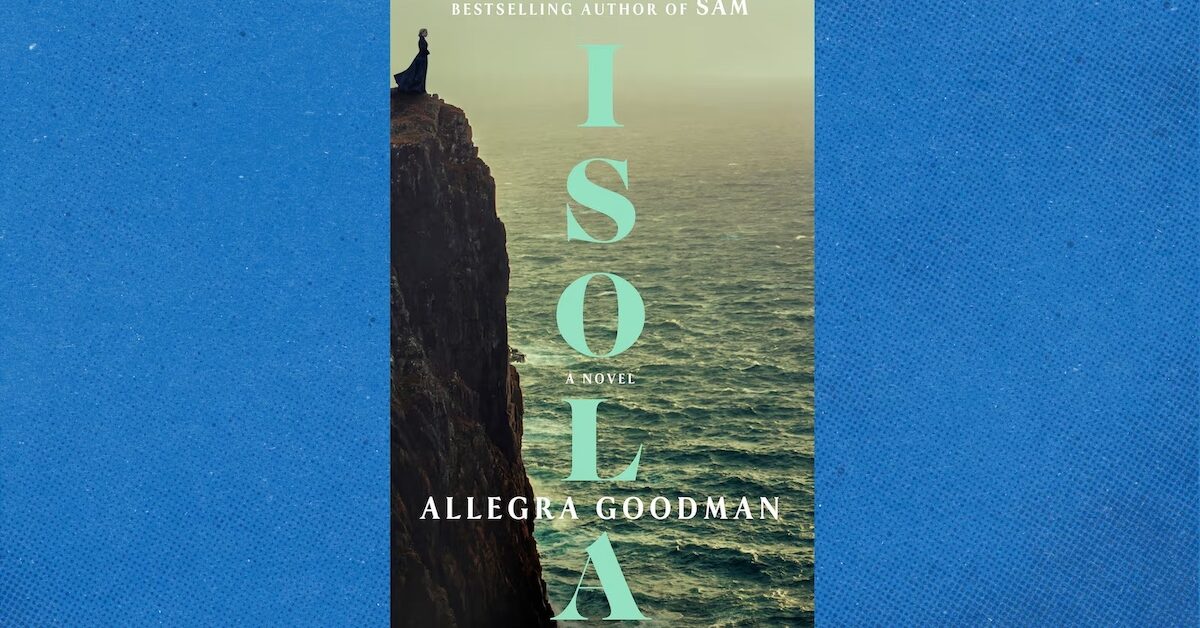
On a recent late winter night, while icy rain spit at my windows, I was on the phone with the novelist, Allegra Goodman. Her newest novel, Isola, which is set in 16th century France, had recently been picked as Reese’s Book Club pick for February, and was released to rave reviews. I’d just finished the book myself, having spent three days happily sick in bed, with a great excuse to read and read more of a book that I simply couldn’t put down.
Isola is a tour-de-force of a novel, conjured with such incredible detail as to cast the historical into the keen and precise gaze of the present, making it both timely and prescient at the same time. With sentences reminiscent of Nathaniel Hawthorne, Isola follows the true journey of a young French woman, named Marguerite, who was forced to survive on an island, in a Scarlet Letter-type situation, for two years alone. Through Marguerite’s story, Goodman explores light and dark, good and evil, God’s word and the final, sweeping decisions of Nature. A great love story, an epic journey, a tale of heroism and courage, and a granular exploration of day-to-day survival, this is the kind of book that comes around so rarely. Think: Bel Canto, All the Light We Cannot See, A Gentleman in Moscow.
Isola began, Goodman told me, with a children’s book she read in the summer of 2002. She was up late nursing her fourth child, her only daughter, who was then a newborn, on a family trip in a rented van, which they drove to Canada. She told me that she had taken along “every children’s book and young adult book about Canada and about Canadian History that I could find in our Cambridge Public Library.” Her three sons, ages ten, seven, and three, would be fascinated by the history of the place they were visiting, she figured. “I really think I was in a state of postpartum euphoria,” she told me. “I was clearly deluded.” Her sons, she said, “read none of them.” Instead, she said, “I read them all myself while nursing the baby.”
During one of her sleepless nursing sessions, she read a book about the French explorer, Jacques Cartier, and his voyages to New France, which encompassed large swaths of North America up until the mid-18th century. She came upon a short parenthetical statement that went, in her memory, something like this: “‘On an accompanying ship full of colonists commanded by Jean-François de la Rocque de Roberval, was a young kinswoman of his who annoyed him, and he marooned her on an island in the Gulf of St. Lawrence, where she managed to survive for two years.’ The parenthetical closes, and then the writer goes right back to talking about Cartier. I could not stop thinking about this woman. I mean, how did she survive?”
The story flickered in the background of Goodman’s mind while she raised her four children in Cambridge, Massachusetts. Meanwhile, she was writing stories for The New Yorker magazine and other novels, her most recent being the 2023 national bestseller, Sam.
But around 2018, Goodman said she decided to do a little more reading about that young woman briefly mentioned all those years before. She didn’t feel confident to write about her yet, it seemed too enormous a task, so she started with a book by the Queen of Navarre, also named Marguerite, who had written down the courageous story of the young Marguerite and her experiences on the Îsle des Démons in the Gulf of Saint Lawrence, off the eastern coast of Canada. The book is loosely modeled on Bocaccio’s The Decameron, in which ten guests each tell a story a night over ten nights to keep themselves entertained while they quarantine from the Black Death. The Queen of Navarre’s book attempted to capture stories of real people who intrigued her—though she didn’t quite make it to 100 stories before she died, only 72, so it became known as a Heptaméron. After reading the Queen’s account of Marguerite, Goodman then found another description of Marguerite’s journey, this time penned by a priest, who was said to have interviewed the young woman. Each version was no more than two pages long, which didn’t give her a lot of information. “As a novelist this is a challenge,” she said, “But it’s also an opportunity because you have a lot of space in which to imagine what happened.” She found herself trying out Marguerite’s story in her head, and trying to find her voice on paper.
Goodman has only been to France one time, when she was a little girl. She grew up on the island of Hawaii; Europe was a long way away. When she was eight, she and her family went to her uncle’s wedding to a French mathematician. “We walked all over Paris, and saw the Louvre and the Tuileries,” she wrote to me. “I remember the fountains in the Tuileries and also riding ponies. I was amazed by the delicious pears and cherries and berries in France. These seemed exotic to me—so different from the guavas and mangoes and papayas that grow everywhere in Hawaii. I loved the croissants our hotel served at breakfast, and smothered mine in butter and jam every morning. We took a train from Paris to the countryside to see friends who lived in a stone house with extensive gardens and orchards.”
This brief trip would leave a lasting impression. Almost 45 years later, at the beginning of the Covid lockdown in March of 2020, Goodman sat down with intention: Isola began to pour out. The novel opens in a château in Périgord, France. In that strange quietude that befell the world during the pandemic, her memories of that family trip to France came rushing back. “I have a good memory. I remember the stained glass in the cathedrals and I remembered how incredibly magical that space was,” she told me. Later, she wrote to me, “I also recall the side chapels with stone effigies on top of tombs. In Isola, when I write about walled gardens, orchards, and the dark sanctuary of the church with its tombs, I am drawing upon these memories.”
Even though there were seven adults living in her Cambridge home during lockdown, and she was working on rewrites of Sam, the confluence of her childhood memories of France and the right voice for Marguerite finally came together. Day by day, Goodman began to resurrect Marguerite’s story, as it had effectively vanished from history. “The way that men appropriate women’s stories, or erase them entirely, really interested me,” Goodman said. It took her three more years to write the book, then another year of rewrites. It was published, at long last, this February—a full 23 years after she first read those initial sentences in the book about Jacques Cartier.
While Goodman wrote, she told me, she did more research, listening to music of the period played on citterns and virginals, looking at images of art, pottery, silver, and fashions of the time. She was reading the Psalms by the 16th century French poet, Clément Marot. She said she was really interested in how Marot “was trying to create these rhyming verses” with the Psalms she already knew well in Hebrew, but not in French. Eventually, those Psalms and Lessons for my Daughter, by the 15th century French princess, Anne of France, became central texts for her book.
Then came another epiphany: As she began to weave the existing French works into her novel, she found she wanted something more than the English translations available to her. And even though, she said, “I don’t speak French well at all,” she decided to take on the added challenge of translation, not just of the Psalms and Anne of France’s Lessons, but also of the Queen of Navarre’s Heptaméron. “When I put the English translations next to the French, I realized I didn’t like the translations. So I did it myself. I knew enough to do that.”
Goodman’s research didn’t end in France, however. She had another enormous job to do because Marguerite spends two years on the L’îsle des Démons, in the Gulf of Saint Lawrence. Goodman had to recreate in her mind, and for her readers, what a remote island, with barely enough soil to grow the few plants that can survive in such harsh circumstances, might have been like 400 years ago. With roiling oceans, freezing winds, nesting snow geese in summer, and Polar bears, wolves, and abundant snow and ice in winter, the austere beauty of the island was her next challenge. How was a woman with skirts made for court and delicate lace-up boots, not a shred of Gore-Tex in sight, going to survive for two years in a place like that?
Well, you’ll just have to read the book to find out.
What I can tell you is that what results in Isola is a woven tapestry of an odyssey that celebrates the epic resilience and survival of one barely 20-year-old woman who suffered terribly—physically, emotionally—and whose losses forced her to reckon with her faith.
You know on page one, because the book is narrated by Marguerite, that she survives. But you don’t know how: The propulsive power of the book is in her incredible courage, illustrated by Goodman’s beautiful prose. It’s that she managed to not just survive, in the most basic sense, but that she was able to find moments of transcendence and beauty in her broken existence.
There is something so painfully tender about Isola coming to us now, in 2025, when evil seems more palpable than ever. Indeed, we must only open The New York Times to read about the deaths, disappearances, and banishments of innocent people, many children or young adults like Marguerite. They have not transgressed any more than Marguerite, who simply refused to be silenced or to give up.
Isola offers no lessons we can transpose into the present day. But if you’ve been waiting for permission to sit in bed and cry, this is your moment, and Isola is your vessel. You might well resonate with Goodman’s heroine when she says, “I bowed my head because the world was stranger and more terrible than ever I’d imagined.”
Caitlin Shetterly is Frenchly’s Editor-at-Large. She is the author of the novel, Pete and Alice in Maine, Harper Books, 2023.


