If, like me, you’re the type of person for whom a well-curated cheese plate is not merely a savory snack or a subtle status symbol, but a way of life, then you’re probably already a fan of Gruyère. Specifically, Le Gruyère AOP, the official title of this crowd-pleasing cow’s milk cheese made in and around the French-speaking district of Gruyère in Switzerland. With its nutty, creamy flavor, satisfying al dente texture, and magical melting abilities, Le Gruyère AOP is distinct yet versatile—as delicious eaten plain with slices of pear as it is topping a soul-warming bowl of soupe à l’oignon.
Achieving an AOP, or Appellation d’origine protogée status, is not an easy feat. Only 12 out of around 500 Swiss cheeses have this designation, which recognizes both the terroir and historical significance of a culinary product, as well as the rigorous production standards required to maintain the highest possible quality. Even if a cheesemaker follows all of the mandates to produce Le Gruyère AOP, each of their cheese wheels will still be tested near the end of the process to determine if they make the grade. If one doesn’t, it will get marked with a giant “X” to indicate that the wheel cannot be sold under the name “Gruyère.”

Despite all this, there is one tricky caveat to Le Gruyère’s AOP status: it is not recognized in the United States. Just about everywhere else in the world, “Gruyère” refers to Le Gruyère AOP of Switzerland, but in America, you could easily purchase a chunk of “Gruyère” from Wisconsin without being any the wiser. It’s like the cheese version of California Champagne—the taste will speak for itself, even if the label won’t.
Now, that’s not to say that there aren’t any Wisconsinites out there making stellar alpine-style cheeses. (As anyone who’s ever heard a cheese expert rave about Pleasant Ridge Reserve will know!) However, there’s a reason the real deal is so highly coveted and often imitated.
How Le Gruyère AOP is Made
Earlier this year, I was given the opportunity to visit Switzerland to learn about how Le Gruyère AOP is made. We were able to witness every part of the process, from the feeding (and less savory daily behaviors) of the dairy cows, through the curd cutting and formation of the initial wheel, all the way to the aging of the wheels in affinages thick with the smell of ammonia.
It’s not a pretty process, or an easy one. Dairy farmers and cheesemakers don’t get days off or overtime pay. Their work consists of manual labor and quick, critical decision-making, informed by instincts finely honed over the course of decades. They maintain a relationship to the cheese, and to the land itself, that supersedes the conventional trappings of a profession: not necessarily a passion, per se, but more so a duty.
Making Le Gruyère AOP requires both adherence to tradition, as well as constant innovation. The Swiss have been making it in more or less the same way since 1115—well before Switzerland itself was a country. But that doesn’t mean that the conditions for making it have remained stagnant.

As climate change spurs on unpredictable weather patterns which can disrupt the moods (and, thus, the milk production) of cows, milk producers like Nicolas Jotterand are working to breed more energy-efficient bovines, a project that will take generations to achieve. All this, while wondering who will be doing the daily work of feeding, milking, and caring for these creatures in the future. Expected working conditions have evolved, Jotterand expressed. The younger generations have little interest in mucking the stables and waking up at dawn every day, even on Christmas, to run the farm—particularly considering that acreage in Switzerland has become so expensive that there is no hope that hired hands would ever be able to own their own means of production. For this reason, it is often fathers and sons working together along the highly-local supply chain of Gruyère AOP.
Even the more “commercial” cheesemaking facilities we visited, like Fromagerie de Mézières, have a very close relationship with the surrounding ecosystem. Raw milk is delivered twice a day, from select local dairies that adhere to AOP regulations, and must be located within a 12-mile radius of the cheesemaking facility. However, Gruyère AOP production can be far more granular than even these bright, pristine facilities.

One morning, we drove high up into the mountains to visit an Alpage, a particular type of pasture where cows are brought during the summer months to feed on wild herbs and grasses. This flora gives the cows’ milk a complexity of flavor that translates to the cheese made from it, which is also called Alpage. At la Moïssetaz, in a small chalet decorated with commemorative cowbells the size of toddlers, cheesemaker Martial Rod huddled over an enormous copper cauldron at dawn, gently heating fresh milk from the night before and that very morning, along with live bacterial cultures and rennet, until the contents of the vat coagulate. The curds are then cut into small grains, and further heated. The cheesemaker monitors the rubbery, elastic texture of the curds until he knows that it is time to strain out the whey and pack the remaining curds into a wheel. They continue to strain until the wheels have set, before being immersed in a salt bath, and then stored on shelves of spruce, where their rind begins to form. Each wheel must be turned and rubbed with a salt brine every day for three months, before being transported to an affinage to age.

These maturation centers, which can be unbelievably massive, can house thousands of wheels of cheese. One we visited, Mifroma, contained an estimated 70,000 Swiss francs worth of cheese. There, wheels stacked 34 rows high are kept for five to eighteen months, at cool temperatures and high humidity, and are regularly rubbed with a salt solution as their rinds thicken and harden. The microbial environment in these grottos is so delicate that we had to wear protective gear and cover our shoes, hair, and hands before entering, in order to avoid any kind of outside contamination disrupting this unique microclimate.
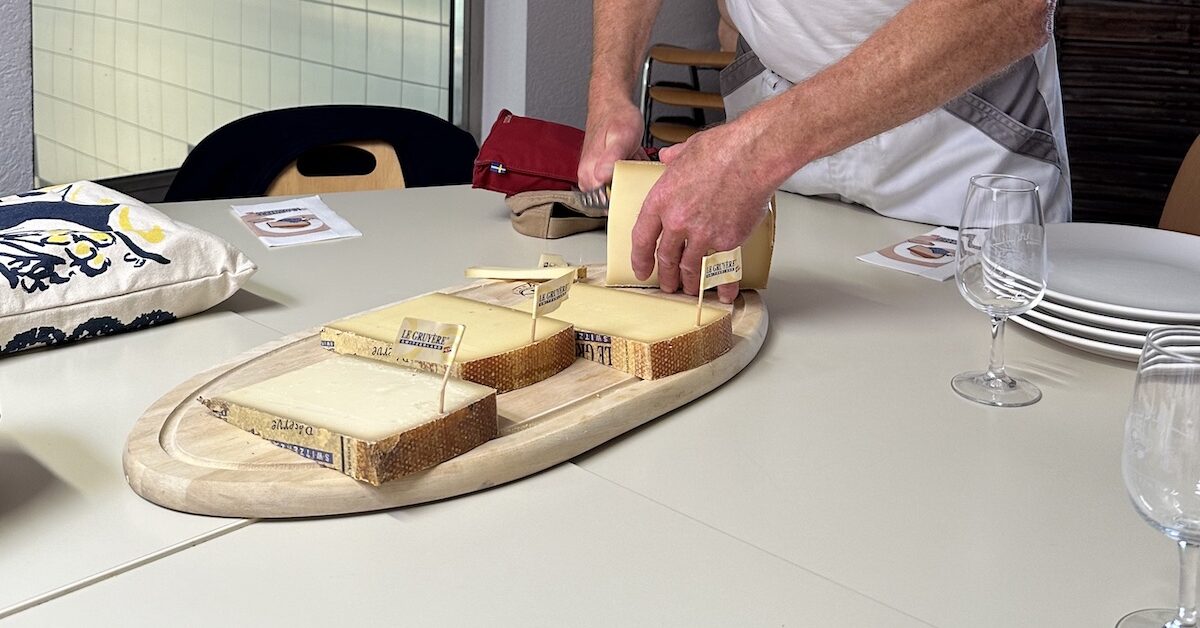
At five months, each wheel is tested. A small tool called a sonde is used to cut a long, thin straw of cheese from the rind. It is tasted and graded to determine whether or not it can be sold as Gruyère AOP. This analysis also helps determine how long the cheese will be aged for overall.

After experiencing all of this, I walked away feeling like every block of Gruyère AOP sold in the U.S. should cost a thousand dollars apiece. The amount of work that goes into making heritage food products like this is often hidden behind the regulation label on a sealed, sterile package tucked away in the refrigerated section of your local grocery store. But behind that bubbling fondue pot is a legacy of cheesemaking that goes back to the farmers, the cows, the grass, to the soil of Switzerland itself. Try to remember that the next time you take a bite—I promise it’ll be the best one you ever have.

How do I know if my Gruyère is real?
If you want to make sure you’re buying true, traditionally-made cheese from Switzerland, look for labels marked as “Le Gruyère Switzerland AOP.” Those three little letters, which typically appear on a black and red flag icon, are the key to separating the curds from the whey, so to speak.
Pretenders to the crown might be found among Germany’s Ammerlander, Wisconsin’s Cheese Brothers, or even the plant-based Vreamery brand. But the Swiss will always have the upper hand—as they have for the last thousand years, and hopefully will for a thousand more.

How is Le Gruyère AOP traditionally eaten?
In Switzerland, Le Gruyère AOP is often eaten plain, with grapes, walnuts, cornichons, or charcuterie to accompany it. However, it is also crucial to the traditional fondue of the region, called moitié-moitié (“half and half”), which consists of 50% Gruyère AOP and 50% Vacherin Fribourgeois AOP. Bread and potatoes are the classic accompaniments, but dried meats, cornichons, pearl onions, and even hard boiled eggs are also options. While you may be familiar with fondue spiked with kirsch, we were assured that the practice of adding cherry eau de vie to fondue, once used to cover up the taste of poor quality cheese, is no longer standard, thanks to the meticulous AOP regulations in place today. Personally, I didn’t miss the kirsch at all—with just a touch of Chasselas, a local white wine, the flavors of both cheeses really came through.
You might also come across Macaronis de Chalet, basically the most decadent mac ‘n’ cheese of all time, often served filled with bits of lardons. There’s also Soupe de Chalet, a warming soup with potatoes, greens, and cream, topped liberally with shredded Gruyère AOP. Or even Tartiflette gruérienne, which subs in the local cheese for the more traditional Reblochon in this hearty Savoyard dish. But there’s no wrong way to enjoy Gruyère AOP! Pair it with a hot cup of Oolong, or enjoy it in grilled cheese form, perhaps on a soft, buttered slice of St. Pierre brioche.
Catherine Rickman is a writer, professional Francophile, and host of the Expat Horror Stories podcast. She is currently somewhere in Brooklyn with a fork in one hand and a pen in the other, and you can follow her adventures on Instagram @catrickman, or on TikTok @catinthekitchen.