
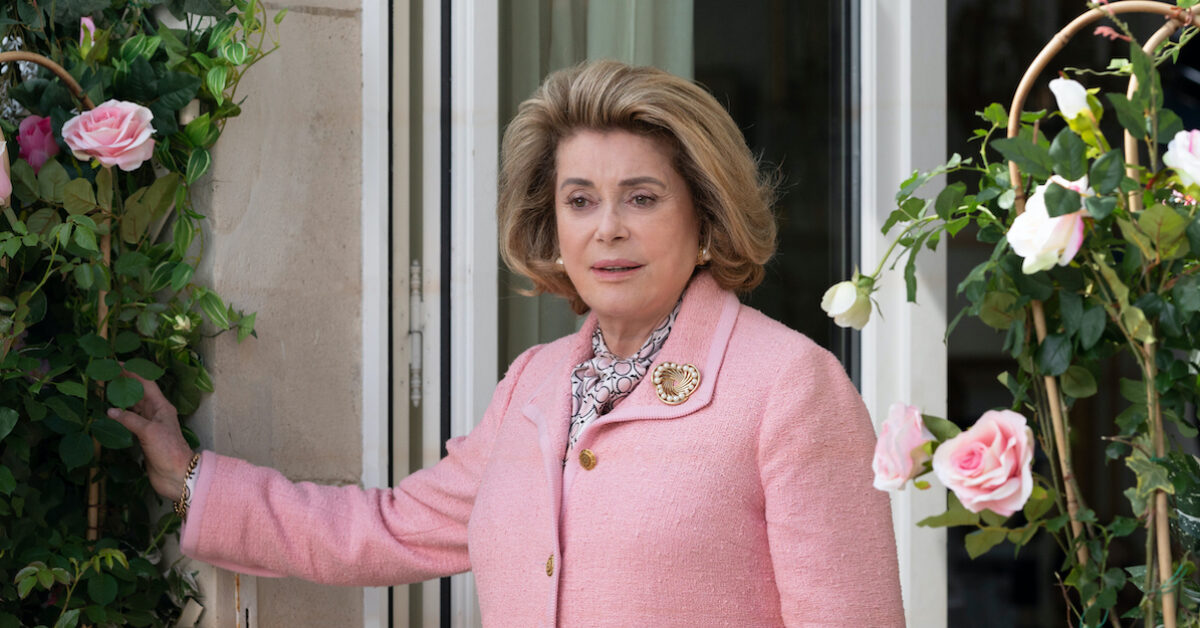
Over the years, books and movies have tried to understand the peculiar mystery of the First Lady. With the exception of Michelle Obama’s refreshing openness, First Ladies the world over have always stood just out of reach, forever shrouded, often making the resultant adaptations of their stories feel wooden. No matter how many years go by, former First Ladies may never tell us what was really going on; what we are capable of imagining might fall pretty far off the mark. Think of Hillary Clinton: We still have no idea what she felt about her philandering husband or why she stayed with him. What we could dream up will always ring a bit false.
But these ambiguous questions and the seemingly blank slate of a First Lady also makes her wonderfully rich ground for storytellers. And the audience is, well, everyone. After all, pundits and plebs alike have spent years of valuable time on such a worthy subject as, “Does Melania Trump hate only her husband or the rest of humanity as well?”
Now, the writer and director Léa Domenach focuses our First Lady curiosity in a new French movie, The President’s Wife, starring Catherine Deneuve. The film tackles a First Lady many Americans might never have heard of: Bernadette Chirac. She was the wife of Jacques Chirac, the (also philandering) two-term French president in the late 90s and early aughts. Americans (perhaps) remember President Chirac as famously taking a stand against George W. Bush’s illegal war with Iraq, in 2003. They might not know that he was nicknamed by the French “Le Bulldozer” for his ruthless methods of pushing his ideas through. So, our ignorance of both the French president and his wife affords us, in this case, a gauzy lens through which to take in the wife of a powerful (and yet, sometimes, pathetic) man, riveting us with a story that feels both freshly new and also familiar.
Why History Forgot Bernadette Chirac
Domenach had an early start on Madame Chirac’s story. Her father, Nicolas Domenach, a well-known French journalist, has written several books about Chirac, as well as other political figures. Domenach was born in 1971, and would have been in her late-twenties when Chirac was president. She assumed, from everything she had read and witnessed, that his wife, Bernadette, was a cold, austere, old-fashioned, Catholic woman who sort of deserved to be forgotten by the public.
But she soon came to find out that perhaps Madame Chirac had been underestimated. In 2016, she watched a documentary about Bernadette Chirac and told me, in a recent interview, that she was blown away by how freely the then-80-year-old former First Lady spoke about her life. She said, “She was funny and liberated.”

Domenach started to wonder if this was a story that had been hidden from French people, especially French women and girls like her, and which might make for an interesting film. A Columbia Film School grad, she had not yet made a feature film. So, she found a co-writer, Clemence D’Argent, and the two of them spent nearly five years writing the script. She was inspired, she told me, when she first met D’Argent, who told her that, even though she was twenty years younger than Domenach, she related to the former First Lady, though she would have been a young girl when the Chiracs were at the Élysée Palace.
Catherine Deneuve’s Performance Was a Game Changer
Then the writing duo had a major coup: They got Catherine Deneuve to play Madame Chirac. Deneuve “loved the script,” Domenach told me. The 81-year-old Deneuve became a bit of a partner as well, once filming began, watching all the rushes (daily takes) and offering her opinion. Because of Deneueve’s advanced age, the laws in France prohibited the filmmakers from using her for more than six hours a day, so everything had to be precisely titrated to maximize every second of filming. What this meant, Domenach told me, was that everything was rehearsed and ready before any cameras rolled.
Instead of focusing on the early years of the Chirac marriage, when the couple was younger and Jaques was a politician coming up the ranks, Domenach and D’Argent decided to focus on his later years when, at the age of 62, he won his first presidential election; he went on to hold the job for another term. The movie opens with a choir in a beautiful French cathedral singing the words, “This is a story loosely based on the life of Bernadette Chirac… It is above all a work of fiction. What follows is not always true.” Then we see Deneuve as Madame Chirac sitting at the confessional. Inside is a priest who has photos of himself yucking it up with various well-known political stars tacked to the walls. Madame Chirac is telling the priest that she has a good feeling that her husband, played by Michel Vuillermoz, will win this time.

Domenach told me that she got that idea from certain real life French priests known for their questionable motives. “In France, we have religious figures who are more like ‘star fuckers’” she told me. “They are priests, but just for stars, and they are really proud because they are doing the wedding of Johnny Hallyday or whatever. And so he has all these photos of himself with the French president and his wife.” In addition to the priest with his photos, there is also the satirical presence of that choir, often singing the narration of the film set to the music of familiar religious hymns. This humorous ribbon, rather than detracting or creating discord in a biographical movie about a real person, adds a bit of much-needed whimsy.
The Trials and Tragedies of the Chirac Family
There are many deeply painful moments in the film. Deneuve pulls them off with such complexity, you can’t help but admire Madame Chirac as portrayed by this accomplished actress. Not only is her husband terribly infantilizing and mean, but he also cheats on her publicly. At the time of Lady Di’s death in Paris, he is MIA in Italy with a famous Italian actress, Claudia Cardinale. Chirac’s younger daughter, Claude, and Madame Chirac herself, are left to handle the fallout in humiliation.
Claude, played here by Sara Giraudeau, is the president’s right-hand woman, often basking in the limelight with her father, and an accomplice in the job of minimizing the First Lady. In one such scene, President Chirac is on the phone with his American counterpart, Bill Clinton, and after it’s made clear that Claude will accompany her father to the G7 summit, not his wife, Claude leans forward to her mother and jabs, “Maman, what’s with the cotton candy outfit?” It’s Chanel.
There is a second daughter, who is older, named Laurence. This daughter was closer to her mother, but also seriously depressed and anorexic; by the time her father became president, she had already attempted suicide more than once. She lived nearby to her parents, and, for a time, in a cottage on the grounds of the family chateau in Corrèze. Her father often ate two lunches, one “official” lunch, and a second with his ailing daughter. President Chirac later said that his daughter’s illness was “the greatest tragedy of [his] life,” and wondered if he should have been more present. Laurence died in 2016 from a heart attack, after 15 attempts at suicide. Both of her parents were still alive. For years before that, Madame Chirac had raised money to bring attention to anorexia and, as First Lady, opened a clinic to help treat and support people suffering from eating disorders. She also started a “Yellow Coin” foundation to raise money for children’s hospitals in France.

What’s interesting is that, even though both Claude and her father sidelined Bernadette, by Chirac’s second term, the First Lady had accrued higher approval ratings than the president. Indeed, we start to understand a First Lady who has her finger on the pulse of the country much more firmly than her husband does. Throughout the movie, Bernadette offers her husband important political advice, which he barely acknowledges, often chiding her or snickering in her face. However, as Madame Chirac gains more notoriety and trust with the French people, the president becomes jealous of her power. His philandering and petty cruelties are now aimed at putting her back in her place. The most devastating moment of the entire film, for me, was small, but something I will never forget: The First Lady is speaking enthusiastically to a group of people who are celebrating after her husband’s second presidential win, one she was instrumental in achieving. He sends a note, written on a cocktail napkin, via Claude, to interrupt his wife. It says, simply, “Shut up.”
Madame Chirac described her life as one full of “immense solitude.” In the hands of Deneuve and Domenach, her loneliness and unhappiness can feel, at times, excruciating. And yet Deneuve finds a mask, one that reads “plucky,” even when destroyed inside. Bernadette Chirac once said, “In the beginning it was hard, and I was often quite sad. But afterwards I accepted it. I told myself that was how it was, and I would have to suffer it with as much dignity as possible.”
Léa Domenach’s innovative debut film, The President’s Wife, is full of attentive and wonderful French whimsy, humor, beauty, political history, and culture. The story is surprisingly moving, as it walks that tenuous line between pathos and comedy. It leaves you feeling, not only like you got to know Bernadette Chirac, but more importantly, leaves you to ponder the emotional cost of being the greater woman behind the great man. I loved every minute of it. I think you will, too.
The President’s Wife opened in France in October of 2023. It will open in theatres across the U.S. on April 18th.
Caitlin Shetterly is Frenchly’s Editor-at-Large. She is the author of the novel, Pete and Alice in Maine, Harper Books, 2023.


