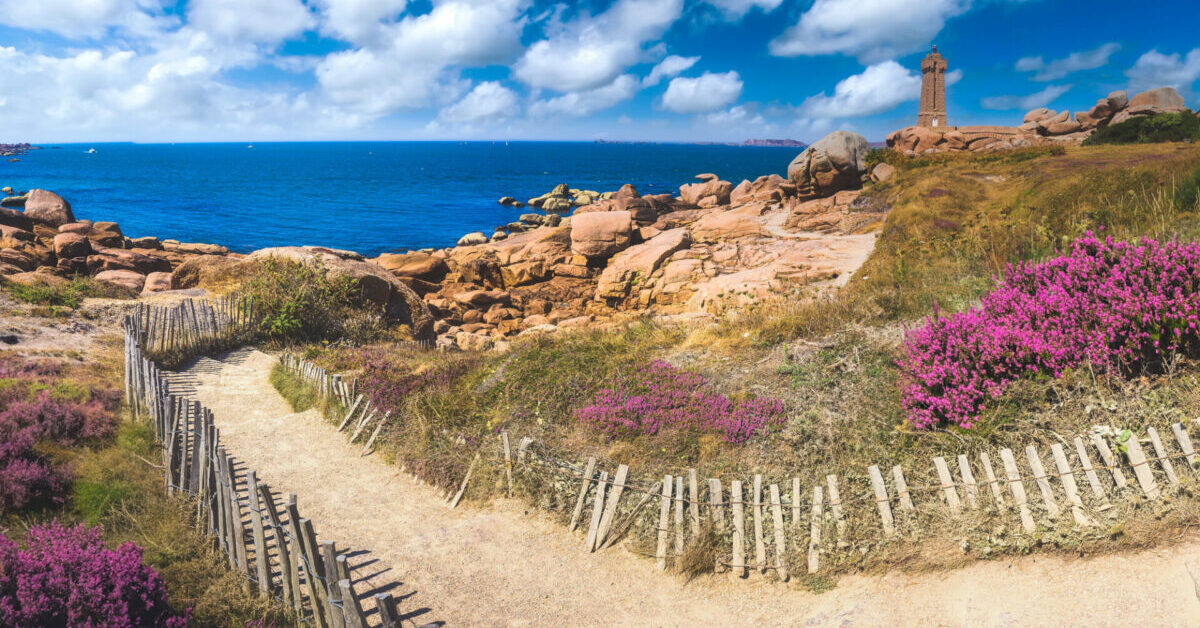
For many travellers, France begins and ends with Paris, Provence, or the French Riviera. Yet venture west and a very different France emerges, one shaped by Celtic roots, dramatic coastlines, diverse local cuisine, and a fierce sense of regional identity. Brittany (La Bretagne) is a world unto itself, where land and sea shape daily life, and it should be the location for your next French holiday.
From medieval capitals and pirate strongholds to prehistoric stone fields and working naval ports, just a short train ride away from Paris, Brittany’s cities tell a story that stretches back thousands of years. So we’ve put together a list of the top five places to visit in Brittany, to help you discover one of France’s most underrated regions.
Brittany’s Top 5 Tourist Destinations
1. Rennes: A Lively Capital with Medieval Vibes

Often overlooked as a mere gateway to the coast, Rennes rewards those who take the time to discover it. As the capital of Brittany, Rennes strikes a rare balance between historic charm and youthful energy. Thanks to France’s high-speed train service, the city is just 90 minutes from Paris, making it a perfect entry point to discovering Brittany. Yet to quickly rush through this city is to miss one of the most livable and dynamic cities in western France.
As the capital of Brittany, Rennes has long played a pivotal role as the region’s political and cultural heart. Its historic center is filled with lively squares and narrow streets lined with oldworld timber facades, many leaning at eccentric angles, giving the city a distinctly medieval look. At its heart stands the parliament of Brittany, an imposing 17th-century building that once embodied the region’s judicial independence, and remains a powerful symbol of Breton identity well worth the visit.
What truly sets Rennes apart is its energy. Home to a large student population, the city hums with youthful creativity, from its contemporary art spaces to its independent bookshops and music venues. In the evenings, head over to Sainte-Anne for some of the best cafes and nightlife Rennes has to offer.
Food is another of Rennes’ strengths. The Marché des Lices, held every Saturday morning, is one of France’s largest and most celebrated food markets. A culinary wonderland for locals and visitors alike, you can shop for oysters hauled in from nearby coasts, fresh vegetables from inland farms, and some of the best staples of Breton cuisine, such as salted butter, apple cider, and buckwheat galettes.
Rennes offers a rare combination of rich history and youthful charm that make it a great introduction to life in Brittany. For a more comprehensive list of things to do in Rennes, check out Frenchly’s guide to a perfect weekend getaway in Rennes.
2. Saint-Malo: A Walled City of Explorers and Tides

If you’re looking for somewhere more visually dramatic, then Saint-Malo easily delivers. Situated on the northern coast, the city almost rises from the sea behind thick granite walls. With a skyline dominated by ramparts, spires, and chimneys, you’d be forgiven for thinking you’ve stepped back in time.
Saint-Malo’s identity is inseparable from the ocean. Once home to corsairs (pirates), privateers, and explorers, the city built its wealth and reputation on its maritime power.
There’s no better way to experience Saint-Malo than to walk the ramparts. From there, you can take in the full force of nature as you watch the waves crash against the walls, and the immense tidal shifts for which the city is famous. At low tide, the sea retreats far enough that visitors can walk across the sand to nearby islands such as Grand Bé, the resting place of famed French writer François-René de Chateaubriand.
While much of Saint-Malo was destroyed during World War II, its reconstruction was painstakingly faithful, preserving the city’s historic appearance. Today, the old town (Intra-Muros) is a compact world of stone buildings, cobbled streets, and inviting restaurants. Unsurprisingly, seafood dominates menus, featuring delicacies of oysters, mussels, and scallops, often accompanied by Breton cider or crisp white wines.
Saint-Malo is also a great vantage point for those wanting to visit the oyster beds of Cancale or the incredible commune of Mont Saint-Michel. Romantic, windswept, and steeped in legend, Saint-Malo captures the coastal soul of Brittany.
3. Carnac: Experience Brittany’s Prehistoric Roots

Nestled near Brittany’s southern coastline is Carnac, a small town whose significance stretches back thousands of years. Spread across its fields are more than 3,000 standing stones (called menhirs) arranged in long, deliberate alignments. Dating back over 7,000 years, older than the pyramids of Egypt and Stonehenge in England, the Carnac stones remain one of Europe’s great prehistoric mysteries.
Walking among these ancient menhirs is a truly humbling experience, and the only real way to appreciate the sheer scale of this monument. Are they astronomical markers, religious monuments, or symbols of social organization? Who’s to say! We recommend taking a guided tour or visiting a local museum to find out more about the history of these mysterious stones.
Beyond its archaeological significance, Carnac benefits from a gentle coastal setting near the Gulf of Morbihan. Sandy beaches, cycling paths, and calm waters make it an appealing stop for travellers seeking both reflection and relaxation. Unlike busier seaside resorts, Carnac retains a calm, relatively undiscovered atmosphere, particularly outside peak summer months.
While Carnac offers a tranquil retreat for visitors, it also reminds them that Brittany’s history stretches far beyond medieval castles and churches, into the very origins of European civilization.
4. Brest: A Look into Brittany’s Modern Maritime Edge

Moving now to the western edge of Brittany, we are met by Brest. Brest was heavily bombed during World War II and largely rebuilt in concrete, prioritizing function over ornament. For some visitors, this city may lack the postcard prettiness of other Breton towns, while for others, it’s precisely this which gives Brest its unique character.
Brest is another Breton city with an identity shaped by the sea. Home to one of France’s most important naval bases, the city sits on a vast natural harbor that has long made it strategically vital. You can get a first-hand look at their maritime focus at institutions like Océanopolis, one of Europe’s leading ocean discovery centers, and the Château de Brest, which houses the National Maritime Museum.
Brest is a working city, shaped by sailors, scientists, and shipbuilders, and serves as a gateway to some of Brittany’s wildest coastal landscapes and islands. For travellers drawn to places with character rather than polish, Brest offers a compelling glimpse into modern maritime Brittany.
5. Quimper: The Soul of Breton Traditions

Quimper embodies the cultural soul of Bretagne. Resting in a valley at the meeting point of the rivers Odet and Steir in Brittany’s southwest, Quimper has long been known as a center of religion, craftsmanship, and regional traditions.
The town’s focal point is Saint-Corentin Cathedral, its soaring Gothic spires dominating the Quimper skyline. The surrounding old town is a delight to explore on foot, with half-timbered houses, stone bridges, and canals lined with flowers. Unlike more touristic towns, Quimper feels lived-in, rather than staged for visitors.
Quimper is best known for faience, hand-painted earthenware ceramics that have been produced for over 300 years. Workshops and museums celebrate this tradition, which has become synonymous with Breton decorative arts.
Beyond faience, Quimper plays a key role in preserving Breton culture. The Breton language is still spoken and taught, traditional music and dance are actively practiced, and festivals celebrating regional costume and folklore punctuate the calendar. You can find most of the season’s cultural events at the Musée Départemental Breton.
The cuisine of Quimper also strongly reflects the city’s heritage, from its hearty stews, fresh seafood, buckwheat flour crêpes, and traditional cider served from faience bowls.
To visit Quimper is to encounter a Brittany that is proudly itself, maintaining traditions not as museum pieces, but as living expressions of identity.
Brittany, One of France’s Most Fascinating Regions
This is just a taste of all of the incredible places, traditions, cuisines, and history that this region has to offer. While we’ve picked out our favorite places, Brittany has so much more to explore and discover, so check it out for yourself, and we’re sure you’ll be rewarded for taking the path less-travelled.
Want to discover other regions in France? Check out Frenchly’s regional travel guides to Normandy or Auvergne Rhone-Aples.
An Australian freelance writer living in Paris, Joe Ciliberto has a background in international relations and renewable energy. He is passionate about gastronomy, politics, travel, and finding the best cold brew coffee in Paris.