
There is no shortage of French restaurants in New York City, particularly amidst the affluent cobblestoned alleys of the West Village. With each generation of New Yorkers, a new guard of restaurants has attempted to define what French food is to an American audience—albeit, one that prides itself on being more worldly and sophisticated than the average flag-waver.
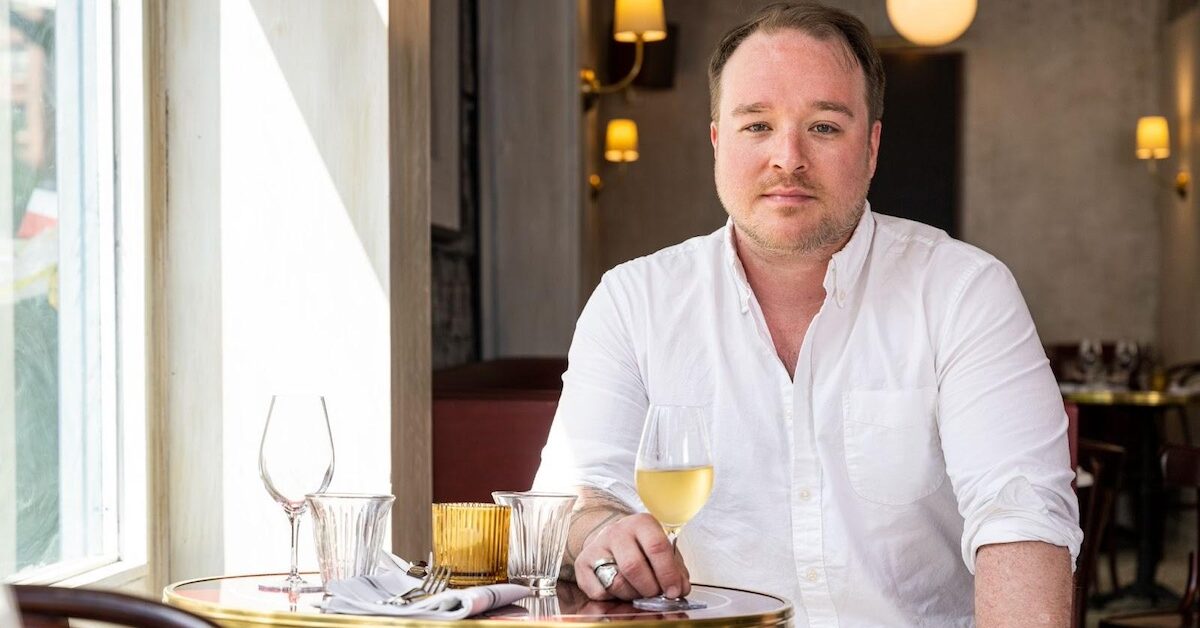
Right now, one key member of that new guard is Cody Pruitt, Beverage Director & Partner at Libertine. When Pruitt joined forces with Executive Chef and Partner Max Mackinnon to open their restaurant last year, it became an instant hot spot. It was impossible to get a table (I would know…), and more than a year in, this buzzy bistro is still going strong. Pruitt was kind enough to share with me some of his hot takes on the French dining scene in New York, and how his relationship with France shaped one of New York’s most in-demand tables.
As a child, Pruitt’s family spent most of their summer vacations and other holidays in France, particularly in the small Burgundian village of Saint-Père-sous-Vézelay. His mom, who had studied medieval history in college, loved to take them to castles and cathedrals throughout the country, staying in small gîtes and auberges throughout their travels. Upon returning to the U.S., Pruitt, even as a child of eight or nine, was disappointed by the French restaurants in his native NYC.
As an adult, he continued his trips to France on his own, exploring the neo bistro movement and the budding natural wine scene, both of which had an undeniable impact on his dining and drinking sensibilities. “Libertine is the four walled and very physical tactile proof of that influence and inspiration for me,” he explained, “the de facto proof of what I took home as a young child, and then kept with me as a frustration with New York and American French restaurants in general.”
For Libertine, that manifested as a menu centering classic and regional French bistro dishes, along with a beverage program composed entirely of French wines and spirits. Pruitt chose to avoid tropes like French onion soup and salade niçoise in favor of more obscure dishes like saucisse purée and oeufs mayonnaise, that speak to more of a traditional bistro experience. “We don’t do fries,” he told me. “I didn’t want to serve steak on the menu. Even though bistros have fries and steak in France. We wanted to draw a line in the sand, so to speak, and highlight less lesser-known preparations, or embrace the innate creativity that these crews are allowed to have. For me, what we were serving was equally as important as what we weren’t serving.”
Pruitt is someone who chooses his words with specificity: bistro, brasserie, restaurant, wine bar, and café maintain their unique distinctions in his world. And at Libertine, you’re firmly in the world of the bistro.
“I always thought that the concept of what a bistro actually is was lost in translation when going from France to America,” Pruitt elaborated. “Now, in America, if something is called a bistro, that just means it doesn’t have tablecloths, or it’s more casual. But for me, bistro cuisine was locavore. It was grandmother food that was intensely regional. Bistros were places where people would go all day.”
Though he (rightly) considers the idea of authenticity to be a “loaded concept,” Pruitt expressed gratitude that people have found his restaurant to be a reliable analog for what they would find in the bistros of Paris or regional France.
“Libertine is a reaction in so many ways to the restaurants that call themselves French,” according to Pruitt, “and to this kind of nebulous concept of the ‘French restaurant’ in America. You look at all these other places and they have, like, nine different steaks on the menu. At that point, it’s Peter Luger’s with a Pepé Le Pew accent. So for us, the hole that we occupy is essentially trying its best to be French by virtue of not trying to do too much.”
Cody Pruitt’s Thoughts on Reservation Culture
With reservation culture dominating the restaurant scene, nowhere more viscerally than in New York, having an impossible-to-get-into restaurant is both a blessing and a curse. “While I absolutely love all the publications that covered us, and all the attention that we got, it got a little frustrating that the majority of talking points about us were how to get in, or where to go if you can’t get in,” Pruitt commented. But as the tides shift (and getting a table at Libertine is no longer a Sisyphean task), he’s grateful for a new crop of regulars, just like any French bistro would cultivate. “Now I’m very happy to be welcoming more people from the neighborhood, or French people or Francophiles who actually want to experience what we’re doing and not just because we’re new. It’s a very satisfying transition.”
Pruitt’s Favorite Restaurants in France
For all this bistro talk, let’s get into some of the places that may have had a hand in Libertine’s final form. Pruitt says that his favorite Parisian restaurants these days are Septime, the trendy Michelin-starred neo-bistro with a sustainability bent; Le Rigmarole, where a husband and wife team serve up one of Paris’s favorite tasting menus from behind a Japanese-style binchotan grill; and Le Bistrot Paul Bert, the old fashioned Parisian mainstay whose large portions of classic French dishes keep folks coming back for more. But it’s Le Saint Eutrope in Clermont-Ferrand in the Auvergne that Pruitt calls the “archetypal perfect bistro.”
“I think the beautiful thing about French and authentic European neighborhood restaurants, whether it be bistros or something else, is that all of them are the opposite of overwrought and they’re usually fairly simple in their preparations and their plating, and they’re humble in terms of what they do.”
Pricing, location, and vibe
If you’ve visited Libertine, you’ll know that, for all Pruitt’s talk of humble preparations and neighborhood vibes, the place is distinctly chic. The last time I wrote about the restaurant, I commented on a server’s fervent insistence that we should make ourselves comfortable, because the restaurant was so, so casual, just a little local bistro where we could put our elbows up on the table. Despite the quality of the food, this attitude gave me pause. A restaurant in one of New York’s most expensive neighborhoods, with its floor tiles patched with bare concrete, felt like it was trying a little too hard to come across as laid back. And while a chalkboard menu might be charmingly provincial, the $25 glasses of wine listed on it… not so much.
At the end of the day, French restaurants have always been associated in the U.S. with blue bloods and fat cats, and plenty of unscrupulous restaurateurs have encouraged this reputation, because it often meant they could get away with overcharging for substandard food. But even the cynic in me was willing to hear Pruitt out on his pricing strategy.
“We are not necessarily at the same price point as the neighborhood corner bistros in Paris,” he acknowledged. “But I knew I wanted to serve a certain caliber and standard of ingredients, which are extraordinarily expensive here, and would need to have prices commensurate with that standard. I knew I would have to do it in a neighborhood with a certain kind of affluent demographic. We had a little bit of a clientele already in the West Village, and we wanted to be able to serve them, and it was also the market that we knew. So it was definitely safer, but it was also strategic and prudent for us to do it. Of course, if you told me to open a restaurant in the East Village, I don’t think it’s the same demographic. And I don’t think we could do Libertine as honestly if we had to do it over there.”
So what is on Libertine’s menu right now?
Libertine’s chalkboard menu isn’t posted online, or even on their Instagram page. But standards include a salade maison with fines herbes and a Sauvignon vinaigrette, a scallop and seaweed dish riffing off of coquilles St. Jacques, tartare de boeuf, gnocchi parisienne, oeufs mayo, and saucisse purée. You’re also likely to find some kind of offal dish, like sweetbreads. As the seasons change, elements of the dishes will evolve, but most of the dishes on Libertine’s small menu remain the same—and are best paired, of course, with a fine French natural wine from Pruitt’s carefully curated list.
Catherine Rickman is a writer, professional Francophile, and host of the Expat Horror Stories podcast. She is currently somewhere in Brooklyn with a fork in one hand and a pen in the other, and you can follow her adventures on Instagram @catrickman, or on TikTok @catinthekitchen.


