
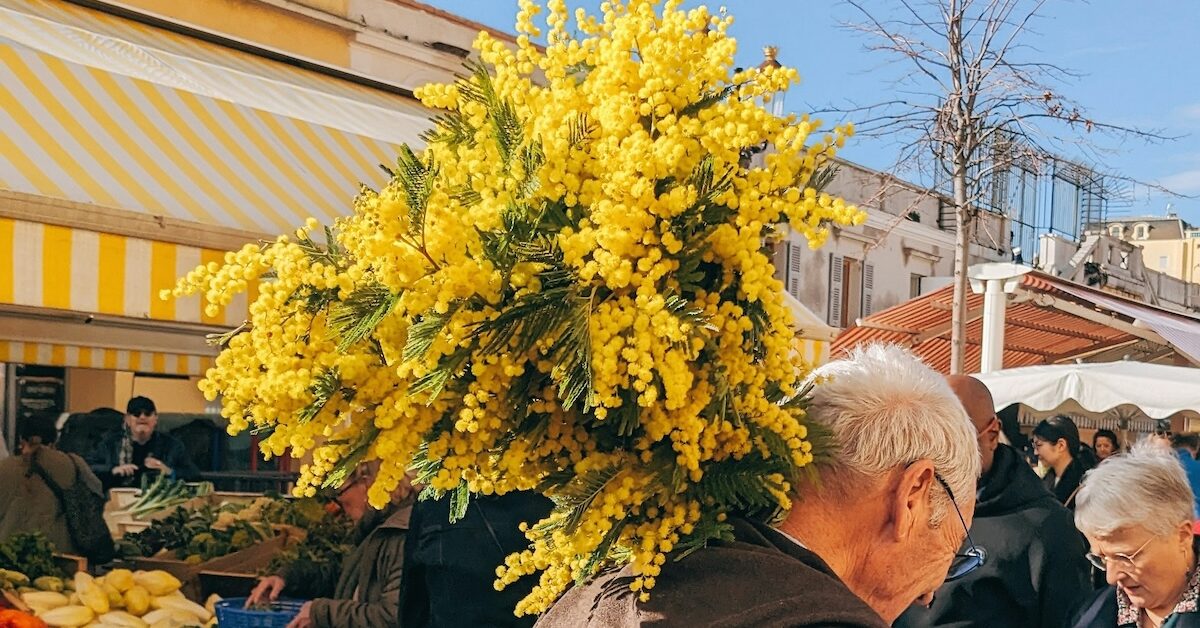
In the midst of winter, during France’s grey and gloomy February, bursts of bright yellow flowers begin to appear in flower shops, markets, and restaurants—mimosas. Fortunately, France has found a way to stay cheerful beneath its (usually) overcast skies, thanks to these golden blossoms. And no, we’re not talking about the cocktail (though more on that later), but rather the delicate clusters of tiny blooms that resemble miniature yellow dandelions at the tips of each branch. Gathered in bunches, they radiate like a beam of sunshine, a sure sign that spring is on its way.
Given the season and climate, the mimosa isn’t the most expected bloom in this part of the world. Yet, it has been embraced and made distinctly French. Today, you’ll find heaps of it across the country, and even used in iconic French fragrances like Guerlain’s Après L’Ondée, Chloé’s Atelier des Fleurs Herba Mimosa, and Chanel’s Coco Mademoiselle.

The History of the Mimosa Blossom
While there are two compelling theories about how the mimosa arrived in France, one thing is certain—it’s not a native bloom. Much like many of France’s finest treasures, it’s something of an expat itself. In fact, the mimosa is a native plant of Australia, with some species found in Africa, Central America, South America, and Asia.
One theory traces its journey from newly colonized Australia to France, at the request of Empress Joséphine, who is said to have ordered silver wattle—along with other exotic species like eucalyptus, kangaroos, and black swans—for her gardens at the Château de Malmaison. Another suggests that the British, having introduced Acacia dealbata to the UK from the Antipodes, later brought it to the South of France in the late 1800s, just as the Côte d’Azur was becoming a fashionable wellness retreat for Europe’s elite.
Regardless of its exact origins, the mimosa has firmly rooted itself in the South of France, thriving in the mild Mediterranean climate of Provence. Easily recognizable, the mimosa’s bright yellow clusters are hard to miss. However, depending on the variety, its leaves range from silvery to deep purple; some even resemble pine needles. It has flourished so well in France that it’s now a cultivated crop (producing an impressive 18 million stems per year), particularly in the Var department, which stretches between Cannes and Marseille. The mimosa has become the emblem of the medieval village of Bormes-les-Mimosas (hence the name), and brightens the landscape from the Corniche des Maures to the Massif du Tanneron and the Estérel. Some species have even gone wild, turning gardens and hillsides a brilliant shade of yellow each season. Think of it like winter’s lavender.
Mimosa Celebrations in the South of France

While you can easily buy a mimosa bouquet to brighten up your home, you can also celebrate these vibrant blossoms at various festivals across the South of France. And we love any excuse to head down south!
Start with the Fête du Mimosa in Tanneron, held every year on the last Sunday of January. The village comes alive with Provençal folk dancing, artisanal markets, flower parades, visits to mimosa farms, and even a kids’ carnival.
The festivities continue into February in Mandelieu-la-Napoule near Cannes, where you can enjoy a vibrant flower parade, a magical nighttime procession, and a firework display at the Fête du Mimosa (which takes place between February 12 and 16 in 2025). Visitors can also enjoy musical performances, food trucks, and local mimosa-inspired culinary creations, as well as special activities like botanical tours and visits to the stunning Château de La Napoule. The event also showcases the town’s blooming mimosa displays along main roads.
At the same time, Sainte-Maxime hosts its own Fête du Mimosa, featuring lively street performances inspired by festivals from around the world.

Bormes-les-Mimosas
For the most iconic celebration of all, head to Bormes-les-Mimosas in February, where visitors flock from near and far to witness one of the most spectacular flower parades, the Grand Corso du Mimosa, featuring over 80,000 blooms during the weekend of February 15-16 in 2025. Wander through the medieval village with breathtaking views over the Mediterranean for an unforgettable experience.
Bormes-les-Mimosas is also home to France’s leading mimosa grower, Pépinières Cavatore, which cultivates over 200 species and varieties. Open year-round, the team at Pépinières Cavatore welcomes visitors to explore its greenhouses and show garden, offering expert advice for enthusiasts. In late winter, the nearby Domaine du Rayol botanic garden hosts a special event, L’Odyssée des Mimosas, a guided world mimosa tour led by a gardener. And along the Côte d’Azur, nature lovers can take part in hikes, guided walks, and photography tours through the stunning landscapes of the Massif de l’Estérel.
Route du Mimosa
For the ultimate mimosa experience, embark on the Route du Mimosa, a 130-kilometer (80-mile) journey through Provence’s most scenic landscapes, filled with the delicate scent of blooming flowers. This panoramic itinerary spans eight charming towns between the Var and Alpes-Maritimes. The route begins in Bormes-les-Mimosas and winds through Sainte-Maxime’s Jardin Botanique des Myrtes, Saint-Raphaël, Mandelieu-la-Napoule, Tanneron, Pégomas, and finally Grasse, the perfume capital of the world. Along the way, you’re encouraged to craft your own adventure—stop in gardens and parks, visit local growers, stroll through fields of golden blooms, or take in the spectacle of flower parades.
This winter road trip, also known as the “Route d’Or,” cuts through the Massif des Maures and the Estérel, winding along the Corniche d’Or, home to the largest mimosa forest in Europe. The striking contrast of golden blossoms against the deep blue of the Mediterranean is really something to see.
The Origins of the Mimosa Cocktail
Though many associate the mimosa cocktail with brunch culture or an early excuse to drink, its origins trace back to Paris, France, and the delicate mimosa flower. Named after the flower, the cocktail’s bright yellow hue mirrors the blossoms.
Typically made with equal parts champagne (or another sparkling wine) and orange juice, the mimosa offers a light, effervescent, and citrusy flavor. Its creation is often attributed to bartender Frank Meier at the Ritz Hotel in Paris, who is said to have been inspired by the yellow flowers in the hotel’s gardens when he worked there in the 1920s.
The mimosa then gained popularity in the United States during the 1960s, becoming a stylish choice at brunches, often paired with croissants and Eggs Benedict. Over time, it has become a worldwide brunch staple, loved for its simplicity and celebratory charm.

The Price of Mimosa Stems in France
The price of mimosa flowers in France can vary depending on the region, time of year, and the vendor. Typically, during the peak blooming season (January to February), prices tend to be higher due to increased demand.
On average, you can expect to pay:
- Around €10 to €20 for a standard bouquet of mimosa flowers (about 10-15 stems).
- A larger bouquet or premium arrangements may cost upwards of €30 or more.
How to Keep Your Mimosa Blossoms Fresh Longer

- Trim the Stems: Trim about an inch off the stems at a 45-degree angle before placing them in water. This helps the flowers absorb more water and stay hydrated.
- Use Clean Water: Make sure the vase is clean, and fill it with fresh, room-temperature water. Mimosas can be sensitive to bacteria, so changing the water every 2-3 days is important to keep them fresh.
- Keep Them Cool: Place the mimosa bouquet in a cool room, away from direct sunlight, heat sources, and drafts. High temperatures can cause the blooms to wilt more quickly.
- Avoid Overcrowding: If you’re using a large vase, make sure there’s enough space for the stems to breathe. Overcrowding can restrict water absorption.
- Remove Wilting Blossoms: As the mimosa flowers age, remove any wilting or dead blossoms to prevent them from affecting the remaining healthy blooms.