
If you pay attention to the New York City dining scene, you may have noticed a lot of hubbub lately around rotisserie chicken. Over the past few months, a slate of upscale restaurants serving glitzed-up iterations of rotisserie chicken have proliferated, none as ire-raising as Gigi’s in the Brooklyn neighborhood of Greenpoint.
Gigi’s, a new project from the Fulgurances group based out of Paris, has ruffled more than a few feathers with its casual bistro menu centered on a rotisserie chicken that goes for a whopping $77—with the half-chicken priced at $40.
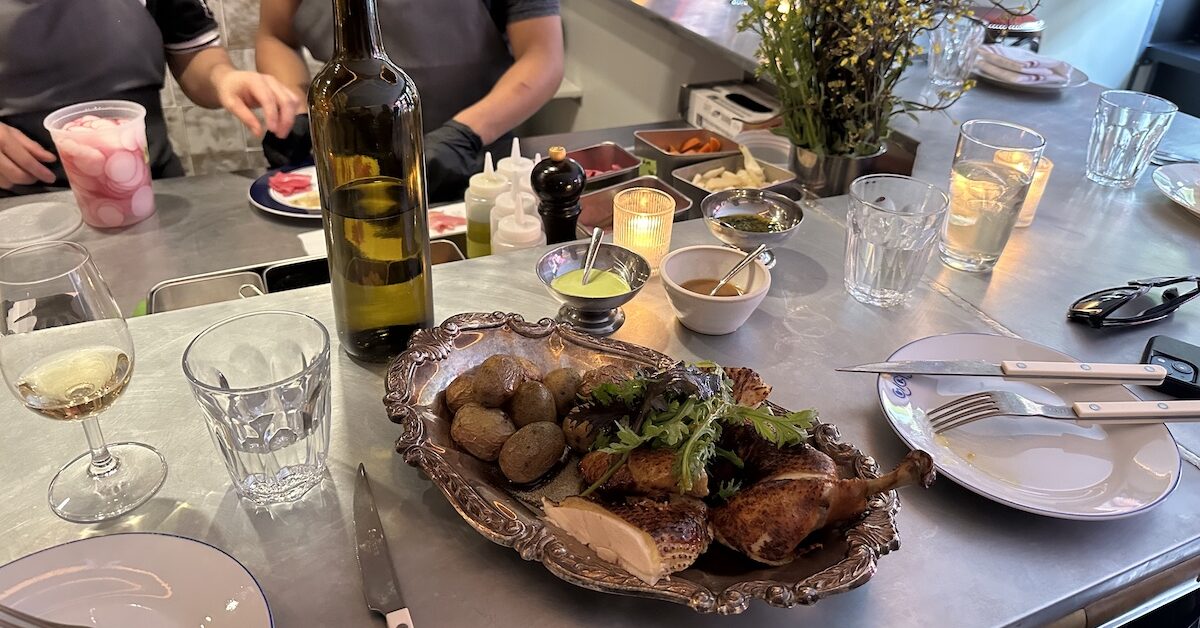
I visited Gigi’s on a Sunday evening, perched on bar stools that offered an unobstructed view of the restaurant’s mechanics. Pale gold birds stuffed with herbs spun on spits in their glass enclosure, before being removed and butchered with much respect, but little mercy. Barely a foot or two in front of us, chefs arranged lox-like golden beets over a bed of pomelo vesicles, and plucked individual mustard blossoms from a large bouquet to adorn pickled slices of shallot and watermelon radish.
The chicken arrived on a silver platter with a handful of velvet-soft potatoes. Three sauces were offered—chicken drippings, chimichurri, and a glossy chive aioli. Each was satisfying, drizzled atop crisp skin, juicy meat, and potatoes already dredged in the chicken’s juices.
Was it a good chicken? Of course. Was it anything worth losing your mind over? I’d say not.
Yet Gigi’s is not alone in its desire to make rotisserie chicken the it girl of 2026. Earlier this month, a new rotisserie opened in NYC’s West Village—Cleo, from Halley Chambers and Kip Gleize of Three Top Hospitality (the team behind Margot and Montague Diner). Their rotisserie chicken is marinated for 24 hours in a proprietary spice blend inspired by Lebanese seven-spice, and served with three sauces: zhug, labneh ranch, and a Fresno chili red sauce. Priced at $32 for the half-chicken and $58 for the whole, it’s less expensive than the one at Gigi’s, though it doesn’t come with potatoes or any additional sides, and the effect is certainly just as elevated.

“We believe rotisserie chicken is having a moment in New York because diners are seeking comforting, high-quality food that feels both accessible and thoughtfully executed amid broader economic and cultural shifts,” Gleize told me in an interview, referring to rotisserie chicken as “a timeless, honest dish that lets technique and quality speak for themselves.”
This might be true, but if so, why put it on such a pedestal? After all, the great pleasure of a good rotisserie chicken lies in its rustic nature. It is hard to eat politely, and your hands should be slicked with chicken fat and gelling collagen by the time you’re done eating. You’re meant to chew it down to the bone, and throw the carcass in a pot the next morning to make stock like a cheerful village grand-mère prepared to weather the coming winter with nothing more than grit and an allergy to waste.
Rotisserie chicken found popularity in the U.S. in the 1950s by way of Boston Market (originally named, appropriately, Boston Chicken), earning its place in the cultural zeitgeist over time, largely thanks to Costco, which intentionally prices its chickens at a loss ($4.99 each) in order to draw in customers. Yet these crispy birds have been a favorite in France since the Middle Ages, and Napoleon Bonaparte was a notable champion of the poulet rôti. To this day, you can walk by just about any boucherie in France and see chickens turning on their spit, waxy yellow potatoes cooking in their fat below. In between splurges at Paris’s famed restaurants, one of my favorite dining memories in France remains one warm spring evening when my cousin and I devoured one of these birds, accompanied by an oil-soaked paper bag full of those irresistible potatoes, with nothing but our bare hands, hoping that any scraps we dropped on the terrace of our Belleville Airbnb wouldn’t lead to any unwanted new critter friends.
I wouldn’t dare to approach this new genre of rotisserie chicken with that feeling of wanton gluttony, however. She demands your respect—and perhaps, at a time when factory farming and diet optimization have pushed us towards the acceptance of bland, poorly-treated poultry, she deserves it. I’m not sure yet if I’d go back for more, but at least, the next time I’m faced with a dry runt of a Key Foods rotisserie chicken, I’ll think to myself, I can do better.
Catherine Rickman is a writer, professional Francophile, and host of the Expat Horror Stories podcast. She is currently somewhere in Brooklyn with a fork in one hand and a pen in the other, and you can follow her adventures on Instagram @catrickman.


