
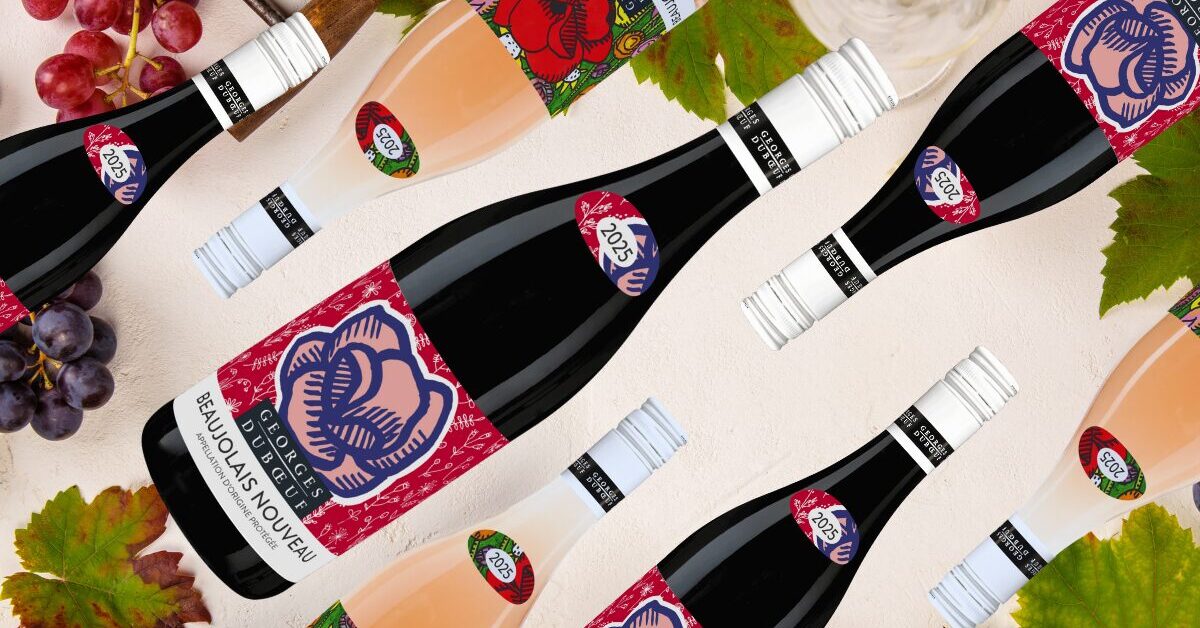
Many of us have been wondering if Beaujolais Nouveau will be released in the United States this year. The answer is… YES!
For over four decades, this once-local French tradition has evolved into a global event. From Paris to New York to San Francisco, the third Thursday of November has become a date when wine bars and restaurants celebrate the arrival of the first wine of the harvest. The United States has enthusiastically embraced the custom, and Beaujolais Nouveau has become a seasonal fixture for many Americans, enjoyed not only at release parties but increasingly at Thanksgiving tables, where its bright, light, fruit-forward profile pairs naturally with the holiday meal. But this year, when people walk into their favorite French bar or restaurant and ask the bartender, “Will you have a Beaujolais Nouveau 2025 event?”, the answer is no longer guaranteed. In previous years, the response was almost always yes. This year, it is not unusual to hear, “We don’t know yet,” or simply, “Non.”
Adjusting to the New Tariffs
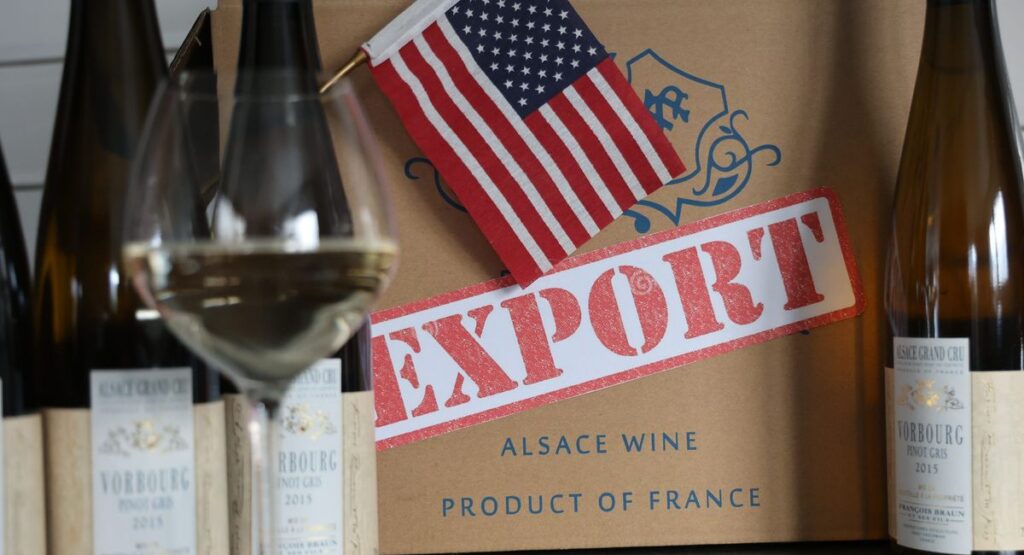
2025 has been an unusually difficult year for importing French wine. On August 7, 2025, a newly implemented U.S. import tariff disrupted the wine industry at the worst possible moment. As part of broader agricultural trade tensions, duties on European products, including French wine, were raised just as Beaujolais Nouveau shipments were being prepared for export. The tariff on still wine increased from 13.5% to 15%, a seemingly minor change that created major complications for a product that relies on precise timing and narrow shipping windows. Exporters, importers, and distributors felt the impact immediately, as the United States is the first and largest export market for French wine. In 2024, it accounted for 15% of exported volume and 21% of export value, making it a critical destination for French producers. French wine remains popular in the United States, with strong consumption in states such as California, Texas, Florida, and Illinois. A shift in U.S. customs duties, therefore, has immediate and wide-ranging consequences for the entire French wine industry, and industry leaders have warned of the financial strain.
Gabriel Picard, president of the French Federation of Exporters of Wines and Spirits, explained on France Inter that the new tariffs come in addition to “the 15% increase in the euro compared with the dollar.” As he put it, “15% more in customs duties plus 15% due to exchange-rate fluctuations means a 30% price increase on the American market.” French winemakers are already feeling the impact that Picard described, and the burden is not shared equally. For smaller producers, the combined effect of the tariff and a weaker dollar is significantly harder to absorb than it is for larger estates. Major houses can spread costs across high volumes, negotiate better freight rates, and rely on diversified markets to cushion fluctuations. Small domaines, by contrast, operate with limited production and tight margins. A 30% rise in export costs can make certain U.S. shipments barely profitable. At Château Roquefort in Bordeaux, commercial director Camille Giai confirmed that the tariff, combined with the weaker dollar, has pushed wines that once sold for $15 in the United States closer to $20. In Provence, Pierre Einaudi of Domaine Bargemone noted that they are sharing the additional cost with their importer to keep final prices under $20, a strategy that larger producers can manage more easily but that places new pressure on smaller estates already navigating rising freight charges and administrative fees.

The effects of the tariff are also being felt inside American dining rooms. In New York City, Amy Babic, owner and wine buyer of Copinette Restaurant, described how prices and logistics have shifted rapidly. “A few suppliers raised their prices about ten percent for new wines coming in,” she said. “I had a sell sheet from the summer, and when I revisited it to add something to my fall list, the price was already higher.” She kept that particular wine but had to increase its price per glass by a dollar. Shipping delays have compounded the challenge. A wine Babic added to her list over the summer had still not arrived by early November. “My supplier was waiting for it to come off the container, even after I had already printed my menus. I had to substitute with another comparable wine until it arrives,” she explained, noting how a single delayed label can create unexpected costs for small restaurants.
Through August and September, new documentation requirements and processing backlogs caused delays and rerouted shipments, with some containers stalled at ports for weeks. Although customs operations are now beginning to stabilize, the disruptions came at a crucial moment, just as retailers and hospitality businesses were preparing for end-of-year celebrations. Faced with uncertainty, many became cautious about committing to seasonal wines that depend on timely delivery, especially Beaujolais Nouveau. In this context, the release of the 2025 vintage in the United States on the traditional third Thursday of November remained uncertain until recently.
What About Beaujolais Nouveau 2025?

In a typical year, Beaujolais Nouveau marks the start of the holiday season for French restaurants, wine bars, and cultural organizations across the United States. It is often one of their busiest nights. For restaurants, it brings large, celebratory crowds. For wine bars, it usually makes a difference because it falls only a few days before Thanksgiving, a period when many bars close for the holiday and experience a noticeable slowdown in business in the days that follow. Traditionally, venues begin promoting their Beaujolais Nouveau events in late September to build momentum ahead of the release. This year, however, far fewer events were announced. The slowdown was not caused by price increases but by uncertainty. The August tariff increase, combined with customs delays, left distributors unsure whether shipments would arrive on time. That uncertainty spread quickly through the market. Distributors hesitated to take early orders, retailers feared announcing events they might have to cancel, and hospitality businesses were reluctant to invest in a celebration without guaranteed wine. A distributor who works across several states said it became unusually difficult to convince clients to commit. “Many of them feared the wine would not arrive by November 20 and did not want to promote an event that might not happen,” she explained.
The impact reached beyond restaurants. For many French nonprofits, cultural centers, and associations in the United States, Beaujolais Nouveau is not only a celebration, but also an important fundraising moment. These organizations usually rely on donated or discounted wine from importers. This year, the tariff reduced distributor margins, which led to cuts in sponsorships and the disappearance of many wine donations. Several organizations had to scale down or postpone their annual Beaujolais gatherings. However, some of these cultural organizations found creative solutions to keep the tradition alive. In the Bay Area, Alliance Française Silicon Valley stepped in to help Beaujolais fans celebrate at home by offering Beaujolais Nouveau 2025 at a discounted price, delivered directly to people’s homes so they could still mark the occasion with friends. Additionally, so that everyone can join the celebration, a sweepstakes is available to win a collector Georges Duboeuf wine fridge. “We will bring the celebration back in 2026, and even better than before,” a spokesperson for AF Silicon Valley said, noting plans for a sommelier-led tasting featuring Beaujolais Nouveau alongside other wines from the region.
Despite the challenges, some distributors remain cautiously optimistic. “We are working with an importer that guarantees delivery before November 20, and we expect a wave of last-minute orders,” one said. “Our sales team is ready for same-day deliveries, and we are absorbing part of the cost increase to keep pricing reasonable.”
Celebrations Across the United States
Beaujolais Day may still be days away, but the celebration calendar is finally starting to open up. What began as a quiet and uncertain season in early October is steadily gaining momentum as venues regain confidence that the wine will arrive on time. Restaurants, wine bars, and cultural organizations are now adding tastings, dinners, and themed evenings, bringing the 2025 release back onto the national radar. The shift is also visible online. Event platforms such as Eventbrite, which showed very few listings earlier in the month, have begun to fill with new announcements in recent days. The growing number of events reflects the reassurance coming from distributors, many of whom have now confirmed that their Beaujolais shipments have cleared customs and will be delivered on schedule.
In Marin County, Marché is among the places maintaining the tradition. General Manager Olivier Criado, a Paris native with decades of experience in the hospitality and wine industry, says that celebrating Beaujolais Nouveau always brings back good memories for him. “Every year at Marché, we celebrate the arrival of Beaujolais Nouveau,” he notes. “This year, alongside the vintage 2025, I have personally selected a range of Beaujolais crus to highlight the diversity of the region. We will also serve a special menu designed to pair with the wines and enhance the tasting experience.”
Across the United States, several major celebrations are now taking shape, offering wine lovers vibrant and welcoming ways to mark the arrival of Beaujolais Nouveau 2025.
Beaujolais Nouveau in DC, NYC, and Florida

- Washington, D.C. – Beaujolais Nouveau Celebration at the Embassy of France.
- Washington, D.C. – Beaujolais Nouveau Day at the Ritz-Carlton.
- New York, NY – Beaujolais & Beyond hosted by the Ordre des Compagnons du Beaujolais.
- New York, NY – Beaujolais Nouveau Celebration hosted by the French-American Chamber of Commerce – New York.
- Miami, FL – Beaujolais Nouveau Mixer hosted by the European American Chamber of Commerce Florida.
- Tampa, FL – Beaujolais Nouveau 2025 hosted by the French-American Business Council of West Florida.
Beaujolais Nouveau in Texas, Chicago, and More

- Chicago, IL – Wine-Tasting: Beaujolais Nouveau 2025 at Le Sud Mediterranean Kitchen.
- Minneapolis, MN – Toast the Beaujolais Nouveau Afterwork with the FranCopains at the Tasting Room.
- La Grange, IL – Beaujolais Nouveau Wine Walk 2025 hosted by Child Link.
- Dallas, TX – Beaujolais Nouveau 2025 Celebration at Fond Bistro.
- Houston, TX – Beaujolais Nouveau Day 2025 at 13 Celsius Wine Bar.
- Houston, TX – Beaujolais & Blues hosted by the University of Houston-Downtown.
- Austin, TX – Austin-Angers Soirée Beaujolais Nouveau.
- New Orleans, LA – Beaujolais Fest hosted by Bacchanal.
- Atlanta, GA – French American Chamber of Commerce – Atlanta.
Beaujolais Nouveau in California and Washington

- Kenmore, WA – Annual Beaujolais Nouveau Dinner hosted by The Lodge at St. Edward.
- Napa Valley, CA – Beaujolais Nouveau tasting hosted by Alliance Française Napa.
- Bay Area, CA – Annual Beaujolais Celebration at Left Bank Brasserie locations.
- Ross, CA – Beaujolais Nouveau and terroir tasting at Marché Restaurant.
- San Francisco & Fairfax, CA – Beaujolais Regions Wines Celebration at Amelie Wine Bars.
- San Francisco, CA – Beaujolais Nouveau 2025 Celebration at Zazie.
- Los Angeles, CA – Beaujolais Nouveau Wine Tasting & Mingling hosted by Coucou French Classes.
- San Diego, CA – Taste of France hosted by The French-American Chamber of Commerce SoCal and Alliance Française San Diego.
Beaujolais Nouveau-Style Wines Made in the U.S.

Given the limited availability of French Beaujolais Nouveau this year, a small but steadily growing domestic alternative has quietly begun to take root. Across the country, winemakers and wine communities are developing their own American Nouveau tradition, producing wines inspired by the freshness and immediacy of Beaujolais Nouveau but shaped by local harvests and regional styles. These young wines often use Gamay and carbonic maceration to create bright, low-tannin bottles meant to be enjoyed soon after fermentation. Division Winemaking Company in Oregon has built a following with its Nouveau Nouveau Gamay. In California, Poe Wines produces a limited Gamay Nouveau that highlights the floral character of coastal vineyards. Larger producers are joining as well, and La Crema’s Red Wine Nouveau, launched in 2024, signals growing consumer interest. In California’s Central Coast, Bodega Los Alamos embraces this spirit as the yearly host of a lively Beaujolais-inspired celebration. As Emily Blackman, beverage director for Companion Hospitality, explains, “We have made it a tradition to celebrate at Bodega Los Alamos, and for the past three years, Beaujolais Nouveau has been our favorite excuse to throw a party. While we do not pour much actual Nouveau, we invite local winemakers to share their freshly bottled Gamay, giving the night that same sense of immediacy and freshness.”
American Nouveau remains a niche category with small production runs and higher prices, but it is gaining momentum. For drinkers who want a lively, fruit-forward wine for the holiday season, these domestic versions offer a meaningful alternative.
Looking Ahead to 2026: From Uncertainty to Renewal
Over the weekend, the U.S. Trade Representative announced a partial adjustment to the August tariff increase, offering the first real sign of hope for French wine exporters and American importers. The 15% duty on European wine still remains in place, but the administration has opened a review window and indicated it may reconsider the rate in early 2026 during new negotiations with the European Union. For the French wine industry, the announcement brought cautious optimism. Industry leaders said more explicit guidance on tariff policy could help stabilize planning for producers and distributors. Winemakers in Beaujolais, Bordeaux, Provence, and Champagne expressed hope that a future reduction could help restore competitiveness after a year marked by higher costs and currency fluctuations. No immediate changes have been made, but the review represents the first sign that the policy may soften. For an industry that has faced months of uncertainty, it offers a hopeful outlook for a more stable environment in 2026. Until then, cheers to Beaujolais Nouveau 2025!
Mariam, originally from Paris, now calls the Bay Area home. A seasoned traveler and writer, she’s always on the lookout for exciting new restaurants, hidden bars, and offbeat experiences. She has a passion for writing about travel, food, people, and all things unexpected. If you’d like to share your tips and events about Paris and France, please feel free to send them her way at [email protected].


