
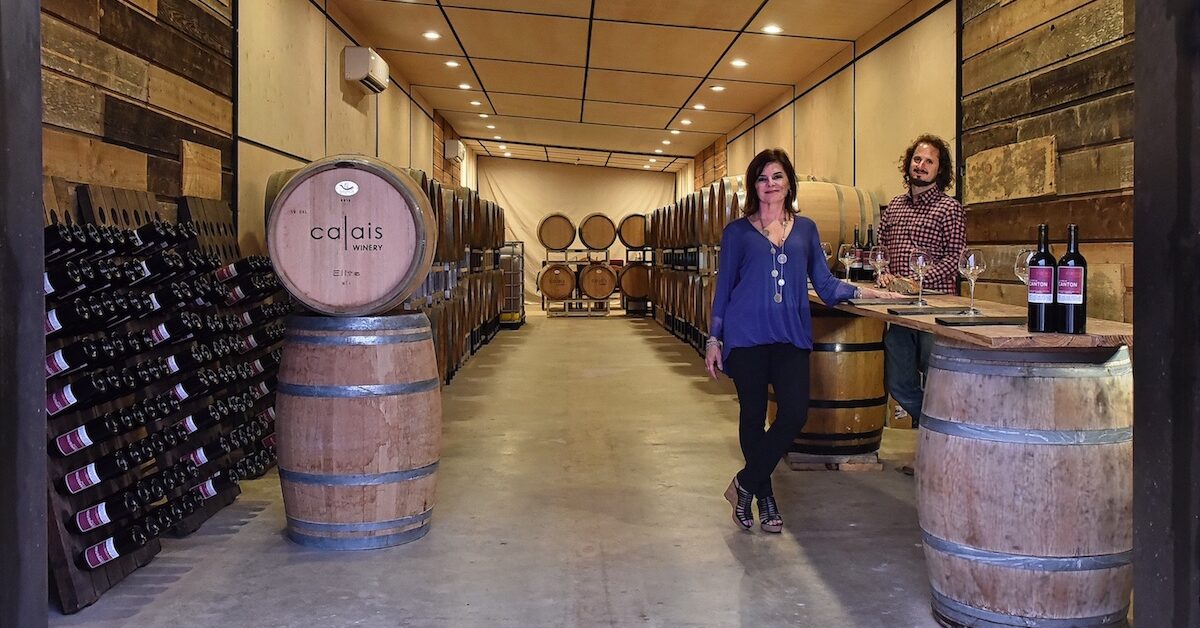
“I’d had my eyes set more on Bordeaux, but for me, there’s no going back. It’s Texas,” recalls Benjamin Calais.
Calais is a winemaker originally from the town of Calais, on France’s northernmost coast, less than two miles from the English Channel. He began making wine in Texas almost two decades ago in, he describes, a “just beyond what you’re allowed to do in your garage” kind of scenario. Based in Dallas as a computer engineer, Calais first approached wine as a weekend project. Now, he owns two thriving wineries in the Texas Hill Country, where there are more than 100 wineries in the country’s third largest American Viticultural Area (AVA), and an abundance of tasting rooms. Calais Winery is an intimate, cavernous winery right off of Fredericksburg’s Wine Road 290. French Connection Wines, with its giant French flag draped over the entry gates, offers a breathtaking patio view of endless Hill Country greenery and gently rugged, contoured landscape.
Calais’ father is the youngest of 13 brothers and sisters. As the family farms were passed on to the first few siblings, both Calais and his father pursued careers in engineering. Calais occasionally helped on the farms during school breaks, and saw firsthand how a diversified approach, with his family cultivating wheat, potatoes, organic milk, specialty meats, and rare breeds of lamb, ensured resilience and longevity. Tending a multiplicity of crops means, Calais explains, “If one thing isn’t doing well in a given year, the farm will still get through.” Now, like many seasoned Texas winemakers, Calais diversifies his grape plantings, because Texas is a risky yet rewarding place to grow Vitis vinifera. “Our diversity makes us resilient. If six vineyards are planted, three or four will always deliver. We are never missing our whole portfolio.” This is important because Texas, according to Calais, is a land of extremes. Drought, heavy rains, and scorching temperatures, especially in the summertime, are all possible, and often recurrent. But viticulture is not new in Texas, and most certainly not a novelty.
The Texas Wine Industry is Hitting Its Stride
Texan wine is still considered nascent by many, despite the fact that Texas is currently the fifth largest wine producing state in the U.S. In the nineteenth century, viticulturist T.V. Munson bred hundreds of cultivars in north Texas by crossing wild and native grape species with European wine grapes, some of which helped rescue the French wine industry from the phylloxera epidemic of the 1870s. The oldest pre-Prohibition winery, Val Verde Winery, is still in operation in Del Rio, Texas, near the state’s southern border with Mexico. Though Prohibition briefly interrupted the industry’s growth, independent trial plantings throughout the state in the 1970s gently revived it, allowing Texas winemaking practices to mature throughout the 1990s and 2000s. Now, a multiplicity of grape varieties are in the spotlight there, like Tempranillo and Dolcetto, as well as Rhône varietals like Viognier, Mourvèdre, Marsanne, and Roussanne.

Now, as a board member of Texas Wine Growers, an industry advocacy group, Calais has worked to dispel the stigmatizing notion that Texas wine depends on out-of-state grapes because of the unique challenges its extreme climate presents. The organization’s first major initiative led to state legislation signed in 2021 that ensures all bottlings labeled “Texas,” or marked with a Texas AVA designation, are made from only (or predominantly, depending on the label) Texas-grown grapes.
“We want to be taken seriously and aligned with regions who have some regulation on a sense of place—after that, it’s about long-term teaching, transmitting information to first generation grape growers, industry newcomers, and the customer.” Part of this is explaining why it’s important to create new American Viticultural Areas in Texas, or to subdivide already existing ones into smaller AVAs. For example, the Texas Hill Country AVA is estimated to measure more than nine million acres. Subdividing these areas into smaller ones distinguishes niche growing conditions, which leads to more marketability. “AVAs showcase a subset of people that think alike, that want to work alike, that want to express specific terroirs. No major wine region has been successful that is not on that quest,” says Calais.
In recent years, Texas viticulturists have had to become more adventurous. Some have secured wind machines to mitigate heat and moisture, and hail netting to protect against spring frosts. Others have ventured west to the Texas Davis Mountains and Chihuahuan Desert near El Paso, where temperatures are cooler, especially at night. While in historically developed wine regions many winemakers are, as Calais says, “breaking the codes,” they are able to rely on signature, defining grape varieties and consistent climatic conditions. But in Texas, says Calais, “It’s not fully established, it’s not codified, and wine is the ultimate proof in the pudding scenario,” he explains. This necessitates a spirit of independence, commitment to self-determination, and long term vision.
The French Connection

Calais often returns to France to explore specific grape varieties and winemaking ideas. “You either make all your mistakes yourself, or you go and learn from somebody else’s mistakes. And in the past 100 years, they’ve worked out the kinks. So if you ask the right questions, you start from a way better standpoint,” he explains.
Let’s take, for example, Tannat, the signature grape of the Madiran AOC in southwest France. Many Texas winemakers find Tannat promising due to its consistency in terms of quality and chemistry, with the variety yielding reliably in the state’s variable weather conditions (according to Mike Nelson, winemaker at Ab Astris Winery in Fredericksburg). Tannat tends to make a full bodied, deeply colored red wine with abundant tannins and acidity. Dr. Bob Young, owner of Bending Branch Winery in Comfort, Texas, describes the grape as versatile, well-suited for sparkling rosé, aged reds, and port, meaning it offers winemakers a lot of options.
“It’s unreal how far you can push that variety,” says Calais, who, before trialing Tannat, visited Chateau Montus in Madiran, known as “the cathedral of Tannat.”
“They let us taste every single block and barrel experiment. It’s a beautiful, beautiful place. They have the oldest Tannat vineyards in the region and make incredible wine on par with first growth Bordeaux in terms of quality.” He also recently traveled to Domaine Cauhapé in the Jurançon appellation in southwest France to learn about Petit Manseng, which will be vinified as a dessert wine at Calais Winery for the first time this year. This variety is one of the most planted in Virginia, and is gaining traction in Texas because, says Calais, “It hangs onto its acid and doesn’t dehydrate—it just keeps ripening.” Similarly, he recalls, “They spent a half a day with us, tasting us through everything, including twenty and thirty-year-old wines.” Calais values this because, he says, “Older wine experiences are cherished, and we’d like to provide those experiences.” He explains that a lot of wine in Texas is designed for immediate consumption; while he leans into this in small releases that tell stories of farmers, of rain, drought, hail, and humidity, and of desert, mountains, plains, and soil, he also hopes to educate people on the special characteristics that aging evokes in a wine, and about how to age wine. “For the five year anniversary of French Connection Wines,” he explains, “We wanted to show wines that have fully aged in that time, and rosé was our only shot. Even our whites are not showing enough age yet.”

This has led Calais to invest in Texas vineyard sites far from the Hill Country, which will lead to wines with longevity, and enhance—though not dictate—regional definition. Calling upon his background in computer engineering, Calais initially wrote software to model climate-based outcomes for multiple areas in Texas, then ran every GPS coordinate in Texas to find the best spot. Calais’ lowest elevation vineyard is at 3,200 feet, and his highest elevation vineyard approaches 5,400 feet. “High elevation means higher risk, but we like the style of wine it makes,” he explains. He describes tasting twenty and thirty year old bottlings of Texas wine that “are drinking well.”
“We know it’s doable, and that’s why we focus on the varieties we focus on—because we know they will make wine that will live for a very long time,” he adds.
Cabernet Sauvignon is a flagship grape variety for Calais Winery, sourced from the Texas High Plains, where a majority of the state’s wine grapes are grown, and the far west Texas Davis Mountains, where Cabernet Sauvignon vines have thus far been low yielding but high quality. Syrah is the same for French Connection Wines. A 2021 replant of Syrah in the Texas High Plains, after some frailty during winter, shows the state’s path to maturity. Trials of Syrah clones were planted in a repeated pattern to determine which would endure winter the best, and 2024 was the first harvest.
“We love working with these two varieties. They can turn out in vastly different ways, some more old school, some modern. And, we have a better grasp on those vineyards than in the past,” explains Calais.
Because of this dualistic mindset—self-directedness and awareness of a collective movement toward regional definition and visibility—Calais says, “There’s strength in the diversity of grape varieties and approaches, and we’re also trying to stay focused on chasing one thing: getting better at what people know we do well. Because you are never done in this business. You can always, always, always get better.” By returning often to France to immerse himself in wine regions where gradual, methodical refinement has taken place over decades, Calais is able to translate this generational knowledge to Texas. Where this savoir-faire meets the independence, commitment to quality, responsiveness to the unexpected, and ingenuity of the Lone Star State, the future of Texas winemaking is limitless.


