
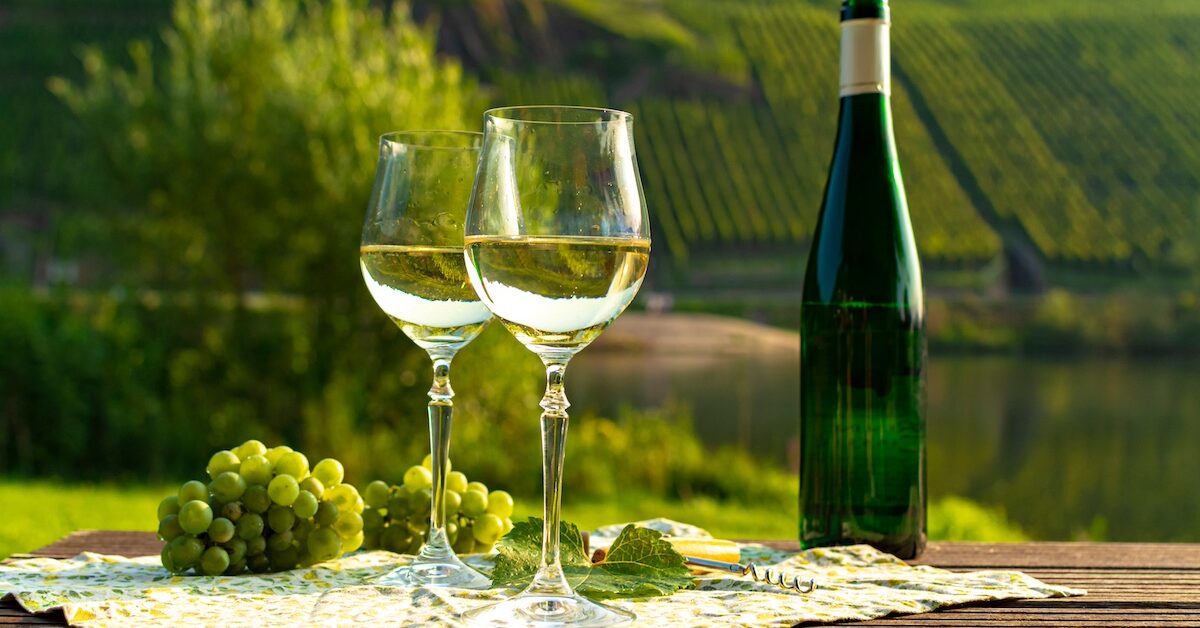
Alsace, which nestles up against the German border in northeastern France, is a region known as much for its tumultuous history as for its storybook charm. Passed back and forth between France and Germany for centuries, its culture bears the marks of this dual heritage.
But while its people have flown different flags and spoken different languages, the terroir of Alsace is not quite so malleable. It is the specific soil and climate that has gifted the region its iconic Riesling wines, dry as a German’s sense of humor, and elegant as a French grande dame.
Riesling, which originated in Germany, is a white grape varietal typically used to make still wines. Though much of it is still produced in Germany and Austria, it can be grown anywhere in the world, from Australia to the U.S. However, it does prefer cool, northern climates, which bring out its natural acidity.
Alsatian Rieslings in particular, aside from being produced in ideal conditions geographically, are often produced with the sustainability of that geography in mind. A whopping 35% of all Alsace vineyards are certified organic or in conversion (meaning they are working through the steps required for organic certification). Wines from Alsace also offer great value at reasonable prices compared to many other French regions, particularly when it comes to the Grand Crus, or wines produced by the most prestigious vineyards.
I recently spoke with a few Riesling experts to learn more about this fascinating style of wine.
What does Riesling from Alsace taste like?
Carrie Lyn Strong, Sommelier, Strong Wine Consulting: In Alsace, warm summers and direct sun exposure on terraced vineyard sites allow for ripe fruit flavors of peach and pear with elegant citrus acidity and noticeable minerality.
Why did Riesling get a bad rap for being too sweet?
Stephanie Teuwen, Strategic Advisor at Teuwen, an Evins Communications Company: For a long time, sweet Riesling dominated the US market. As of the past 10+ years or so, Rieslings are mostly dry, sometimes less than 5 grams of residual sugar per liter. That’s less than a latte (25 g/l), orange juice (69 g/l), or any soda (81 g/l or more). But since Riesling is an aromatic grape, its aromas of peach and pear can be confused with sweetness. A few years ago, we blind-pitted a Moscato with 30g of residual sugar against a Riesling with 2.5g at a consumer event, and most thought the Riesling was sweeter. Perception is everything.
Foulques Aulagnon, Export Marketing Manager, CIVA (Comité Interprofessionnel des Vins d’Alsace): During the 20th-century, the yields [the total weight of grapes harvested, and thus wine produced] were higher and more “industrial.” Today, there is a greater focus on low yields and higher quality.
What makes Riesling from Alsace different?
Foulques Aulagnon: Alsace wine production is influenced by both German and French tradition. Drawing from German culture, we produce mostly single varietal wines, which list the grape variety on the front label. Drawing from French/Latin culture, we make wines from specific vineyard sites and terroirs, including lieux-dits (small vineyards whose names appear on their wine bottles) and Grand Crus.
In my opinion, there are three general types of Riesling in the world: light, delicate Rieslings (produced in cooler climates); full-bodied, powerful Rieslings (made in warmer climates); and Rieslings that fall somewhere in-between — more structured, balanced, and mineral-driven, with great aging potential. Rieslings from Alsace fall into the latter category. The region’s warm, sunny days and cool nights produce complex Rieslings with the perfect balance of fruit, minerality, freshness/acidity and alcohol.
What are the different styles of Riesling in Alsace?
Teuwen, an Evins Communications Company: In Alsace, Riesling can be broken into three general styles – AOC Alsace, AOC Alsace Grand Cru, and Vendanges Tardives/Sélection de Grains Nobles. AOC Alsace Riesling is known for its elegant freshness, zesty acidity and aromas of orchard fruits, citrus, flowers, and spice. AOC Alsace Grand Cru Rieslings are marked by the influence of their terroir; this terroir can be expressed in the wine through intense aromas (often dominated by mineral notes and salinity), full body, and remarkable texture on the palate. The vast majority of Alsace Riesling is produced in a dry style, but Vendanges Tardives/Sélection des Grains Nobles Rieslings can also be produced in sweeter styles in exceptional years.
Carrie Lyn Strong: There are 51 Grand Cru vineyards in Alsace, resulting in 5% of the total production of wine in the region. It is in these Grand Cru vineyards where terroir – specifically geology, climate, and sun exposure – is extremely important to the flavors and textures of the individual wines made from each Grand Cru.
How should you pair Alsatian Rieslings with food?
Foulques Aulagnon: Our wines are incredibly food-friendly and made to be enjoyed with lunch and dinner – although many also drink wonderfully on their own.
Carrie Lyn Strong: AOC Alsace Rieslings with ripe fruit flavors pair so beautifully with spicy, savory, or fresh garden dishes like spicy tuna sushi, tomato caprese salad with fresh basil, or pizza. AOC Alsace Grand Cru Rieslings can be paired with complex dishes such as butternut squash ravioli with sage, shaved Parmesan, and amaretti cookie crumbs.
Catherine Rickman is a writer, professional Francophile, and host of the Expat Horror Stories podcast. She is currently somewhere in Brooklyn with a fork in one hand and a pen in the other, and you can follow her adventures on Instagram @catrickman, or on TikTok @catinthekitchen.


